



Old Testament Life and Literature (1968)
Gerald A. Larue
Chapter 11 – David
Read II Sam. 2-4
THE way was open for David to assume the throne: Jonathan, the natural successor, was dead; David had won recognition as a popular hero and a military expert, and had gained the loyalty of the southern cities of the Hebrew nation by sharing booty with them. His marriage to Michal, Saul’s daughter, might also have been significant for it related David to the royal household.1
David’s first move was to Hebron where he was anointed king over "the house of Judah" (II Sam. 2:2 f.). The groups forming "the house" are not indicated, but Martin Noth has suggested that a six-tribe confederation consisting of Judah, Caleb, Othniel, Cain, Jerahmeel and Simeon might have been involved.2 Apparently the Philistines were unconcerned, for they counted David as an ally. David now began to woo the northern groups. A letter to Jabesh-Gilead commended the people for providing proper burial for Saul and Jonathan, offered David’s support and reminded them that David was now king (II Sam. 2:5-7).
But the northern tribes had taken other action. Abner, Saul’s commander-in-chief, had Saul’s fourth son, Ishbaal, appointed king in Israel.3 No mention of Ishbaal has been made prior to this time, and nothing is known of him apart from a note appended by a Deuteronomic redactor to the effect that he was forty years old at this time (II Sam. 2:10-11).
A curious episode interrupts the narrative to explain the hostility between Abner, commander of the army of Ishbaal, and Joab, commander of David’s forces. Twelve men from each of the armies engaged in a contest in which combatants paired off, each placed one hand upon the head of the adversary and with the free hand sought to thrust him through with a sword. The significance of this strange match is not known, although a relief from Tel Halaf depicts men in this very position.4 Abner’s men were defeated and Abner and those who remained fled. In the pursuit, Asahel, a brother of Joab, followed Abner and was killed by the more experienced warrior. The battle marked the beginning of a protracted struggle between Ishbaal and David in which "David grew stronger and stronger, while the house of Saul became weaker and weaker" (II Sam. 3:1). Later, a literal-minded editor inserted an isolated fragment about David’s family, portraying David’s growth in strength in terms of his six wives and six sons (II Sam. 3:2-3).
Now problems developed within Ishbaal’s household. Abner took one of Saul’s concubines for himself and inasmuch as the taking of a king’s widow could be construed as seeking to take the place of the dead king, Ishbaal questioned Abner’s intentions. Angered by the accusation (which may have been justified), Abner offered to bring Israel under David’s control if David would enter into a covenant with him. What Abner was to gain is not stated, unless it would be a guarantee of safety and security and position with David. David accepted but demanded the return of his wife Michal, Saul’s daughter.5 Once this action, a token of good intention, had been taken, Abner began to undermine Ishbaal’s position among the northern tribesmen. Subsequently twenty northern leaders and Abner participated in a feast as David’s guests to plan strategy for bringing Israel under Davidic rule.6
But David had failed to consider Joab. As redeemer-of-blood7 for the death of his brother, he killed Abner, placing David in the embarrassing position of having to retain his friendship with Joab and hold the loyalty of the northern tribesmen with whom he had broken bread. The compromise was effected by David’s denial of any part in Abner’s death, by his public lamentation in which he composed a dirge for Abner, and by the participation of Joab in the mourning rites. The dirge (II Sam. 3:31-34), like that for Saul and Jonathan, may be a Davidic composition.
The report of Abner’s death in the northern kingdom was accepted as a sign of impending doom. Ishbaal was murdered by two military leaders who removed his head and brought it to David, seeking his favor (II Sam. 4:4-11). Although he had gained politically through this event, David could not afford to express approval. The two were promptly executed (II Sam. 4:12).8
Read II Sam. 5
All opposition was now removed and David entered into a covenant with the northern tribes and was anointed king at Hebron (II Sam. 5:1-3). His role as "shepherd" of Yahweh’s people was carefully delineated, and it is possible that the covenant took the form of a written contract agreed to by both parties, sworn to before Yahweh, and deposited in the Hebron sanctuary. Through this event the tribes of the north and of the south, first brought together through a national emergency under Saul, accepted the concept of nationhood. Undoubtedly the nation was weak and, without continuing crises, could easily have disintegrated through national suspicions and jealousies. Apparently David recognized the uneasy nature of the bond and took steps to consolidate the kingdom. The neutral Jebusite city of Jerusalem, which had remained free of Hebraic control up to that time, was taken, and this strong fortified hill-city strategically located near the border between the north and south, became the capital.
At this point a number of isolated fragments have been inserted into the narrative. At II Sam. 5:4-5 a Deuteronomic editor added a note about David’s age and the time spent in Hebron. Another insertion at 5:8b relates how a proverb came into being. In 5:11-12 a brief statement about David’s palace appears, and verses 13-14 give details about his expanding harem as David cemented good relationships with the Jebusites by marrying some of the townswomen.
Philistine reaction to David’s assumption of the combined thrones of Israel and Judah was not delayed, for verse 17 records that the Philistines attacked upon hearing the report of the anointing at Hebron. David met and defeated his former allies in the valley of Rephaim, west of Jerusalem. Other battles with the Philistines are reported (cf. 18:1), but it would seem that from this time on they posed no real threat to the Davidic empire.
Read II Sam. 6-8
Having achieved political union and having made Jerusalem the capital, David now sought to make this city the center for the national cult of Yahweh. The sacred ark was brought into the city with great rejoicing (ch. 6). The reference in 6:19 to raisin cakes, usually associated with the worship of foreign deities or with the fertility cult,9 may indicate an adoption of features of Canaanite religious practice by the Yahweh cult. Ritual sacrifices associated with the moving of the ark were performed by David. No special shrine or temple was constructed for the ark, making it necessary for a writer to explain why David failed to build a temple for Yahweh although he constructed a palace for himself (ch. 7).
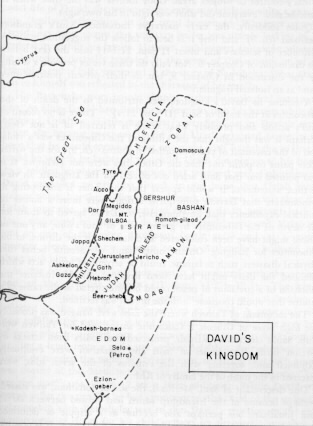 Two isolated fragments of Davidic history comprise Chapter 8. The first summarizes David’s military campaigns (8:2-14): he subdues Moabites, Edomites and Ammonites, making these areas subject states controlled by garrisons. Despite the absence of references to the conquest of other Canaanite city-states such as Jerusalem, it can be safely assumed that they were brought under control, for it is quite clear that David intended to develop a kingdom free of conflicting elements. The second historical note lists the officials of David’s court (8:15-18). Joab was commander-in-chief of the army, but a certain Benaiah is said to have been in charge of the mercenaries made up of Cretans (Cherethites) and Philistines (Pelethites). In addition to a court recorder and a secretary, two priests are named, and David’s sons are also said to be priests. A similar list of officials is given in II Sam. 20:23-26 with the role of chief of forced labor added, implying that David initiated the corvée. Such lists demonstrate that the old "chieftain-type" kingship represented by Saul belonged to the past; kingship now involved administration of a large unified central state and military control of subject areas. Gone forever was the time when it could be said "everyone did what was right in his own sight."
Read II Sam. 21:1-14; 9
Quite suddenly, the early narrative introduces Saul’s grandson Meribaal (ch. 9), and here it is best to follow the suggestion made by a number of scholars and insert II Sam. 21:1-14 into the text before the discussion of Chapter 9. Not only do these verses provide a setting for the discussion in Chapter 9, but in their present position they stand as an isolated fragment.10
A famine in David’s kingdom was attributed to the death of the Gibeonites at the hand of Saul (II Sam. 2 1:1).11 There is no record of Saul’s action and precisely what crime is referred to is not clear. Perhaps it was thought that the killing of the Gibeonites was a violation of the covenant of peace recorded in Joshua (ch. 9), for the writer takes pains to point out that the Gibeonites were not Hebrews. It is also pointed out that Saul acted out of zeal for the kingdom. In view of these statements, it would appear that the writer is attempting to demonstrate that David’s subsequent actions were more a matter of political expediency than anything else, for David agreed to atone for the death of the Gibeonites by giving seven of Saul’s sons, any one of whom might have been considered a contender for the throne, to the Gibeonites for hanging. On the other hand, the Semitic belief that physical disasters, such as famine, could be accounted for by acts which offended the deity might have been involved. In this instance the violation of a covenant of peace could be interpreted as the cause of a famine that would continue until the breach was rectified.
The mountain of Yahweh where the men were hanged was probably the high place of Gibeon, a Canaanite shrine used for Yahweh worship. Saul’s concubine, Rizpah, protected the bodies from attacks by carrion birds. The bones of Saul and Jonathan were eventually exhumed and, together with the remains of the seven sons, were interred in the tomb of the family of Kish.
One descendant of Saul, Meribaal, the son of Jonathan, was spared, perhaps because of the friendship which had existed between David and Jonathan, but perhaps also because as a cripple or deformed person he could not be considered a rival for the throne. It is possible that David hoped to win support from those who still believed in the Saulite kingship and resented the assumption of the throne by David. Thus, Meribaal entered David’s household.
Read II Sam. 10-12
Chapter 10 of II Samuel makes it clear that David did not hold his newly conquered territories without effort. The death of a king who had signed a treaty with David brought to the throne a successor who resented Hebrew control and who planned rebellion. Thanks to the military skill of Joab, the Hebrews defeated the rebels. Suddenly the story of the rebellion is interrupted, and the reader is informed of what was taking place at the court at this same time. The account of the armies in the field is taken up again in chapter 12:26-31.
From what may be personal records or personal knowledge of the court life of David, the writer of the early materials provides a glimpse into family relationships in the royal household. Whatever prowess David may have shown as a military leader was utterly lacking in his leadership within his family. His own ruthlessness, in taking whatever he desired, is partially revealed in the story of the acquisition of the kingship, and is fully portrayed in the story of Bathsheba. What David was in himself was reflected in the character of his family.
The Bathsheba story is told simply, without theological interpretation. As king, David had Bathsheba brought into his harem while her husband Uriah, a Hittite mercenary, was fighting in David’s army. When she became pregnant David had Uriah returned home in the hope that he would spend at least one night with Bathsheba so that he could be said to be father of the child. Uriah did not go to his home. As a soldier he observed the taboo that required sexual abstinence.12 David managed to get him drunk in the hope that Uriah might stagger home, but the soldier did not break the taboo. It was clear that Uriah must die, and Uriah carried his own death warrant back to Joab, who could be trusted to do whatever David requested. Uriah was sent to one of the more dangerous battle areas and, at a crucial moment, Joab withdrew support so that Bathsheba’s husband and those with him perished.
At this point theological judgment is introduced with the appearance of the prophet Nathan (II Sam. 11:27b-12:1). The king’s role as guardian of the national safety and of individual freedom is reflected in the parable Nathan related to David. A powerful, rich man fulfilled the nomadic rule of hospitality by offering the very best of provender to a guest, not by drawing from his own flocks but by stealing a lamb from a poor and weaker neighbor. In righteous anger David demanded the name of the rich man, declaring that such an act was worthy of the death penalty (12:5). Nathan’s response was "You are the man" (vss. 9b to 12 are a later addition). While David was not to suffer the penalty he had pronounced, the child of the unlawful relationship with Bathsheba was to die. David’s reaction to the pronouncement of doom for his child reflects his pragmatic approach to religion. While the child lived David fasted hoping that Yahweh would be persuaded to alter the child’s fortune. When the child died, rather than performing the customary mourning rites David returned to the normal pattern of life (12:20-23). A footnote to the story announces the birth of Solomon and the pet name given by Nathan to the new prince – Jedidiah or "Beloved of Yahweh" (12:24 f.)
Read II Sam. 13-20
Subsequent chapters recount the decaying family relationships within David’s household. Amnon, one of David’s sons, raped his half-sister Tamar and was killed by Tamar’s brother, Absalom. To escape punishment Absalom fled and David, while mourning for Amnon, longed to see Absalom (13:37-39). Joab knew David’s mind and arranged for a "wise woman," possibly a representative of the wisdom school, to present a problem to the king. Once again the accessibility of David to the common people demonstrates the role of the king as defender of human rights. Like Nathan, the woman posed a problem involving Semitic justice, and once again David in his response judged himself. David recognized Joab’s role in this plot and sent Joab to bring Absalom back from exile. Two years later Absalom was fully readmitted to the royal household (ch. 14).
Absalom began to undermine David by suggesting that David was neglecting his duty of safeguarding the rights of his subjects. Within four years he had won enough people to his way of thinking, including David’s counselor, Ahithophel, that he dared to be crowned king at the shrine in Hebron (15:1-12). David fled, leaving ten concubines to care for the palace, Zadok and Abiathar to care for the ark, and Hushai to act as spy.
The problems of that hectic period were further complicated by Meribaal, son of Jonathan, who thought that the state of disorder provided opportunity for seizure of the throne (16:1-14). The attitude of Shimei makes it clear that then was a faction still loyal to Saul that Meribaal might count upon for support. Meribaal’s plans never developed; Absalom took over the palace and erected his personal tent upon the roof, proclaiming to all that he had usurped his father’s throne and was master of the royal concubines. The taking of the royal concubines constituted a proclamation of kingship, and there is some evidence in the Bible that a new king inherited his predecessor’s harem.13 Then Absalom made the error that cost him the kingdom. Relying upon the advice of David’s spy, Hushai, and rejecting the counsel of Ahithophel, he failed to press his advantage by attacking David when the royal forces were still unorganized (ch. 17). Meanwhile David mustered his army and Absalom was defeated and killed in the battle of the forest of Ephraim (ch. 18). David’s mourning for Absalom was so intense that Joab warned the king that he was making a bad impression upon those who had fought to retain his kingdom and that military victory was a time for rejoicing (19:1-15). In a spirit of magnanimity David forgave those who had opposed him, including Meribaal, and rewarded the faithful with the exception of Joab who had rebuked him. Joab was replaced as commander by Amasa. The spirit of distrust between north and south was not diminished and the sense of being separate peoples was still prevalent (cf. 19:41-43).
The interpretation of Sheba’s rebellion (ch. 20) presents something of a problem. Despite David’s generosity in forgiving his enemies, a number of persons from the southern kingdom of Judah were not sure of David’s attitude toward them because they had supported Absalom. David urged the Judaeans to welcome him as king (19:11 ff.). Whether it was caused by jealousy over this action, or perhaps by the belief of a rebellious group of Israelites that there was still a chance to break away from Davidic rule, is not clear, but Sheba led the northern tribes in rebellion. His war cry was a call for independence: "We have no portion in David, and we have no inheritance in the son of Jesse, every man to his tents, O Israel." David commissioned his new commander, Amasa, to rally Judaean troops, but he was so slow in executing this responsibility that David turned again to Joab and his mercenaries. Joab murdered Amasa and pursued Sheba to the far northern city of Abel. Here Sheba died at the hand of his own people who decided that it was better that one man should die than the whole town suffer, and for a time the rebellious mood of Israel was quiet.
Read II Sam. 21
Now the Philistines attacked, on the assumption that the trouble within the Hebrew kingdom had weakened David’s power. David participated in one battle but he had neither the strength nor the stamina for warfare. His men sent him back to Jerusalem and carried on without him (21:15-22). A further summary of the Philistine battles and a list of warriors who participated is given in 23:8-39.
Read II Sam. 22-23
At this point, two intrusions interrupt the narrative. The first, Chapter 22, is a psalm identical to Ps. 18. According to the superscription (vs. 1), David sang this song on being saved from Saul. However, the psalm appears to be a national hymn of thanksgiving from dire distress used in some cultic celebration. The poem reflects the time when the temple had been erected (vs. 7) and when the Davidic line had been established (vs. 50-51), so it comes from a later period than David’s time. The second intrusion consists of the first seventeen verses of Chapter 23 in which an oracle pertaining to the kingship is attributed to David, giving David the status of an inspired person. This passage is from a later time.
Read I Kings 1-2:12
The Davidic story continues in I Kings. The opening verses demonstrate that the Hebrew monarchy was like that in surrounding cultures wherein the life and health of the nation was reflected in the physical well-being of the ruler. Not only was it important that the king be a person of strength and beauty,14 but he had to be a man of sexual vigor and potency, for the reproductive power of the monarch symbolized the blessings of fertility for the land and flocks. Because David was impotent, Abishag, the young Shunamite maiden was brought to court in the hope that she might stimulate him sexually.15 When she was unable to arouse him, David’s kingdom was threatened.
Adonijah, David’s son, was aware of the monarch’s impotency and chose this moment to seek the throne, enlisting the help of Joab and Abiathar, the priest (1:8). An enthronement feast was held at the shrine at En-rogal near Jerusalem, to which David’s sons (except Solomon) and those who could be counted upon for support were invited. The omission of Solomon from the invited guests would indicate that Adonijah was aware of the political aspirations of Bathsheba and her son. Nathan, the prophet, reported the coup to Bathsheba, and together they plotted the means whereby Solomon could become king. They convinced the aged king that he had promised the crown to Solomon (a promise not noted before) and, revealing Adonijah’s plans, persuaded David to have Solomon crowned co-regent. Riding upon the royal she-mule and accompanied by the priest Zadok and the prophet Nathan, Solomon went to Gihon, close to the city of Jerusalem, and was anointed king. In triumph he returned to Jerusalem, and Adonijah, hearing the news, knew his cause was lost. In fear of reprisal, Adonijah sought sanctuary in the shrine at En-rogal, clinging to the horns of the altar.16 Solomon spared Adonijah’s life, asking only a promise of loyalty (1:53). Without further difficulty, Solomon joined his father upon the throne of the Hebrew kingdom.
The last days of David are recorded in the first twelve verses of I Kings, Chapter 2. The failing monarch required promises from Solomon that both Joab and Shimei would be put to death, and that the family of Barzillai, the Gileadite, would be rewarded because of the aid it had given to David when Absalom had revolted. Much has been written on these verses by scholars, with some arguing that the passages are to be treated as a late addition17 with others justifying David’s wish on the basis of the Hebraic belief in the importance of the practice of blood revenge,18 and with still others using the passages to reveal the vindictiveness of the ailing king who, having failed to settle his own accounts, passed the responsibility on to his son.19 The accounts seem to be designed to remove the stigma attached to Solomon for the way in which he brought about consolidation of the empire by the removal of potential rivals. The stories protect Solomon’s reputation and explain the deaths of Shimei and Joab as the fulfillment of a deathbed wish of David.
Thus the record of David’s reign closes. The identity of the author of the early account has been debated many times. It is recorded that David had a scribe and a recorder in his court (II Sam. 8:16 f., 20:23 f.) ; perhaps it can be assumed that it would be the function of these officers to record the royal transactions and to prepare a daily chronicle or what might be called a "history" of royal events. Such documents might have provided the basic materials for the historian of the Davidic account. Whether or not personal memoirs were also employed cannot be known. Many scholars are convinced that the writer was someone close to the court, and both Abiathar, David’s priest, and Ahimaaz, Solomon’s son-in-law, have been suggested. Whoever the writer was, the tragic decline of David’s career, beginning with his association with Bathsheba, was sketched with artistic skill.
David is never permitted to become, as idealized personalities often do, someone removed, unreal, and too good to be true. He is introduced as a young court musician whose winsome personality soon made him a favorite and won for him the friendship of Jonathan. As they participated in military forays, David’s skill as a warrior brought him fame and popularity. At what point David realized that he might become king is not revealed by the biographer. As a refugee among the Philistines and as a chief of an outlaw band, he had the opportunity to test his ability to lead and administer. When Saul and Jonathan were both dead, David was a natural contender for the throne, and it is at this point that the biographer reveals how well David had learned to manipulate men and situations to his own advantage. Even a tragedy, such as the death of Abner, could be converted into a step toward power.
Another aspect of David’s personality – his utter ruthlessness in achieving his ends – is disclosed in the story of the murder of Uriah. Some hint of this side of David’s character was foreshadowed in his callous attitude toward Nabal, and if it is true that the aged king asked Solomon to kill Joab and Shimei, a vindictive trait is exposed. The closing years of his reign could not have been particularly happy ones for David. Family tragedies, such as the rape of Tamar, the murder of Amnon, and the rebellion of Absalom, must have burdened the king. Finally, he appears as a confused old man, physically enfeebled, impotent and no longer an adequate symbol of the vigor of the nation. To save his crown and perhaps himself from Adonijah, he was compelled to share his throne with his son Solomon. Whereas Saul emerged as a tragic figure, the last pictures of David are of a pathetic hero.
Endnotes
- Cf. J. Morgenstern, "David and Jonathan," Journal of Biblical Literature, LXXVIII (1959), 322-324.
- M. Noth, The History of Israel, p. 182.
- The name "Ish-bosheth," "man of shame," is the work of a redactor who contributed to the downgrading of Saul by reacting against the Canaanite name Ishbaal, "man of Ba’al," or perhaps, as Dr. Albright has suggested, "Ba’al exists" (cf. Archaeology and the Religion of Israel, pp. 113, 207 n. 62). The older form of the name is preserved in I Chron. 8:33. It should not be assumed that in naming a child after the god Ba’al, Saul had compromised his faith in Yahweh. There is no evidence to suggest that Saul was other than a devout Yahweh worshipper, and his son’s name may simply reflect the use of a popular name of the period; it seems to indicate that there was, at this period, no open conflict between Ba’alism and Yahwism.
- Journal of the Palestine Oriental Society, XXI (1948). It has been suggested that the contest was a form of "belt-wrestling" in which combatants fought to the death. Cf. G. Cornfeld, Adam to Daniel (New York: The Macmillan Company, 1961), p. 273.
- Noth, op. cit., pp. 184 f., believes that the marriage of David to Michal did not take place until this time and that the account of the marriage in Saul’s lifetime is a late tradition.
- The significance of a meal shared was that of peaceful relationships, for a man did not break bread with an enemy. Participation in a meal signified that a bond of peace existed between the participants so that Abner departed "in peace." Cf. in English, "companion" (com-panos – with bread).
- See p. 88, n. 18.
- At 4:4 the account is interrupted by a legend associated with Meribaal (changed to Mephibosheth by a later editor)
- Cf. Hos. 3:1.
- Bentzen, op. cit., II, 94; Pfeiffer, op. cit., p. 353.
- The account of the plague in chap. 24 would seem to belong in this same context, and the plague story may come from the same early tradition to which chap. 9 belongs.
- The reasoning behind this taboo is not clear. it is possible that it was believed that association with women before battle might make a man "effeminate in battle" (cf. G. B. Caird, The Interpreter’s Bible, II, 997). It is more probable that, because the war was a "holy war" (note the reference to the ark in vs. 11), the taboos were rules of ritual purity to enable a man to be sanctified for battle. For other taboos see Deut. 23:9-14.
- Cf. II Sam. 12:8 where Nathan says David inherited Saul’s concubines. See also the situations involved in II Sam. 3:7 f. and I Kings 2:13-22. On the other hand, there are protests made against incest: cf. Gen. 35:22 and 49:3-4; Lev. 18:8; Deut. 27:20. When David finally recovered his harem he set the women apart, probably because they had been violated by Absalom, cf. II Sam. 20:3 ff.
- Cf. I Sam. 9:2; 10:23; 16:12; 17:42; II Sam. 14:25; I Kings 1:6.
- It has been argued that sexual concepts should not be read into this story (cf. Cyrus Gordon, Introduction to Old Testament Times, p. 167). The very fact that the writer of this account found it necessary to note that David did not have sexual relationships with Abishag (cf. vs. 4) signifies that this information was important for the understanding of the story itself and for what followed. Cf. N. Snaith in The Interpreter’s Bible, 111, 19 f.
- Hebrew altars had four horns (probably symbolic ox homs), one mounted at each corner of the altar. By clinging to these horns an individual could claim sanctuary, because the spilling of blood in an act of vengeance would violate the holy place.
- Cf. R. H. Pfeiffer, Introduction to the Old Testament, P. 368.
- Cf. J. A. Montgomery and H. S. Gehman, The Book of Kings, International Critical Commentary (New York: Charles Scribners, 1951), pp. 88 ff.
- Cf. N. K. Gottwald, A Light to the Nations, p. 200.
Old Testament Life and Literature is copyright © 1968, 1997 by Gerald A. Larue. All rights reserved.
The electronic version is copyright © 1997 by Internet Infidels with the written permission of Gerald A. Larue.