

Old Testament Life and Literature (1968)
Gerald A. Larue
Chapter 12 – Solomon
Read I Kings 2:13-11:43
UNDER Solomon, national and religious self-consciousness, encouraged by the king and the temple priesthood, resulted in the production of a great body of literature, of which the Davidic record was but a part. Unfortunately, no biographical data like that pertaining to David have come to us from the reign of Solomon, nor from those rulers that succeeded him. Instead, a history developed by the Deuteronomists is all that remains. The compilers acknowledge some of their sources, including "The Book of the Acts of Solomon" (I Kings 11:41), "The Book of the Chronicles of the Kings of Israel" (I Kings 14:19), and "The Book of the Chronicles of the Kings of Judah" (I Kings 14:29), but it is difficult to determine what material may have come from these sources, and it is impossible to know what principles guided the Deuteronomists in their selection of data. Within the stories pertaining to Solomon’s reign numerous Deuteronomic additions can be recognized1 and, when these are removed, a sketchy literary picture of the monarch’s career remains, an account which appears to be relatively correct. Archaeological evidence has helped to fill in other details.
Following David’s death Solomon acted quickly to strengthen his position. Those who might have presented a challenge to his rule (I Kings 2:13-46) were eliminated. Adonijah requested Abishag, the young woman who had been David’s last concubine, as a wife. It has been noted previously that such a request was tantamount to seeking to take the place of the dead monarch, as Solomon’s response clearly indicates:
"Ask for him the kingdom also; for he is my elder brother and on his side are Abiathar the priest and Joab the son of Zeruiah."
– I Kings 2:22
This request brought about Adonijah’s murder. Abiathar was spared and sent to Anathoth, perhaps because he was a priest.2 When Joab learned of Solomon’s pogrom he fled to a shrine, but even as he clung to the horns of the altar, Solomon’s executioner, Benaiah, murdered him. Shimei, whose loyalty to the family of Saul had never wavered, was finally killed when he violated parole. For his services Benaiah was made commander-in-chief of the army. The editors summarize the discussion of the strategic murders with the statement "So the kingdom was established in the hand of Solomon."
Solomon’s biographer appears to have been impressed with certain facets of Solomon’s career – his marriages, his wisdom, his wealth, his buildings, and his international business dealings. Of Solomon’s 700 wives and 300 concubines (I Kings 11:3a), only Pharaoh’s daughter is singled out for specific mention. This marriage demonstrates the wealth and power of the Hebrew monarchy, for Pharaoh’s daughters did not ordinarily marry outside of their own family, and perhaps indicates the weakness of the Egyptian kingdom at this time.3 This strategic marriage provided a basis for trade relationships (10:29) and gained for Solomon’s empire the city of Gezer as a wedding payment (9:16). How important the marriage was in Solomon’s eyes is perhaps demonstrated by the fact that of all his wives only Pharaoh’s daughter appears to have had a special apartment built for her within the royal palace (7:8; 9:24).
Solomon’s wisdom, extolled by the editor of Kings, became the symbol of all wisdom for later Hebrew history. Not only were portions of the book of Proverbs ascribed to him, but Ecclesiastes, the Song of Songs and the Wisdom of Solomon were composed in his name. None of these writings are believed to be the work of the Hebrew monarch. According to I Kings 4:29-34 Solomon is supposed to have composed proverbs and songs, but the specific themes which are said to be the subject of these compositions are scarcely mentioned in the writings bearing Solomon’s name.
Solomon may have composed wise sayings, but it is more likely that his reputation for wisdom rests upon a different and somewhat more significant base.4 Within the courts of the ancient Near East, the wise man held an office of special honor. Jeremiah put wise men of Babylon in the same category as princes (Jer. 50:35). The high standing of the wise man is reflected in Egyptian literature, for Amen-em-opet was controller of the land,5 and the "councils of Duauf," which probably come from the fourteenth century, link wisdom with the scribe along with the comment that every court office lay open to such a person. It is possible that Solomon’s reputation for wisdom stems from the establishment of a wisdom school par excellence within the royal court, rather than from his own personal contribution to wisdom literature. In a kingdom so young and in a court so recently organized, the establishment of such a school with an international reputation was worthy of record. How much support subsequent monarchs gave to the wisdom school cannot be ascertained, but the caption above Chapter 25 of Proverbs indicating that the material was copied by "Hezekiah’s men" may have reference to royal patronage. If this interpretation of the scanty references is correct, Solomon’s fame as a wise man is, perhaps, justified.
Perhaps the king’s most important role for his biographers was as the builder of the temple of Yahweh. Construction details are set forth in I Kings 6, and the manufacture of the accoutrements is recorded in I Kings 7:9-50. From his sources the editor drew information concerning the trade agreements between Solomon and Hiram, King of Tyre. Twenty Galilean cities, plus Hebrew grain and oil, were exchanged for timber and gold (5:1, 6-12; 9:10-14). Labor was recruited through the corvée or forced labor policy.
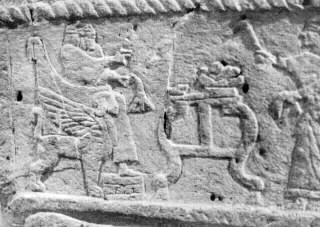 KING AHIRAM of BYBLOS is pictured seated in his throne chair with its guardian cherubim. The carving is from a side panel of the royal sarcophagus.
By modern standards the temple was small – ninety by thirty feet and forty-five feet in height.6 The building was modeled after Phoenician-Canaanite temples (see the sketch of the Tainat temple) and was divided into three sections. The porch or ulam served as an entrance hall. Two bronze, free-standing pillars named Jachin and Boaz stood "within" this area.7 Through "folding doors" entrance was gained to the central chamber or hekal, a room about sixty feet long decorated with pomegranates, lilies and palms. Here were numerous cult objects, such as the incense altar, the table of shew bread, the ten golden candlesticks (five on the right and five on the left), basins, cups, goblets, etc. Beyond this room was "the most holy place" or the "holy of holies" or debir. This cubical room, thirty by thirty by thirty feet, was probably a raised section approached by stairs (although stairs are not mentioned). In this room the sacred ark was placed between two guardian cherubim. Here was the dwelling place of the deity. The appearance of the cherubim is not known. They may have resembled the winged beasts with bearded human faces that acted as guardians in Mesopotamian cities, or the winged sphinx-like figures found in the carved ivories at Megiddo or depicted in the portrait of the king of Byblos.8 A three-story complex of rooms was constructed against the side and back walls of the temple, but just how these rooms were used is not indicated. It is possible that they were for storage.
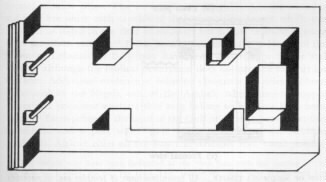 THE TAINAT SHRINE. An isometric drawing of the eighth or ninth century shrine found at Tainat (ancient Hattina) between A1eppo and Antioch in Syria. The drawing is based on the sketch appearing in The Biblical Archaeologist, IV (1941), 21. The shrine was built next to the royal palace. Two free-standing pillars stood in the porch area and a raised pediment occupied the inner room.
The temple should not be thought of in terms of a modern church or synagogue. For the most part the people of the land continued to worship at local shrines. The temple was the royal chapel, the center of the national cult of Yahweh. The public did not enter the building, although presumably certain rituals performed within the hekal could be witnessed through the open doors. Public ceremonies were associated with the altar for burnt offerings in the open courtyard before the temple proper. It is clear from Babylonian temple records and from the responsibilities of the priestly class as set forth in Lev. 5, 6, 13, 15, that temples were as much administrative centers for the nation as places of worship. Present-day responsibilities of departments of health, sanitation and social welfare were included in the duties of the priesthood. The fact that Solomon acted as a priest and that he was able to depose Abiathar and appoint individuals of his own choice suggests a bureaucratic administrative pattern (cf. 4:1-2, 5).
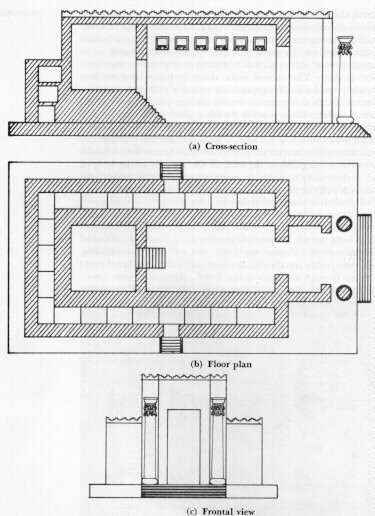 HYPOTHETICAL RECONSTRUCTION OF SOLOMON’S TEMPLE. All reconstructions of temples are, of necessity, hypothetical. The particular floor plan shown here (b) suggests that the two free-standing pillars named "Jachin" and "Boaz" stood in front of the temple proper, although it would have been just as feasible to place them within the porch or ulam as in the Tainat shrine. The cross-section (a) portrays the innermost room or debir(described as a perfect cube in I Kings 6:20) with a floor level above that of the rest of the temple. The debir might just as well have been on the same level as the rest of the building and the roof in this part of the building may have been lower. The recessed windows are styled after stone frames found in the excavation at Ramat Rahel, Israel. The crenelations on the roof are based on remnants of structures found at Megiddo and utilized in the Stevens reconstruction of the temple (cf. G. E. Wright, Biblical Archaeology, p. 139), but no one knows if such battlements were used on shrines. The capitals are styled after one found at Megiddo. The temple faced the east.
How ritual for temple services developed is not known. Possibly certain rites from local Hebrew and Canaanite shrines were adopted. Festivals accompanying seasonal changes found in Canaanite worship may have become part of the Hebrew agricultural interpretation of religion. The structural design of the temple, planned by Phoenician artisans, was most likely designed to accommodate rituals familiar to Phoenicians and Canaanites,9 for the Hebrews had had no such building prior to this time. It also seems likely that, having been in the land for more than a century, the Hebrews had developed religious rituals associated with their own sacred symbols. Such a psalm as 24:7-12 may have been sung in a ritual in which the ark was taken into the temple. In addition to the temple for Yahweh, Solomon built shrines for other deities (11:7).
Solomon’s palace was a major building operation, requiring thirteen years to complete, as compared to seven for the temple. Standing near the temple, the royal complex must have somewhat overshadowed the building designed for the deity. A construction program of this magnitude required money, some of which Solomon raised by taxation (4:7-19) and some of which came from business profits. Horses were imported and resold at a profit to other nations (10:28).10 Simultaneously a strong force of war-chariots and cavalrymen were developed for national security (10:26 and following verses; compare with 4:28), and these forces were stationed throughout the empire in strategically located chariot cities. The excavation of Megiddo has uncovered a stable of five units, each capable of sheltering thirty horses, which was at one time dated in the time of Solomon but is now believed to come from the ninth century.11 It has been suggested that the House of the Forest of Lebanon (7:2-5) may have been a stable for horses and chariots although the biblical description does not provide support for this idea. Additional evidence of Solomon’s business activities has been discovered in the Negeb, east of the Arabah, where ancient copper mines and primitive smelters that may belong to his time have been found.12 Ezion-geber, at the head of the Gulf of Aqabah, was a fortified storehouse and a port which gave Solomon access to the Arabian peninsula, African cities on the Red and Arabian Seas,13 and possibly also to India if "Ophir" (I Kings 9:28) can be equated with Suppara, India.14
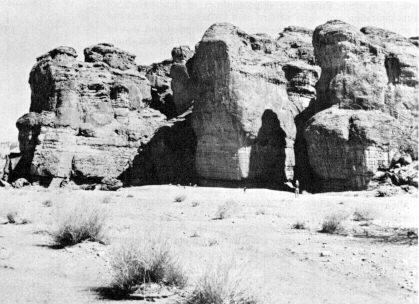 "SOLOMON’S PILLARS." The massive stone outcroppings pictured above are in the Negeb about sixteen miles north of the ancient port city of Ezion-Geber on the Gulf of Aqabah. They have been called "Solomon’s pillars" because some scholars believe that copper was mined here in Solomon’s time. Smelting furnaces and heaps of slag have been found nearby. The aridity of the area, the burning heat of the summer sun, the distance from central Palestine and the problem of transporting food and equipment necessary for sustaining life in this barren area must have resulted in a high mortality rate.
In spite of the mobile army, Solomon was unable to control all parts of the extensive Hebrew kingdom. An Edomite rebellion which appears to have taken place early in his reign is recorded in I Kings 11:14-25. A certain Hadad, exiled in David’s time, returned when Solomon became king and became an adversary.15 Unfortunately the text breaks off in the middle of Verse 25. Some scholars suggest that Verses 23 and 24 should be treated as intrusions into the text, and that the difficult Verse 25 should follow after Verse 22 and read in conclusion that Hadad reigned over "Edom" (as certain manuscripts have it). In any event Solomon appears to have retained his hold on Ezion-geber (I Kings 9:26 ff.).
Another rebellion was led by Jeroboam, an Ephraimite, whom Solomon had placed in charge of one section of the corvée (I Kings 11:26 ff.). When Solomon sought to kill him, Jeroboam took refuge with Shishak, king of Egypt. Despite good relations of trade and marriage with Egypt, extradition rights were apparently not observed.
A figure as colorful as Solomon would naturally attract legends. Folktales developed about his wealth (10:14-25), trade (10:11-12), and international reputation for wisdom (3:16-28; 10:1-10). The final touch was added by Deuteronomists who are responsible for the account as we have it. Stern judgment was passed upon Solomon for his numerous wives who led him to worship other deities beside Yahweh. At the same time, the speeches placed in Solomon’s mouth reflect Deuteronomic convictions about the significance of the Hebrew religion and contain interpretations of history that follow the Deuteronomic point of view.
Endnotes
- Cf. I Kings 3:3, 6b-7a, 14; 5:3-5; 6:11-13; 8:9, 14-61; 9:1-9; 11: lb-2, 3b, 4b-6, 11-13, 41-43.
- Vs. 27 is a midrash or commentary explaining the significance of Solomon’s action.
- Cf. I Kings 11I: 19 f. where the pharaoh’s sister-in-law is given to Hadad, a prince of Edom. Cf. John Wilson, The Culture of Ancient Egypt (Chicago: University of Chicago Press, 1961), pp. 253 f., where it is noted that Rameses II, who had a huge family, married one son to the daughter of a Syrian sea captain.
- That monarchs did compose wisdom sayings can be demonstrated in "The Instructions for King Meri-ka-re" which a twenty-second century B.C. Pharaoh prepared for his son and in the "Instructions of King Amen-em-het" prepared for Amen-em-het’s son in the twentieth century B.C.; ANET, pp. 414 ff.
- Cf. "The Instruction of Arnen-em-opet," ANET, pp. 421 f.
- The unit of measurement used in the Bible is the cubit, which is the distance between the elbow and fingertip. While cubit measurements differed, 18 inches is assumed to be equal to a cubit for convenience. Cf. R. B. Y. Scott in BA, XXII (1959), 22 ff.
- The significance of the names is not known. For a discussion of various theories, cf. John Gray, I & II Kings, The Old Testament Library (Philadelphia: The Westminster Press, 1963), pp. 174 ff.
- Cf. Wm. F. Albright, "What Were the Cherubim?" The Biblical Archaeologist Reader, ed. by G. E. Wright and D. N. Freedman (Chicago: Quadrangle Books, Inc., 1961), pp. 95 ff. (also in an Anchor paperback edition).
- The temple may have been dedicated at the New Year with the coming of the fall rain. Cf. J. Gray, op. cit., pp. 192 f. The "bronze sea" may have represented the cosmic ocean, important in the New Year rites, cf. Gray, ibid., pp. 176 ff.
- The text at this point is defective. If, as the RSV translation indicates, Solomon imported horses from Egypt and Kue (believed to be Cilicia in Asia Minor) and sold them to the Hittites and north Syrians, one wonders why the Hittites had to buy through Solomon when they might have purchased the animals directly.
- Y. Yadin, "New Light on Solomon’s Megiddo," BA, XXIII (1960), 62 ff.
- It has been argued recently that no metallurgic work was done during the time of the Hebrew monarchy and that the material evidence has to be credited to the Edomites and dated in the eleventh century (cf. Beno Rothenberg and Alexandru Lupu, "Excavations at Timna," Museum Haaretz Bulletin, No. 9, June 1967.
- Nelson Glueck, "Ezion-geber," BA, XXVIII (1956), 70-87.
- Jack Finegan, Light From the Ancient Past, p. 182 and works cited there.
- When a monarch died the decrees issued against individuals were, apparently, rendered null and void, permitting exiles to return home.
Old Testament Life and Literature is copyright © 1968, 1997 by Gerald A. Larue. All rights reserved.
The electronic version is copyright © 1997 by Internet Infidels with the written permission of Gerald A. Larue.