



Old Testament Life and Literature (1968)
Gerald A. Larue
Chapter 15 – E
BROADLY speaking, E can be said to include the literature which remains in the Pentateuch after P and D (easily identified) and J sources are removed, although in numerous passages it is difficult to distinguish between J and E.1 Distinctiveness of grammar, style and vocabulary, not always apparent in English translations, provide the basis for the identification of E material. Some of the more obvious features include labeling the sacred mountain Horeb rather than Sinai as in J, the identification of pre-Hebrew inhabitants of Palestine as Amorites, not Canaanites as in J, and naming Moses’ father-in-law Jethro rather than Reuel. As we noted, E does not use the name "Yahweh" for the deity until it is revealed on Mount Horeb (Exod. 3:15).
Because of E’s fragmentary nature, it is impossible to make more than the most general comments about the writer’s moral and theological concerns. At times E appears to exhibit greater concern than J with the moral implications of traditions, so that when Abraham pretends that Sarah is his sister, E points out that she was, in reality, a half-sister (Gen. 20).2 E makes it clear that Sarah did not cohabit with Abimelech. On the other hand, E seems untroubled by Aaron’s lie. (When challenged by Moses in the golden calf episode, Aaron implied that the molten metal just happened to flow into the calf pattern, whereas the E editor has stipulated that Aaron fashioned the statue; cf. Exod. 32:4 and 24.) Some cruder anthropomorphisms of J are avoided in E and God’s will is revealed through dreams (Gen. 15:1; 20:3; 28:12) or messengers (Gen. 21:17; 22:11), but E does not hesitate to state that God wrote laws with his own finger (Exod. 31:18b). E’s interest in ritual has led to the suggestion that perhaps the writer was a priest,3 for he mentions the prohibition against eating the ischial sinew (Gen. 32:32), and refers to oil libations poured out on, masseboth (standing pillars) (Gen. 28:18; 35:14) and to tithing (Gen. 28:22). At the same time a reforming interest is also apparent. For example, the story of Abraham’s near-sacrifice of his son may be a sermonic parable directed against child sacrifice (Gen. 22). The condemnation of the golden calf, a cult symbol in the royal shrines at Bethel and Dan, constitutes a very bold protest (Exod. 32).4
It is generally agreed, despite slender evidence, that E is a product of the northern kingdom.5 There is more information about Jacob and Joseph, more emphasis on northern shrines of Bethel and Shechem, and less data pertaining to Abraham and Hebron than in J. The use of the Israelite designation of Horeb as the sacred mountain, which appears also in the Elijah cycle (I Kings 19:8), also points to a northern provenance for E.
E is often given a date in the eighth century B.C., usually during the reign of Jeroboam II (c. 786-746), a prosperous time reflected in the lack of mention of struggle and difficulty in E, or in the ninth century in the time of Jehu (842-815) when pro-Yahwist parties were in control. On the other hand, there is no reason why the writing could not have been produced in the tenth century during the reign of Jeroboam I, immediately following the separation of the two kingdoms. If writings like J and E were a product of the national cult and were used in ritual, it would seem natural that when the royal shrines were erected at Bethel and Dan, E was compiled from the same or similar sources as J. The literature, as we are able to extract it from the Torah, is probably best understood as a product of the developing cult or as the result of a process of progressive interpretation by which the relationship of the northern kingdom to Yahweh continued to be expressed and expanded.
It has been argued that E lacks J’s dramatic simplicity of style and this may be so, but one cannot avoid noting the tense, moving portrayal of the Abraham-Isaac episode of Gen. 22, and the excellent characterizations in the Joseph cycle that reflect the work of a master raconteur. E’s objective is that of J: the proclamation of Yahweh’s purposes for his people, promised in the past, expressed through salvation history, being realized in the present and giving promise for the future.
How E came to be combined with J can only be conjectured. When Israel collapsed before Assyria in the eighth century, it is possible that priests from Bethel fled across the border, seeking sanctuary in Jerusalem and bringing with them sacred traditions of their shrine and nation. Why the writings were merged cannot be known. It can only be said that in the editing preference appears to have been given to J materials. No E creation story has survived, although it is possible that the use of the term "Elohim," together with "Yahweh," in Gen. 2:4b-3:24 signifies a fusion of J and E primeval myths.6
|
– PASSAGES BELONGING TO E –
|
|
| The Abraham Cycle | |
| *Gen. 15:1-3, 5f., 11, 12a, 13-14, 16 | Often ascribed to E, but note the name "Yahweh" which was not yet revealed. The material appears to be late, reflecting D influence. |
| Gen. 20:1-17 | Abraham and Sarah in Gerar. |
| Gen. 21:8-21 | The Hagar story. |
| Gen. 21:22-32, 34 | Abraham and Abimelech at Beer-sheba. |
| Gen. 22:1-13, 19 | Abraham and child sacrifice. |
| The Jacob Cycle | |
| Gen. 28:11-12, 17-18, 19b-21a, 22 | Jacob’s dream. |
| Gen. 30:1-8 | Jacob and Laban (a conflation of J and E). |
| Gen. 30:26, 28; 31:2, 4-17, 19-20, 21b-43, 45, 46b, 49-50, 53b-55 | Jacob leaves Laban. |
| Gen. 32:1-2 | Jacob at Mahanaim. |
| Gen. 32:13-21 | Jacob and Esau. |
| Gen. 32:23-32 | Jacob wrestles with God and Jacob becomes Israel. |
| Gen. 33:18-20 | Jacob at Shechem. |
| Gen. 35:1-8 | Jacob at Bethel. |
| Gen. 35:16-20 | Birth of Benjamin and death of Rachel. |
| The Joseph Cycle | |
| Gen. 30:22-24 | The birth of Joseph (a conflation of J and E). |
| Gen. 37:5, 9-11, 19-20, 22, 24, 28a, 29-30, 36 | Joseph is sold into slavery. |
| Gen. 40:1-23 | Joseph interprets dreams. |
| Gen. 41:1-45, 47-57 | Joseph and Pharoah. |
| Gen. 42 | Joseph and his brothers. (A conflation of J and E. E material may include 42:1, 3-4, 8-25, 29-37.) |
| Gen. 45:5-8, 15-18, 20, 25-27; 46:1-5 | Jacob comes to Joseph. |
| Gen. 48:1-2a, 7-9a, 10b-12, 15-16, 20-22 | Jacob’s blessing. |
| Gen. 50:15-26 | Deaths of Jacob and Joseph. |
| The Moses Cycle | |
| Exod. 1:15-2:10 | Moses’ infancy stories. |
| Exod. 3:1, 4b, 6, 9-15, 19-22 | Moses encounters Yahweh. |
| Exod. 4:17-18 | Moses leaves Jethro. |
| Exod. 4:20b-21 | A warning about Pharaoh. |
| Exod. 4:27-28 | Moses and Aaron |
| Exod. 5:1-2, 4 | Moses and Aaron before Pharaoh. |
| Exod. 7:15b, 17b, 20b; 9:22-23a, 25a, 35a; 10:12; 13a, 14a, 20-23, 27; 11:1-3 | E materials pertaining to the plagues. |
| Exod. 12:31-42a; 13:17-19; 14:15-19a, 21-23, 26-27a, 28-29 | The Exodus. |
| Exod. 15:20 f. | Miriam’s song (vss. 1-18 are a separate expansion). |
| Exod. 16-18 | Basically a conflation of J and E, so combined that any separation is conjectural. (Possible E material = 17:3-6, 8-16, 18:1-27.) |
| Exod. 19 | May contain J-E material at 19:1-3a, 18. The remainder has been overwritten by a redactor. |
| Exod. 20:1-23:19 | Whether or not E contains legal material has been debated. Many scholars place these two law codes in E. |
| Exod. 20:1-20 | The ethical decalogue. |
| Exod. 20:22-23:19 | The Covenant Code (based on an old Canaanite civil code). 23:20-33 is by Rje or Rd. |
| Exod. 24:12-14, 18b; 31:18b | Moses receives stone tablets of law from God. |
| Exod. 32:1-8, 15-24, 35 | The Golden Calf. |
| Exod. 33:4-6 | Discarding of ornaments. |
| Exod. 33:7-11 | The Tent of Meeting. |
| Num. 11:1-3 | Complaints at Taberah. |
| Num. 11:16-17 | The seventy elders. |
| Num. 11:24-30 | Eldad and Medad. |
| Num. 12:1-15 | Rebellion of Aaron and Miriam. |
| Num. 13-14 | Sending out spies. The E material is closely interwoven with J and P and the following list of E passages is conjectural: 13:17b-20, 22-24, 26b, 28, 30-32; 14:1, 3-4, 11-25, 31-32, 39-45. |
| Num. 16:1b, 2a, 12-15, 25-26, 27b-34 | Dathan and Abiram rebel (E mixed with J and re-edited). |
| Num. 20:1b | Death of Miriam. |
| Num. 20:4-13 | Water problems. |
| Num. 20:14-21 | Problems with Edomites (contains both J and E). |
| Num. 21:4-9 | The brazen serpent (late addition to J?). |
| Num. 21:21-25 | The battle with Sihon of the Amorites. |
| Num. 21:33-35 | The battle with Og of Bashan. |
| Num. 22:3b-4, 8-16, 19-21, 35b-41; 23:1-30; 24:1-2, 10-14, 20-25 | Oracles of Balaam (interwoven with J). |
| Num. 25:1-5 | Worship at Ba’al Peor (some J?). |
| Num. 32:1-5, 16-17, 20-27, 34-41 | Reuben and Gad settle in Transjordan. |
* Asterisks mark passages usually assigned to E but which, according to personal analysis, may not be E.
The E Saga
Read the Abraham Cycle
The E tradition, insofar as it can be isolated, commences with a number of variations of the J tradition. The story of Sarah in the court of Abimelech displays E’s striking sensitivity to Sarah’s situation. By divine intervention, both Sarah and Abimelech are protected from guilt and sin, thus shielding the woman who was to be mother of the heir of the divine promise from any possible taint. E does not err anachronistically, as does J in Gen. 26, by linking Abimelech of Gerar to the Philistines. A different reason and setting is provided for the expulsion of Hagar (cf. J in Gen. 16), and Sarah’s envy and personal enmity is replaced by a mother’s jealous desire to protect her son’s inheritance. Abraham’s participation in the expulsion is due to the revelation that this was part of God’s plan for the future. Ishmael’s salvation and future is, according to E, the result of divine mercy and intervention.
The near-sacrifice of Isaac is the most moving story in E’s Abrahamic cycle. The concept of a God who would demand so barbaric and traumatic an ordeal for both father and son can only be characterized as sub-human, unless the author, who has in other Abrahamic stories revealed sensitivity to the human predicament, had some purpose that would justify the harshness of the characterization. Such a purpose becomes clear when the story is recognized as a parable designed to teach that Israel’s god did not want or demand child sacrifice, but, on the contrary, required a substitution.
Human sacrifice has been noted earlier in discussion of the herem and the Jephthah story in judges. It is clear that child sacrifice was practiced in Judah (II Kings 16:3; 21:6; 23:10; Jer. 19:5) and in Moab (II Kings 3:27) and elsewhere (II Kings 17:31). Regulations governing firstfruit rituals in which, by offering a part, the ownership of the whole by the deity was recognized, required that the firstborn child be sacrificed. Exod. 22:29, part of the so-called "Covenant Code," states that the firstborn child be "given" to the deity just as the firstborn animal was given. Subsequent legislation contained a redemption clause providing for the replacement of the child by an animal (Exod. 13:12-15). It is possible that the E story, in which Abraham, the father of the people, dramatized the deity’s demand for the substitutionary practice, stood between Exod. 22:29 and the later legislation as one of the factors bringing about cultic reform and the abandonment of the human sacrifice. The primacy of this interpretation has been challenged by those who believe that the story signifies exactly what it portrays-a test of Abraham’s faith and the recognition that Israel’s existence was due to the mercy of God, with the anti-human sacrifice element being secondary.7
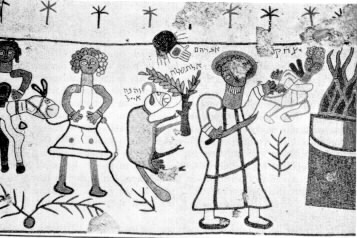 SYNAGOGUE FLOOR AT BETH ALPHA. The mosaic floor of the sixth century A.D. synagogue found at Beth Alpha depicts an artist’s concept of the near-sacrifice of Isaac by Abraham. The patriarch stands at the right with the sacrificial knife in his right hand, and with the left hand holds Isaac close to the altar with its leaping flames. Isaac’s name appears to the left of the boy’s head, and Abraham’s name is to the left of his head. At the far left, two servants stand with the ass. Above Abraham’s head, the hand of God is seen breaking through the sky-line and the accompanying Hebrew words read "lay not," the initial words of the deity’s command to halt the sacrifice. Below the hand is a ram tied to a tree and the Hebrew words here are "Here is a ram."
Read the Jacob Cycle
The Jacob cycle begins with the dream of a stairway between heaven and earth, reflecting the cosmology of the era and calling to mind the ziggurats of Mesopotamia with the stairways or ramps uniting the topmost levels with earth and providing a means for divine-human encounter. Some additions to the J cycle suggest that E represents little more than a variant tradition. Other portions are more significant. Jacob’s contest with God and the subsequent change of name (Gen. 32:23-32) is most significant, for a name change signifies change in destiny and status. Jacob’s refusal to release the deity until a blessing was given is reminiscent of folk tales in which a deity or other non-human power was held until some gift was given.8 It has been suggested that the deity represents the god of the land to be possessed (El Shaddai) and that the story symbolizes divine sanction for the Jacob tribe to wrest the land from its earlier inhabitants, the Canaanites.9 It is significant that when Jacob arrives at Shechem he raises an altar to "El, the God of Israel" (33:18-20) and a second altar at Bethel (35:1-8).
Read the Joseph Story
The Joseph story presents slight variants to J. Joseph is rescued from a pit where he was placed by his hostile brothers and is taken to Egypt and sold there by Midianites, not sold by his brothers to Ishmaelites as in J. Divine protection and guidance enabled Joseph to rise from the status of a prisoner to that of Vizier in the royal court. Ultimately, all the Jacob tribes came to Egypt to enjoy the privileges afforded by Joseph’s office.
E’s Moses tradition parallels J’s with some significant additions. E’s reasons for the persecution of the Hebrews and the story of the miraculous preservation of the child destined to be savior of the people set the stage for the Exodus. According to E, the name "Yahweh" was unknown to the Hebrews prior to the revelation to Moses and this suggests that the cult of Yahweh which united the northern tribes was a relatively late development.10 E introduced the "rod of God" by which miracles were wrought, assigned Aaron a more significant role as wonder-worker and heightened the account of the plagues.
The relationship of the Decalogue to the traditions of the sacred mountain is, as Martin Noth has pointed out, at best a tenuous one,11 and it cannot be determined for certain whether the commandments should be assigned to E or to some separate cultic source. In their present form, some laws reflect settled culture (see Exod. 20:17) but do not provide a basis to justify questioning the antiquity of all, despite the impossibility of giving a date to any. The laws constitute a minimum expression of cultic and social responsibilities of Yahwism.
The Covenant Code or "book of the Covenant," as the section is sometimes called, appears to be a self-contained legal collection inserted into the Mosaic tradition. As noted previously, the forms and contents are much like law codes found elsewhere in the Near East. The code could just as easily be ascribed to J as to E and probably represents Hebrew borrowing of established Canaanite law with Hebrew legal additions.12
The condemnation of the cult of the golden calf, placed in Moses’ mouth, is perhaps the most startling E tradition13 for the cult was under royal aegis. The story of the brazen serpent preserved by E is an aetiological cult legend explaining the seraph-serpent symbol in Hebrew worship (see II Kings 18:4).
Endnotes
- It has been argued that E does not represent a separate source but at best the results of re-editing J. Cf. P. Volz and W. Rudolph, Der Elohist als Erzähler. Ein Irrweg der Pentateuchkritik?, Beiheft, Zeitschrift für die Alttestamentliche Wissenschaft (BZAW) LXIII, Giessen, 1933; and W. Rudolph, Der ‘Elohist’ von Exodus bis Josua, BZAW, LXVIII, Berlin, 1938.
- Marriage with half -sisters was later prohibited (cf. Lev. 18:9, 11; 20:17 and II Sam. 13:13).
- R. H. Pfeiffer, Introduction to the Old Testament, p. 173.
- Ibid., p. 170, Pfeiffer believed the golden calf episode to be post-Exilic.
- S. Mowinckel has argued that E belongs to Judah. Cf. "Der Ursprung der Bil’ amsage," Zeitschrift für die Alttestamentliche Wissenschaft, XLVIII (1930), 233 ff.
- Cf. Weiser, op. cit., p. 103.
- G. von Rad, Genesis, pp. 239 ff.
- Ibid. P. 316.
- G. A. Danell, Studies in the Name Israel in the Old Testament (Upsala: Appelbergs Boktryckeriaktiebolag, 1946), p. 18.
- M. Noth, Exodus, The Old Testament Library, J. S. Bowden (trans.) (Philadelphia: The Westminster Press, 1962), p. 43.
- Ibid., p. 160.
- Ibid., pp. 109-194 for detailed study.
- Noth assigns the tradition to J. Ibid., p. 243 f.
Old Testament Life and Literature is copyright © 1968, 1997 by Gerald A. Larue. All rights reserved.
The electronic version is copyright © 1997 by Internet Infidels with the written permission of Gerald A. Larue.