

Old Testament Life and Literature (1968)
Gerald A. Larue
Chapter 24 – Life and Literature of the Early Period
ONLY limited information is available concerning the Jews in the Persian period. Apart from Biblical sources and a few Persian inscriptions, contributions coming from archaeological studies or literary documents from other parts of the Near East have been, at best, peripheral. Nevertheless it is possible to gain some insight into the historical situations that produced the biblical literature of this period and to reconstruct in broad general outline some aspects of Jewish life and thought.
Read II Chron. 36:22-23; Ezra 1:1-6
The Persian conquest brought dramatic changes in governmental policies to that part of the world once controlled by Babylon. Cyrus’ liberal attitude toward his subjects, his respect for local tradition and custom-both religious and cultural-and his willingness to permit flexibility within his empire, appear to have won for the Achaemenid ruler generous cooperation from his people. A workable government, not without its bureaucratic structure, put minimal social pressures on the populace.
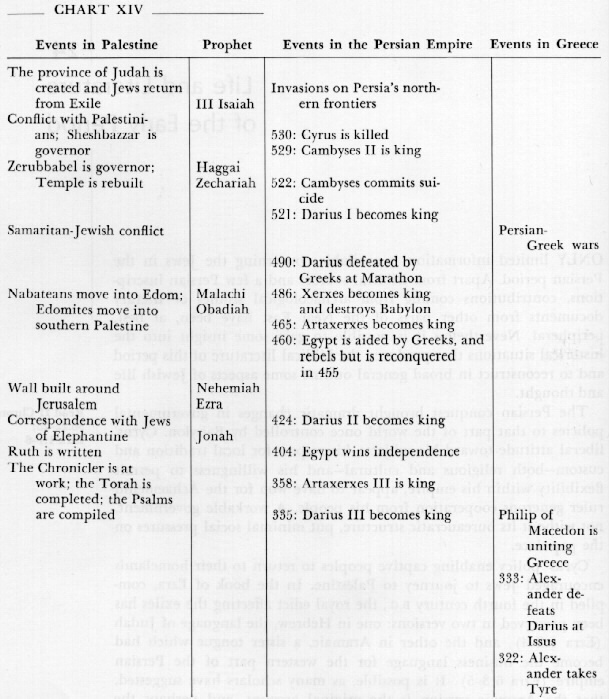
Cyrus’ policy enabling captive peoples to return to their homelands encouraged Jews to journey to Palestine. In the book of Ezra, compiled in the fourth century B.C., the royal edict affecting the exiles has been preserved in two versions: one in Hebrew, the language of Judah (Ezra 1:2-4), and the other in Aramaic, a sister tongue which had become the business language for the western part of the Persian empire (Ezra 6:3-5). It is possible, as many scholars have suggested, that the Aramaic version is the original account, and perhaps the Hebrew version rests on the spoken announcement of the herald who proclaimed it.1 In any case, the decrees are in basic agreement in that both record permission to rebuild the temple, and although the privilege of returning to Palestine is mentioned only in the Hebrew version, perhaps it is implied in the Aramaic.
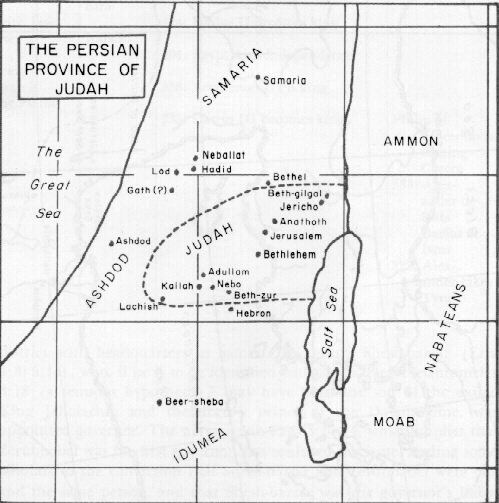
Within the fifth Persian satrapy2 Cyrus had created the province of Judah, extending from a line north of Hebron and just south of Bethzur to the area north of Jerusalem, a distance of about twenty-five miles. This land appears to have been removed from an administrative district with headquarters in Samaria. A certain Shesh-bazzar (Ezra 1:8; 5:14), who, if he is to be identified with Shenazzar of I Chronicles 3:18 (a tenuous hypothesis)3 may have been the son of the exiled King Jehoiachin and therefore a prince of the Davidic line, was appointed governor. The narrative in Ezra 3:1-4:4, which implies that Zerubbabel was the first governor, has confused the issue, leading some scholars to the conviction that Shesh-bazzar and Zerubbabel were one and the same person, and that Shesh-bazzar was the governor’s Baby-vincing argument.4 Without entering into the arguments, it seems simplest and best in the light of the evidence to recognize Shesh-bazzar as the first governor and Zerubbabel as his successor and to acknowledge Cyrus’ political acumen in encouraging loyalty by giving the returning Jews one of their own people, possibly a member of their own royal family, as their first governor.
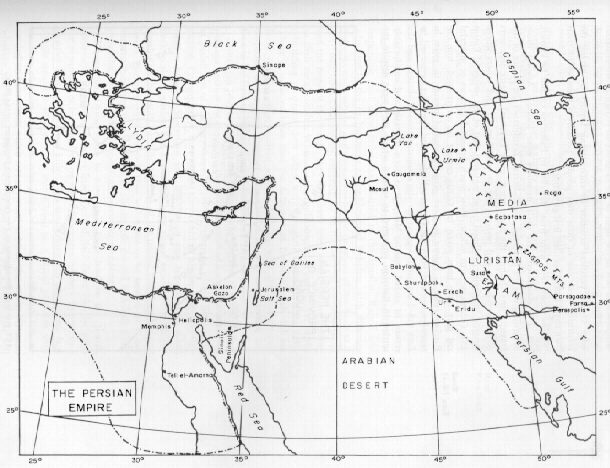
How many Jews went from Babylon to Palestine cannot be known, but it is estimated that their numbers were limited. Among those returning was the governor, Shesh-bazzar, Zerubbabel the prince of the Davidic line, Joshua the high priest, some Levitical priests, followers of Deutero-Isaiah and perhaps the prophet himself, and others whose longing for their childhood home matched that of the writer of Psalm 137. Others were to follow. (Read Ezra 1:6-11) How much financial support or material aid may have been given by Cyrus cannot be ascertained, but the Persian ruler is known to have given grants of money to assist in resettlement and both the Cyrus cylinder5 and the edict preserved in Ezra 6:3-5 mention support for the reconstruction of shrines and the return of sacred vessels. Many Jews born in exile and comfortably settled in Babylon preferred to remain where they were despite the predictions of future glory for Palestine by Ezekiel and Deutero-Isaiah.
What emotions the Jews experienced as they entered Jerusalem, with its tumbled stones serving as a grim reminder of the devastation of half a century earlier, have not been recorded. In contrast with the splendors of Babylon, the scene must have been shocking: ruins of the sacred altar, the demolished temple, the fallen walls and broken dwellings covered with drifted soil and overgrown with weeds. Perhaps there was a small village, a cluster of homes built by those who had not been exiled. All of this must have seemed a far cry from what may have been anticipated from the words of the Exilic prophets.
Read Ezra 3-4:5
With considerable energy the newcomers began to build homes and lay the foundation for a new temple. According to Ezra 3 the altar was built, almost at once, and the offering of sacrifices begun. But work did not proceed without difficulty. Crop failure placed severe economic strains upon the community. Animosity and jealousy between the exiles and the descendants of those who had remained in the land hindered progress. The permanent residents appear to have greeted the Babylonian Jews with something less than enthusiasm (cf. Ezra 4:4 f.), possibly because of claims relating to repossession of family land or because of other economic reasons. On the other hand, it is not impossible that some exiles contributed to the tension. Raised and educated in the environment of sophisticated Babylon, with differing outlooks and customs, and persuaded by the prophets of the Exile that they had been cleansed by suffering to be the seed of the new Israel and the hope of the future, they may have been somewhat patronizing to their rural cousins. When local people sought to participate in the rebuilding program, their offers were haughtily refused (Ezra 4:3). There is some evidence that the followers of Deutero-Isaiah did not favor a policy of separation and, in keeping with the monotheistic emphasis of the great prophet, argued that all who came to the one God in the faith of Judaism would be accepted (Isa. 56).
Samaritan Jews appear to have added to the problem of relationships, perhaps because they resented the establishment of a separate province of Judah out of territory they had considered to be within their jurisdiction. Consequently, they did all they could to hinder progress. The tension between Samaritan and Jew, which may have had its roots back in the suspicion that appears to have always existed between the north and the south even in the time of the united kingdom, did not lessen, but grew into a breach that was never to be healed. It is not surprising to find that the work of the temple ground to a halt while the exiles concentrated. on social and economic problems.
Meanwhile, Cyrus seems to have paid little heed to the Jewish settlement. Nomadic invaders from Central Asia drove him to press for expansion of his kingdom on the northeastern borders. In 530, in a frontier battle, Cyrus was killed. His tomb, long ago plundered, is a simple structure of square cut stones built on a raised platform with six tiers of stairs. Plutarch, who lived between A.D. 46 and 120, recorded an inscription which was supposed to be on the tomb: "O man, whoever you are and from wherever you come, for I know you will come, I am Cyrus and I won for the Persians this empire. Therefore, do not begrudge me this little earth which covers my body" (Life of Alexander: vi. xxix. 5).
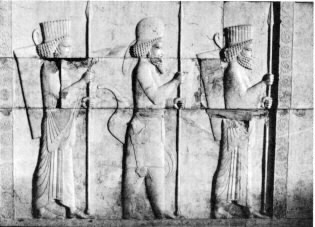 CARVED FIGURES ALONG THE STAIRWAY TO THE APADANA (HALL OF PILLARS) AT PERSEPOLIS. The two outer figures with the fluted headdress are Persians, and the central figure with the domed headdress, short skirt and trousers, is an Elamite. Their rather rigid position with the spear held on the left toe may indicate some sort of salute. Darius the Great constructed this magnificent city, and Alexander the Great demolished it.
News of Cyrus’ death reached Babylon late in 530 and his son Cambyses II (529-522) who had been reigning as king of Babylon ever since Cyrus captured that city, now became "King of the lands" and "King of kings," officially beginning his first year in Nisanu (March-April) in 529. Almost immediately the new monarch began the invasion of Egypt, and, with the conquest of this territory in 525, ruled the greatest empire the world had ever known. So far as it is possible to tell, Cambyses II continued Cyrus’ policy of non-interference with the religious and social customs of his people.
When Cambyses, perhaps mentally and emotionally ill, committed suicide, a pretender, Gaumata the Magian, posed as Cambyses’ brother (who had been murdered) and claimed the throne. Simultaneously, various provinces (conquered areas) seized this moment to attempt to gain independence. Gaumata, the usurper, was overcome by Darius I, the Great (521-486), an Achaemenid prince who recorded his achievement and his version of events leading up to his victory in the Behistun rock inscription carved into a high cliff above the main highway between Ecbatana (the capital city) and Babylon. A relief panel shows Darius with one foot on the neck of the prostrate Gaumata, behind whom are the captured leaders who attempted to defect. What is more significant, perhaps, is the figure of the winged disc with a human head, the symbol of Ahura Mazda, god of the Zoroastrian faith. With Darius, Zoroastrianism became the religion of the Persian court. There is no evidence of any official change in attitude toward the beliefs of the different groups constituting the empire, but, as we shall see, there is ample evidence that some Persian concepts made a lasting impression on Jewish religious thought.
The disrupting events associated with the death of Cambyses seem to have been interpreted by two prophets, Haggai and Zechariah, as signaling the collapse of the Persian empire and the time for the establishment of the ideal state envisioned by the Exilic prophets. With the fanatical zeal of those who have but one theme by which all else is interpreted, they convinced Zerubbabel, who was by this time governor of Judah, and Joshua, the high priest, and indeed, the whole populace, that once Yahweh’s temple was completed, Zerubbabel would be crowned king of the new kingdom of the Jews which would soon be established. But before turning to their persuasive message preserved in their collected oracles we will consider the final portion of the composite book of Isaiah, Chapters 56-66, which belong in the period just before the time of Haggai and Zechariah.
TRITO-ISAIAH
The last eleven chapters of Isaiah, which, at times, reveal a close affinity to the words of Deutero-Isaiah, appear to have been recorded in the early post-Exilic period, possibly, in part, by Deutero-Isaiah’s disciples, and possibly, in part, by the great prophet himself. It is clear that the temple was still in ruins (64:11) and that initial steps toward rebuilding, perhaps the laying of foundations, had been taken (66:1). Much work remained, including the repair of city streets (58:12) and walls (60:10), and no significant restoration appears to have been done in the outlying villages (61:4). It is clear that the provenance of the writings is Judah.
No real unity or singleness of theme exists in these chapters, and because smaller collections of poems can be recognized it is doubtful that the work should be attributed to a single writer. Three poems of promise in Chapters 60-62, and similar poems in 57:14-19 and 66:6-16 are alike in theme and structure, and so strongly resemble the work of Deutero-Isaiah, particularly the servant songs, that it is reasonable to suppose they may be the work of the great Jewish prophet of Babylon. Attacks on leaders in 56:19-57:13 seem to be by a different hand with no relationship to the foregoing passages. Broadly speaking, Trito-Isaiah appears to be the work of several different authors, all deeply affected by Deutero-Isaiah, using many of the same characteristic expressions of their master, and employing a variety of literary types, including laments and oracles of promise and condemnation, to convey their messages. The chapters read as though the enthusiastic hopes of Deutero-Isaiah were being reinterpreted in a new and different setting, illustrating once again the pattern of continuing or progressive interpretations.6
Read Isa. 56:1-8
The immanence of the in-breaking of Yahweh into human affairs to fulfill the Exilic predictions of a new kingdom is expressed in the opening words of Trito-Isaiah, in particular in the word "soon." After stressing the importance of Sabbath observance and ethical behavior the prophetic writer, in a universalistic spirit akin to that of Deutero-Isaiah (cf. 44:5; 49:6), welcomed into the cultic community those eunuchs (excluded by Deuteronomic law, cf. Deut. 23: 1) and foreigners (excluded by Ezekiel, cf. Ezek. 44:9) willing to accept Jewish covenant responsibilities and beliefs. Universalism is carried further in the statement that Yahweh’s temple and the privilege of sacrificing upon the holy altar would be open to all who accepted the Jewish faith. Such a claim invalidated any attempt to exclude any group of Jews from the cultic community and perhaps may be interpreted as placing responsibility for proselytism upon the Jews who recognized themselves as central figures in the new kingdom.
Read Isa. 56:9-57:13
The next three oracles form a unity and include a diatribe against corrupt leaders (56:9-12), a lament over the plight of the righteous and a complaint about leaders (57:1-6), and a closing diatribe accompanied by a threat (57:7-13). The expressions of complaint in the first poem sound much like those of Jeremiah (cf. Jer. 2:20 ff.) or Ezekiel (cf. Ezek. 16:23 ff.) and appear to reflect conditions prior to the destruction of Jerusalem. On the other hand, there is no reason to suppose that the practices condemned by the earlier prophets automatically ceased in Judah with the Exile. In its present setting, the poem provides a fitting answer to those who ask why Yahweh delayed the establishment of the new kingdom. The prophet responded that ancient evils had not been eliminated, perhaps imitating and drawing upon an older oracle from the time of Jeremiah. The second poem laments the fate of the righteous whose deaths went unnoticed while the coming of the kingdom was delayed and the followers of non-Jewish cultic rites mocked. The final poem continues the theme of apostasy and concludes with the familiar threat of punishment for the wicked and reward for the righteous.
Read Isa. 57:14-21
The next oracle of promise with its hymnic addition (vss. 19-21) is so close in style and theme to Deutero-Isaiah that it might well be the work of that prophet who had returned to Jerusalem (cf. vss. 16 f. and Isa. 54:7 f.). The poem gives reassurance of Yahweh’s forgiveness and intention to restore.
Read Isa. 58:1-59:15a
As we shall see, there is evidence in Zechariah (ch. 7) that, after the destruction of the temple, those left in Judah observed regular fasting rites as they periodically commemorated this event and mourned their loss. Isaiah 58:1-3 suggests that some questioned the validity of the fast inasmuch as Yahweh seemed to pay no attention to it. The prophet’s answer laid bare the emptiness of mere outward ritual performance. Like earlier prophets, he demanded a change in ethical and moral conduct, not only as a witness to sincerity in the observance of the fast, but as a fulfillment of what Yahweh demanded of men before the kingdom would be established. Concern for the poor and oppressed is in the tradition of earlier prophecy. The stirring predictions provide clues as to the time of writing, for there is no indication that the temple has been rebuilt, and 58:12 implies that much restorative work was yet to be done. Oracles on the Sabbath (58:13-14) and on falsehood and unrighteousness (59:1-8) are followed by a penitential prayer of confession (59:9-15a) in which the community admits guilt and sin.
Read Isa. 59:15b-21
The next section contains two isolated fragments (59:15b-20, and 59:21) which may have been added to the preceding material for liturgical purposes. The confessions of guilt recited by the cultic community were followed by a statement of Yahweh’s act of purgation (which had been experienced in the Exile). The promise of the new eternal covenant in Verse 21 (cf. Jer. 31:31-34) provides a triumphant and comforting conclusion to the liturgy.
Read Isa. 60-62
The three poems of consolation and praise in Chapters 60-62 so closely resemble the writings of Deutero-Isaiah, that they may, like 57:14-21, be the work of the prophet from Babylon, supposing, as it has been suggested, that he accompanied those returned to Palestine. Otherwise, the poems are the work of a disciple whose style and vocabulary were deeply affected by his teacher.
The opening call to witness a theophany, the revelation of the divine glory ( kabod), suggests the rising of the sun, and perhaps the occasion is the New Year festival and the prophet is proclaiming the dawning of the Day of Yahweh. The approach of that day, when the promises of restoration would be fulfilled, can be seen in the return of the exiled people; perhaps new groups were arriving from different parts of the Persian empire to swell the numbers of those who first responded to the opportunity to return. From this immediate evidence the prophet moved into speculations about the future when more people would come, when the city wall would be rebuilt by foreigners (60:10), when the temple would be restored (60:13-14) and when the triumphant role of the Jew as the victor rather than the vanquished would be realized. The joy, prosperity and peace of the new-Jerusalem-to-come could only be appreciated by contrast with the present surroundings of the speaker (60:15 ff.), and his visions of the future were marked by supernatural glories to be experienced in an earthly paradise. As a messenger of Yahweh the King, the prophet stated his commission (61:1-3) and then recited the message heralding restoration, prosperity, peace and an ideal human community. Following the triumphant proclamation is an exultant song of joy (61:10-11).
In his jubilant revelation of what he had envisioned and in his effort to convey the magnificent transformation he sees taking place, the prophet gropes for terms to express the newness of what he sees. Jerusalem receives a new title: "the Zion of the Holy One of Israel" (60:14), with walls named "Salvation" and gates called "Praise" (60:18). The people are called "oaks of righteousness" and "the planting of Yahweh" (61:3). In contrast to the divorce imagery in Hosea the land is called "married" and the people "my delight is in her" (62:4). In fulfillment of Ezekiel’s visions the people would be known as "the holy people," "redeemed of Yahweh," and Jerusalem as "sought out" (62:12). The revelation of Yahweh as "light" is to his chosen people and to the world. In recompense for the double cup of suffering experienced by Israel, the reward would also be doubled and witnessed by the nations (62:2). The oracle closes with a stirring call to rebuild Jerusalem in preparation for the coming of the exiles.
Read Isa. 63:1-6
A little poem (63:1-6) in dialogue form introduces Yahweh as judge of nations, and stresses that Yahweh alone would act as judge and executioner, rewarding or punishing as he deemed fit. The portrayal of Yahweh as god of avenging justice with garments stained with blood from the wrathful trampling of peoples is both terrifying and horrifying.
Read Isa. 63:7-65:25
The words of reassurance for Israel which follow the judgment poem take the form of a recitation of the past expressions of Yahweh’s loyal love for his people (ch. 63). The people respond with a prayer for the realization of the theophany promised by the prophets (ch. 64). Something of the desperate situation of the people is revealed in the closing cry of the prayer beseeching Yahweh to act on behalf of his people.
Yahweh’s response (65:1-25) presents the plight of a deity who almost begs his people for recognition only to be rejected, provoked and affronted. Thus it was, the poem explains, that the decision was made to punish but leave a remnant as the seed of the future. The faithful remnant were to be inheritors of the divine promise in the restored, redeemed community.
Read Isa. 66
The final chapter in the Trito-Isaiah collection has been widely discussed among scholars.7 Some believe the chapter is composite, a collection of small oracular units with no binding unity. Others find larger units. It has been suggested that the setting is Babylonian, Egyptian or Judaean. Some think there is a rejection of the temple in the opening verses while others find only a rejection of corrupted attitudes and worship patterns.
There is no reason why the whole chapter could not have come from Judah in the post-Exilic period, perhaps from a slightly later time than the rest of Trito-Isaiah, when the rebuilding of the temple was underway. In contrast to the enthusiasm which we shall find expressed by Haggai and Zechariah, the writer of the opening verses believed that Yahweh did not need or want a temple, and that the building and rituals would only serve as food for man’s pride. Moreover, there is a rejection of the promise implicit in Haggai’s prediction that once the temple was restored the fortunes of the exiles would improve (cf. Hag. 1:2 ff.). Verse 3, directed against the cult and perhaps against syncretistic cult practices, seems to be intrusive, the work of a different hand. The announcement of the theophany, the divine judgment, and the restoration of the people (vss. 6 ff.) conforms to the ideas of other contributors to Trito-Isaiah, in stressing the event as an act of Yahweh, eschatological in nature, designed to introduce with startling suddenness the golden age (cf. vss. 12-16). Verse 17, which picks up the theme of Verse 3 and is perhaps by the same writer, also appears to be intrusive. The final oracles (18-21, 22-23) convey hope for the future, and in 22 and 23 the idea of a new creation, involving not only Judah and Jerusalem, but the entire world presses universal restoration to the uttermost. Apparently some editor, who believed that a note of judgment on apostates was needed, affixed the rather gruesome picture of the privilege of the redeemed to witness the eternal affliction by worm and fire of the bodies of sinners.
MAJOR CONCEPTS IN TRITO-ISAIAH
The contributors to Trito-Isaiah followed the teachings of Deutero-Isaiah in recognizing Yahweh as the sole deity beside whom there could be no other. The continuing violation of the covenant law by those who paid homage to false gods or who contaminated the cultic rites placed these individuals outside of the community of the redeemed. It was in the loyal remnant, swollen by others who accepted the covenant faith, that Yahweh placed the hope for the new tomorrow. In the past he had chosen Abraham and those who would descend from him; now he had chosen the new remnant. As old relationships were disestablished through apostasy, the new relationship would be safeguarded through a new act of Yahweh, more magnificent than anything ever before witnessed. As their forefathers had seen the dawning of an age of hope that had materialized into an empire only to be destroyed through sin, this new people could also see the breaking of a new age that offered greater and more wonderful possibilities than anything in the past. As the old kingdom came through a series of mighty acts of Yahweh, the new kingdom would be established, not through anything the people might do, but as a mighty creative act of Yahweh ushered in by a theophany and developing within the context of immediate history.
The words of these prophets were directed to Jews raised in exile and now united with the descendants of those who had remained in Palestine. For at least one contributor to III Isaiah there was room for all within the new kingdom, as well as for those who were yet to come. The only criterion for fitness to participate in the coming joys was fidelity to the covenant with the accompanying practice of mercy, understanding, compassion and human brotherhood.
HAGGAI
Apart from the designation "Haggai the prophet," little is told about this prophet. No record of his family or his prophetic call has been preserved, and even the analysis of his name, which is related to the word for "festival," has produced nothing more than the suggestion that he may have been born on a feast day.
His oracles, which because they refer to the prophet in the third person appear to have been gathered by an editor, provide us with a rather precise chronology, indicating that all were given within a four-month period between August and December, 520 B.C., which falls in the second year of Darius I. Unfortunately, some slight disarrangement appears to have occurred in these oracles and although four addresses are listed, some scholars think there are really five. Verse 1:15a seems to stand alone. By linking it with 2:15-19, the following sequence is obtained:
1:1-14, the first oracle.
1:15a; 2:15-19, the second oracle.
1:15b-2:9, the third oracle.
2:10-14, the fourth oracle.
2:20-23, the fifth oracle.
Read Hag. 1:1-14
The first oracle delivered in August, 520 at the time of the new moon festival (cf. Num. 28:11-15), explained that the famine afflicting the community had come as a punishment from Yahweh because the temple had not been built. The pronouncement stirred leaders and people to action. (Read Hag. 1:15a; 2:15-19) When just over three weeks had passed since the first oracle was given and the people were at work and the economic outlook had improved, Haggai was led to promise that from this time onward Yahweh would bless his people.
Read Hag. 2:1-9
Nearly one month later the prophet was confronted by some older men who looked at what had been accomplished and complained that the present building could never measure up to Solomon’s temple (cf. Ezra 3:10-13). Haggai replied that ultimately the glory of the second temple would outshine that of the first, for Yahweh would cause the nations to shower it with treasures.
Read Hag. 2:10-14
The precise meaning of the fourth oracle, delivered early in 519, is not clear. Literally, it appears to be concerned with a liturgical issue about the power of contamination possessed by clean and unclean objects. Many scholars think a much broader problem is involved: whether the Samaritans or people who had remained in the land and who now wished to participate in rebuilding the temple, being unclean or unpurged by exile, would contaminate the work-a sociotheological rather than purely liturgical issue (cf. Ezra 4:1-3). The priests’ response, which is apparently in agreement with Haggai’s, reveal how far this prophet was removed from the speaker whose words were preserved in Isa. 56:3 ff.
Read Hag. 2:20-23
The final oracle goes much further in its promises for the future than anything previously uttered and predicts the overthrow of Persia and the establishment of a new kingdom with Zerubbabel as king-a prophecy that failed to be realized. Doubtless the disturbed state of affairs in the Persian empire prompted Haggai to interpret events as signs of Yahweh’s action on behalf of the Jews.
ZECHARIAH
Zechariah prophesied in the same period as the prophet Haggai, and the first eight chapters of Zechariah’s work reveal the pressure of problems and issues similar to those found in Haggai’s oracles. Chapters 9-14 belong in a different and later context, as we shall see, and represent the work of another person. These later chapters are often labeled Deutero-Zechariah (Chapters 1-8 are, therefore, Proto-Zechariah) and will be considered separately.
Like Haggai, Zechariah is mentioned in Ezra 5:1 and 6:14 where he is called a prophet, but in Nehemiah 12:16 he is listed among the priests. It is quite possible that, like Ezekiel who appears to have had great influence upon him, he was both. Because he is called "the prophet Zechariah" and is referred to in the third person, his work, like that of Haggai, was compiled by an editor. The edited work may be divided into three major sections, with several subsections:
I. Introduction, the initial address, November, 520, Ch. 1:1-6.
II. A. Eight Visions, all received in February, 519, Chs. 1:7-6:8.
1:7-17, a vision of reconstruction.
1:18-21, the four horns and the four blacksmiths.
2:1-5, the man with the measuring line, and a word to Jews in Babylon (6-10).
3:1-10, a vision of Joshua and the Satan.
4:1-14, a vision of a seven-branched lampstand and two olive trees.
5:1-14, a vision of a flying scroll.
5:5-11, a vision of a woman in an ephah.
6:1-8, a vision of the four horsemen.
B. A truncated historical appendix, Ch. 6:9-15
III. Closing oracles from December, 518, Chs. 7-8.
Read Zech. 1:1-16
Shortly after Haggai had answered those who were making disparaging remarks about the new temple, Zechariah received his call to prophesy. No details of the commissioning of the prophet are given, but the message included a call for moral change and a warning drawn from past history. Yahweh’s promise to return indicates that Ezekiel’s prediction was not yet fulfilled (cf. Ezek. 43).
Read Zech. 1:8-17
In the first nocturnal vision of the three patrolling angels and of the angel of Yahweh riding a red horse, a response is given to the inquiry about how long it would be before the new Israel was a reality. The answer was that Yahweh had returned to Jerusalem guaranteeing the rebuilding of the city and future prosperity.
Read Zech. 1:18-21
The vision of the four horns and four smiths predicted the destruction of Israel’s conquerors. The four horns may symbolize the four corners of the earth.
Read Zech. 2:1-5
It is possible that Zerubbabel planned to rebuild the wall around Jerusalem. in the vision of a man with a measuring line (an inversion of the message of Amos 7:7 ff.), the prophet rejected this idea and promised divine protection for the city. Like Haggai, Zechariah appears to have believed that the building program ought to be concentrated in the temple.
Read Zech. 2:6-13
The proximity of the Day of Yahweh and the idealized Jewish kingdom led the prophet to urge those remaining in Babylon to come to Jerusalem.
Read Zech. 3:1-10
The scene of the next vision is the same court of heaven described in the prologue of Job. The Satan, the prosecutor, stood at the right hand of Yahweh, the judge. Before them was Joshua, the high priest, whose filthy clothes symbolized guilt and impurity-whether his own or the nation’s is not indicated. It is possible that Joshua had been charged as unfit to perform priestly functions and was exonerated through the prophetic vision, or, perhaps, the vision provides a stylized picture of the rite of investiture of the high priest in which Joshua divests himself, symbolically, of his old character or perhaps of impurity and dons new robes representing his new office. The charge, given by Yahweh’s angel, lists the high priest’s duties.
The use of the term "Branch" for Zerubbabel (3:8) is related to Isa. 11:1 and Jer. 23:5 where the branch of the Davidic line is described as the ideal king. For the first time a term that has clear messianic overtones is applied to a living person in the post-Exilic age. The prophet was convinced that the new age was at hand. The identity of the "stone" set before Joshua is unclear.
Read Zech. 4:1-14
Verses 6b-10a interrupt the thought in Chapter 4 and therefore will be considered separately. The symbolism of this vision is confusing. The oddly formed lampstand represents the all-seeing eyes of Yahweh (vs. 10). The olive trees are Zerubbabel and Joshua divinely anointed for special responsibilities.
Verses 6b-10a, beginning with "This is the word of Yahweh" and ending with "the hand of Zerubbabel" constitute a promise that Zerubbabel would complete the building of the temple. Perhaps this verse is a further reply to the skeptics who troubled Haggai.
Read Zech. 5:1-4, 5-11
The next two visions are concerned with sin. The scroll announced doom for perjurers and thieves. The woman signified sin and for Zechariah the proper depository for sin was Babylon (Shinar)!
Read Zech. 6:1-8
The visions end as they began, with those who patrol the earth.
Read Zech. 6:9-15
The historical appendix records the crowning of the "Branch." Despite the fact that Joshua’s name appears in Verse 11, the subsequent verses clearly refer to Zerubbabel, while the priest who stands by the throne in Verse 13 is Joshua. It is possible, as numerous scholars have suggested, that Zerubbabel’s name originally stood in Verse 11, but was altered to Joshua by someone who, after Zerubbabel failed to fulfill prophetic expectations, desired to center hope for future messianic leadership in the high priesthood.
Read Zech. Chs. 7-8
In 518 a deputation from Bethel asked whether the annual mourning rite for the old temple should be continued because the new temple was nearly completed. Zechariah’s response comes as a harsh rebuff, for he denied that the fasts had any significance at all, and like his eighth century predecessors, he stressed the importance of the moral life. His concluding remarks looked to the new Israel and the exalted position of the Jew.
MAJOR EMPHASES IN HAGGAI AND ZECHARIAH
Like Haggai, Zechariah provides important information about the struggle of the Jews to form a new state after the Exile and about problems associated with the construction of the second Temple. There can be little doubt that the two prophets were instrumental in bringing the temple to completion. With the new temple, Jewish religion was given a center for worship, an altar for sacrifice and a headquarters for administration and interpretation. In Babylon, Jewish scholars were to continue wrestling with the implications of the faith for centuries, but it was always to Jerusalem that the faithful looked as the center of the religion.
The effect of the teachings of the Exilic prophets, particularly Ezekiel, is readily recognizable, and belief was strong that fulfillment of Exilic prophecies of the ideal kingdom was at hand. With Haggai and Zechariah the concept of leadership begins to acquire overtones that later become messianic and eschatological, but it was not until the hopes for the future failed and the possibility of an earthly king ruling an ideal kingdom faded that messianic and eschatological themes developed. Zechariah and Haggai are really not concerned with eschatological (end of time) ideas, but rather with the new tomorrow that was so close that it was to follow the completion of the temple, a new day that was imminent in Zerubbabel, the "servant of Yahweh" (Hag. 2:23; Zech. 3:8), "Yahweh’s signet" (Hag. 2:23), "the Branch" and the "Rod" (Zech. 3:8; 6:12 f.) of the root of David. The political ends and the national triumph to be experienced under Zerubbabel came not through the monarch but through mighty acts of Yahweh, and it was the conviction that this new day was at hand that give these prophetic oracles their sense of urgency and immediacy, reflections of the enthusiasm and driving power of the two prophets.
Zechariah’s visions show how far advanced the development of angelology was in Jewish thought. Not only is there a court of heaven with the Satan, the accuser, familiar from the Joban prologue, but angelic horsemen and angelic interpreters are added. At this point, apart from the Satan, the angelic functionaries are anonymous and without titles.
Zechariah and Haggai give no indication of a change in the way in which the "word of Yahweh" was experienced, but they appear to have had experiences much like the early prophets (cf. Zech. 7:8; Hag. 1:2, 7, etc.). Like their predecessors, they believed that Yahweh revealed his intentions to his servants, the prophets.
A new answer is given to the problem of theodicy. Yahweh was about to act to reward the righteous, not in the distant future but immediately-a prediction that failed. There was no argument with the teachings of the Exilic prophets that the Exile was punishment for sin, a purging, and that a new community would arise. Haggai and Zechariah were convinced they were part of the ideal Israel.
THE COMPLETION OF THE TEMPLE
Read Ezra 5:3-6:22
Whatever dreams Haggai and Zechariah may have entertained for the collapse of Persia were dispelled when, by 519, it became clear that Darius had put down all rebellions and was in control of a tightly consolidated empire. Although Darius made no effort to interrupt the building of the Jewish temple, the satrap Tattenai, governor of the province beyond the river," attempted to intimidate the builders and dispatched a letter of inquiry to verify the Jewish claim of official permission to build. The letter went to the summer capital of the empire at Ecbatana and a search of the archives produced Cyrus’ edict (Ezra 6:3-5), completely vindicating Jewish claims. Indeed, Darius went further and presented items for sacrifice and ordered Tattenai’s province to provide a subsidy for the Jews.
In the spring of 515 the new temple, now the second temple, was completed. The dedication service (Ezra 6:17) did not reach the elaborate proportions of Solomon’s (cf. I Kings 8:5), but these were difficult days for the Jews and the kingdom was much smaller. With the temple came renewed interest in liturgy and worship patterns which ultimately was to result in the compilation of a book of Psalms, as we shall see.
Hopes for the ideal kingdom under Zerubbabel faded, and the Jewish prince disappears from history, perhaps, as some have suggested, removed from office by the Persian king. It was one thing to rebuild a place for worship, but quite another to become the symbol of divine overthrow of the existing government. How the Jewish community was affected by the failure of the prophetic hopes is not recorded. In the absence of a king, the role of the high priest in the temple assumed greater significance as the community, which saw itself as a people of Yahweh, looked to this office for leadership. Meanwhile the political affairs of Judah were administered by a governor appointed by the Persians, although it is possible that the Jewish state was incorporated in a larger district with headquarters at Samaria.
INTERNATIONAL DEVELOPMENTS
Under Darius the empire prospered. From all parts exotic products flowed into central cities. Beautiful new buildings were erected. Communication was facilitated with road improvements, a canal was dug linking the Nile and the Red Sea, and better protection was provided for caravans. Banking and commerce were encouraged and a coinage system was developed for the empire.
Meanwhile, development and expansion were taking place in the Aegean world. Greek mercenaries had fought both for Cambyses and against him in the war with Egypt. Greek power had now become a threat to be reckoned with on Persia’s western front. Finally, Darius engaged in war with the Greeks, suffering bitter defeat at Marathon in 490. When Darius died in 486, the Greek-Persian struggle was inherited by his son, Xerxes.
Xerxes, or Khshayarsha (485-465), who is probably the King Ahasuertis mentioned in Esther 4:6, had a troubled reign. A revolt in Egypt was followed by another in Babylon, and on this great city Xerxes released his anger, pulling down portions of the city wall and demolishing Esagila, the shrine of Marduk. The war with Greece went badly and Xerxes was forced to withdraw from Europe. In 465 he was assassinated.
In 460, Egypt, supported by Greece, revolted against Artaxerxes I Longimanus (465-424), son of and successor to Xerxes, and it was not until 455 that Egypt again came under Persian rule. Darius II, son of Artaxerxes I by a Babylonian concubine, came to power following a civil war marked by numerous assassinations, and he reigned during a tumultuous time in Persian history. Satraps rebelled and weakened the empire. Fortunately for the Persians, the Greeks were embroiled in their own Peloponnesian war and were far too busy to take advantage of Persia’s weakness.
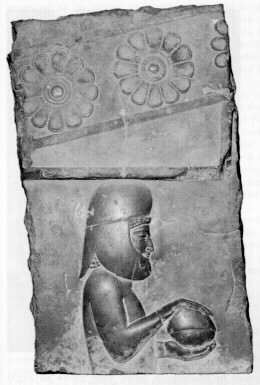 A TRIBUTE BEARER. A stone relief from Persepolis depicting a tribute bearer. The rosette pattern at the top of the relief was a popular motif in Persian art.
Artaxerxes II Mnemon (404-359), the next monarch, struggled through civil war, intrigues, assassinations, and a revolt by which Egypt gained her long-sought independence. When Artaxerxes III (358-338) assumed the throne, his able but ruthless approach brought the loss of provinces by rebellion to a halt and made possible the repossession of some areas previously lost. When provinces along the Mediterranean revolted, the Persian army, greatly strengthened by Greek mercenaries, attacked and destroyed a number of coastal towns, including Sidon, and opened the way for an attack on Egypt. About this same time, Philip of Macedon was uniting Greece, and now Greek armies, strengthened by Macedonian forces, were poised for world conquest.
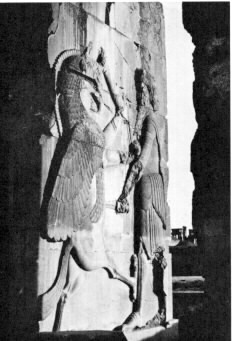 A CARVING IN A DOORWAY AT PERSEPOLIS portrays Darius the Great with the famous Persian short sword killing a winged monster. Whether or not there was cultic significance to this scene is not known, but perhaps it is meant to symbolize Darius’ defeat of demonic forces.
Artaxerxes III was murdered by a certain Bagoas, a eunuch, who exterminated most of the Achaemenid line before passing the kingship to Darius III Codommanus (335-331) because, as an imperfect man, Bagoas could not rule. Darius reconquered Egypt but was unable to withstand the tremendous military power of the new Greek-Macedonian forces led by Alexander the Great. Now the Hellenization of the Near East, already well under way, was to be greatly accelerated, as we will see in the next section on the Greeks. During the years of Persian rule walls were erected around the city of Jerusalem, largely through the efforts of Nehemiah. Some information about Jewish life in Egypt comes from the Elephantine papyri, which were written during the reigns of Artaxerxes I and his son Darius II (423-405).
MALACHI
The book titled "Malachi" is the last in the prophetic collection known as "The Twelve," or Dodecapropheton (see Chart I). Despite the opening words, the author is unknown, and the superscription was appended by an editor who believed the words "my messenger" ( mal’akhi) in 3:1 were a clue to the personal name of the prophet. The term translated "burden" or "oracle" ( massa’) in 1:1 appears also in Zechariah 9-14 and it has been suggested that the four chapters of Malachi which are a unity, were at one time gathered in a larger collection incorporating the chapters now appended to the work of Zechariah.
There are indications within Malachi that suggest it was a product of the first half of the fifth century, possibly from the time of Artaxerxes I. The temple had been rebuilt (3:1, 10) and Judah was under a governor (1:8). Complaints about poverty, poor harvests and locust plagues (3:6 ff.) which, according to Haggai, ought to have ceased with the completion of the temple, and inferences of disappointment because of the delay in the coming of the ideal kingdom (2:17 ff.), point to a period after 515. The discussion of "mixed marriages," which were ultimately forbidden by Ezra, suggests that his legislation had not yet been passed.
Malachi’s oracles are given in response to a series of questions, perhaps representing the give-and-take situation of the street orator. It appears that there were those who questioned current theological dogma, and in a manner similar to that employed by the wisdom school, argued from experience that prophetic utterances had been inaccurate.
Read Mal. 1:1-5
The book appears to begin in the middle of a discussion. The prophet has been asked, "What evidence is there that Yahweh loves his people?" His response drew upon history, past and present. In the choice of Jacob and the rejection of Esau, Yahweh had expressed his love (election). When the Babylonians came, Edom had escaped the devastation that came to Judah by quietly submitting to Nebuchadrezzar and rejoicing in the fall of Jerusalem (cf. Ps. 137:7; Lam. 4:21 f.). Now Edom was tinder pressure from the Nabataeans, a people that had formerly lived by preying on caravans and was now moving toward a settled mode of life.8 The Edomites, forced out of their homeland, migrated into the territory south of the Persian province of Judah, becoming the people known in later times as Idumeans. The Edomites were, according to Malachi, confident that they would recover, just as the Jews were recovering, but the prophet declares that their efforts would fail. The immediate and future problems confronting the Edomites were, for the prophet, evidence that Yahweh hated the descendants of Esau, just as the reestablishment of the Jews demonstrated divine love.
Read Mal. 1:6-2:9
The priests, accused of despising Yahweh, asked "What have we done?" The prophet’s response is an attack on the official cult and on the careless attitudes toward rules of purification and sacrifice, which reveal not only the priests’ indifference to liturgical responsibilities but deliberate attempts to defraud Yahweh (cf. 1:14). The prophet described the functions of the priesthood: to guard divine knowledge and to instruct the people in Yahweh’s way (2:7).
Read Mal. 2:10-16
When the prophet condemned those who divorced their Jewish wives to marry aliens, the offenders argued that because all mankind was created by one God, all were children of one father, so that it didn’t matter whether a woman was a Jewess or an alien (cf. Isa. 56:3 ff.). The prophet replied that divorce in itself was a violation of a covenant made before Yahweh, and marriage to one who worshipped another deity was violation of the Yahweh-Israel covenant.
Read Mal. 2:17-3:5
Those whom the prophet accused of wearying Yahweh asked "How?" The prophet described their mockery of Yahweh’s righteousness (2:17), and responded to the issue about theodicy with the belief, current in his time, that the Day of Yahweh was at hand.
Read Mal. 3:6-12
Yahweh’s call for the people to return was meaningless to those who believed they were fulfilling the law. But nonpayment of tithes and offerings robbed Yahweh, and the people were subsequently robbed as Yahweh failed to pour out material blessings.
Read Mal. 3:13-15
Those who challenged the accusation that they had spoken against Yahweh, were reminded of discouraging remarks about the futility of serving Yahweh.
Read Mal. 3:16-4:3
The prophet’s demand for reform prompted some to pay heed to his words, and the prophet issued a stern warning about the Day of Yahweh.
Read Mal. 4:4-6
Because Malachi was placed at the end of the collection known as "The Twelve," it was necessary to add a note to close the total collection. The three-verse colophon reminding the reader to observe Mosaic law included an interpretation of Mal. 3:1, in which the messenger who would prepare Yahweh’s way is identified as Elijah. According to II Kings 2:11, Elijah did not die but was miraculously transported to heaven in a whirlwind and was, therefore, capable of being sent back to earth to herald the Day of Yahweh.9
The book of Malachi is primarily concerned with the disintegration of cultic ritual and morals. The fact that the emphasis appears to fall more upon ritual underscores the importance of the temple and its cultus in the prophet’s thinking as well as the impact of the teachings of Ezekiel, Haggai and Zechariah.
OBADIAH
The Nabataean displacement of Edomites prompted another Judaean, Obadiah, to express his feelings. The bitter memories of Edomitic behavior during the Babylonian conquest are revealed in the stinging words of what can best be identified as a hymn of hatred.
The bulk of Obadiah is generally placed in the first half of the fifth century. References to the sacking of Jerusalem (vss. 1 ff.) and to the same disruption of the Edomites mentioned in Malachi suggest the post-Exilic period. The intense nationalism is characteristic of other writings from fifth century Judah. The similarity between vss. 1-9 and Jer. 49:7-22 has led some scholars to suggest that both prophets adapted a pre-Exilic and anti-Edom hymn to their own use.10 The late R. H. Pfeiffer dated the last three verses of the poem in the fourth century,11 but they can just as easily be placed in the fifth century and attributed to Obadiah.
Read Obad. vss. 1-21
The first nine verses of this poem mock the Edomites for the failure of their sources for security-remoteness, alliances, national strength. Now they have suffered a fate not unlike that which had come upon Judah in 586. According to Obadiah, the Nabataean attack was divine punishment for the role of the Edomites during the Babylonian conquest. Like other post-Exilic writers of this period, Obadiah believed that the Day of Yahweh was near when all aliens would suffer the wrathful punishment of the deity and only Judah would be saved to take possession of and rule in the new expanded kingdom. The fact that this poem was preserved probably indicates that it represented more than the view of a single individual and portrayed what was a rather common interpretation of events.
Endnotes
- R. A. Bowman, "Ezra: Exegesis," The Interpreter’s Bible, III, 571.
- A satrapy was a Persian administrative unit ruled by a satrap or governor.
- Cf. John Bright, A History of Israel, p. 343 where the identification is supported, and M. Noth, The History of Israel, p. 309, where the theory is dismissed.
- Cf. article on Sheshbazzar in The Interpreter’s Dictionary of the Bible.
- Cf. ANET, pp. 315 f.
- Cf. R. H. Pfeiffer, Introduction to the Old Testament, p. 480.
- For an excellent summary, cf. J. Muilenburg, "Isaiah, Chapters 40-66," The Interpreter’s Bible, V, 757-60.
- Cf. article on "Petra" in The Biblical World, C. F. Pfeiffer (ed.) (Grand Rapids, Michigan: Baker Book House, 1966), pp. 443 ff.
- Elijah subsequently became the forerunner of the Messiah, and in the New Testament both John the Baptizer (Luke 1:17; Matt. 11:14; 17:12f.) and Jesus (Mark 8:28; Matt. 16: 14; Luke 9:19) were identified as Elijah.
- R. H. Pfeiffer, Introduction to the Old Testament, p. 585; J. A. Thompson, "The Book of Obadiah: Introduction," The Interpreter’s Bible, Vl, 858.
- R. H. Pfeiffer, Introduction to the Old Testament, p. 586.
Old Testament Life and Literature is copyright © 1968, 1997 by Gerald A. Larue. All rights reserved.
The electronic version is copyright © 1997 by Internet Infidels with the written permission of Gerald A. Larue.