



Old Testament Life and Literature (1968)
Gerald A. Larue
Chapter 26 – The Great Documents of the Persian Period
NOW the second temple stood within the walled city of Jerusalem. Cultic rites, conducted by the Levites, included sacrifice, offerings, prayers and songs. Through the work of Ezra, the people had acquired a new understanding of the law of Yahweh and the nature of the covenant. We can assume that temple literature included scrolls of prophetic oracles, the combined JE epic, the Deuteronomic history and probably a collection of hymns, prayers and liturgical data.
Nevertheless new material was needed. The history of the monarchy, which had started in Solomon’s time and had been reworked by the Deuteronomist, had not been extended beyond the middle of the Exilic period. Now, in the Persian period, princes from the Davidic line had lost the privilege of government and the circumstances called for a new understanding and a new interpretation of the past. The author known as the Chronicler, whose writings include I and II Chronicles, Ezra and Nehemiah, accomplished the task of rewriting and updating the history.
As in Solomon’s time the J writer had combined creation mythology and election and salvation traditions, and as in Jeroboam’s day the E writer had done the same for the northern kingdom, now, in the light of the experiences of the Exile, a new interpretation of the combined JE sagas was needed. This need was met by the addition of the so-called P writings. The combined work was linked to the book of Deuteronomy to form the completed Torah.
The third literary effort in the period was necessitated by the completion of the temple and consisted of a collection of prayers and hymns or psalms designed for worship. The editor of the book of Psalms combined older collections, individual prayers and newer hymns into one massive unit for temple use, and this collection, together with some additions made shortly afterward, constitutes our present book of Psalms.
To these great literary works from the Persian period we will now turn, remembering that in every instance the writers or compilers made use of older materials. That which was added or omitted was part of an effort to keep relevant traditions that had meaning for the cult and the nation by concentrating on that which was seen to be central. In other words these writers in the Persian period engaged in the responsible task of continuing or progressive interpretation.
THE CHRONICLER
The Deuteronomic interpretation of the nation’s past did not go beyond the middle of the Exilic period. Now, in the post-Exilic era, it was deemed necessary to extend that account and to review history from the point of view of more recent theological developments. It has been argued that the Chronicler had no intention of rewriting the history of Judah, but only wished to draw lessons in a homiletic or midrashic1 fashion for the benefit of the community.2 However, in a sense, all history writing is interpretation, and we have noted that the Deuteronomic history was an interpretation of events in the light of the Deuteronomist’s "theology of history." The Chronicler continued this process from a somewhat different theological angle of vision.
It has been stated previously that the work of the Chronicler included I and II Chronicles and Ezra and Nehemiah. The arguments supporting this contention include the recognition of the flow of II Chron. 36:22-23 into Ezra 1:1-4 and the similarity of language, literary style, historical interest and theological outlook in the two books of Chronicles and Ezra-Nehemiah. In all documents the writer revealed his deep interest in that which pertained to the temple, the Levitical priesthood, temple singers and worship. There is a consistent emphasis on the importance of genealogies and statistics. Finally, the narratives provide a continuum despite the disrupted order of the Ezra-Nehemiah sequence, and present a unified statement of Jewish history up to the time of Ezra.3 The uniformity of language, style and outlook suggests that the entire work is the product of a single writer, one steeped in Jewish history and cultic life, perhaps a priest or scribe. The affinities of style and outlook between the Ezra memoirs and the work of the Chronicler, first noted by C. C. Torrey,4 have led a number of scholars, including W. F. Albright, to conclude that Ezra was the Chronicler.5
Whether or not one agrees that the Chronicler was Ezra there is growing accord among scholars that the writing is from the Persian period and that arguments for a date in the Greek period6 can be maintained only with the greatest difficulty. The language of the book is Hebrew strongly influenced by Aramaic and with numerous Persian terms characteristic of the Persian period but which tended to die out during the Greek era. The Aramaic section of Ezra employs the same vocabulary, idioms and spelling forms as the Elephantine papyri and is, therefore, from the same time. Furthermore, the last Persian king mentioned is Darius II (423-405), and the Davidic genealogy in I Chron. 3:10-24 is traced up to the seventh generation from Jehoiachin (598/586); allowing twenty-five years for a generation, we arrive at a date roughly between 420 and 400. It would appear that the Chronicler wrote about 400 or shortly thereafter.7
Like other early historians, the Chronicler drew on sources8 and some of these can be recognized. It is clear that he had before him copies of I and II Samuel and I and II Kings that were substantially the same as our present versions and that he did not hesitate to reproduce large portions of the earlier work.9 He drew also from the "memoirs" of Ezra and Nehemiah and from a long list of official documents which he identifies: "The Books of the Kings of Judah and Israel" (II Chron. 16:11; 25:26; 32:32) or "The Books of the Kings of Israel and Judah" (II Chron. 27:7; 35:27; 36:8), "The Book of the Kings of Israel" (II Chron. 20:34), and a source titled "The Midrash of the Book of Kings" (II Chron. 24:27). He used prophetic material now lost to us but attributed to Samuel (I Chron, 29:29), Gad (I Chron. 29:29), Nathan (II Chron. 9:29), Iddo (II Chron. 9:29; 12:15; 13:22) and an unknown prophet (II Chron. 33:19). He was fascinated by what he could demonstrate by genealogical tables (cf. I Chron. 1-9). These varied traditions were woven into a connected narrative covering history from Adam to Ezra. The entire work can be simply outlined as follows:
I Chronicles
Chapters 1-9, genealogical tables.
Chapter 10, the death of Saul.
Chapters 11-29, the Davidic period.
II Chronicles
Chapters 1-9, the Solomonic period.
Chapters 10-25, the Divided Kingdom up to Josiah’s reform.
Chapter 36, the Exile up to Cyrus’ edict.
Ezra-Nehemiah, from Cyrus’ edict to the restoration of the temple, city walls and Law.
Read I Chron. Chs. 1-9
The genealogical tables in the first section of I Chronicles provide tedious reading and may be drawn from a separate source. In their present position, they serve to introduce some of the Chronicler’s dominant interests, including Judah, the Davidic line, and the temple. The lineage of the first three chapters leads directly to David. In the following chapters, the Chronicler moves back to pre-Davidic time to trace family lines from Judah (ch. 4). With the exception of Levi and Benjamin, the remaining members of the twelve-tribe federation are rather quickly dismissed. Levi receives special attention because of the Levitical priesthood which stemmed from this group. Levitical priests, the Chronicler notes, attended and protected the ark of Yahweh in the pre-temple period, and Levitical functionaries were officially appointed and installed by King David and the seer Samuel (9:22). The superiority of the Levites to the Korahite priesthood, which appears also in the "P" material, is carefully noted (9:17-34).10 Moses, a Levite and the hero of the Deuteronomic history, is barely noted in passing and is called a "servant of God" (6:49). No reference is made to his leadership, for the Chronicler was interested in portraying David as the ideal leader. Benjaminite genealogy was important because it introduced Saul, the first king, whose reign served as a backdrop against which the entrance of David could be best understood (8:1-40; 9:35-44).
Read I Chron. Ch. 10
Saul’s story begins in the midst of the final battle between the Israelite king and the Philistines and is taken from I Sam. 31. Because of a lack of interest in pursuing any details of the family of Saul, the Chronicler records that Saul’s entire house was killed. It is now unnecessary for him to admit any challenge to David’s rule by members of Saul’s family. A theological judgment was added, explaining the unfitness of Saul to reign (vss. 13-14).
Read I Chron. Chs. 11-29
Nothing was drawn from the record in II Sam. 1-4 concerning David’s mourning for Saul and Jonathan, and the Chronicler moved immediately to the account of David’s crowning at Hebron and the conquest of Jerusalem (from II Sam. 5). The list of David’s heroes in 11:10-41 is the same as II Sam. 23:8-29, but supplemental material in 11:42-12:40 comes from some unknown source. The Chronicler selected what he wished to use, combined different sources and altered the order of presentation as he saw fit.
In general, the account of the removal of the ark to Jerusalem follows that of II Sam. 5:11 ff., but the Chronicler stressed cultic problems and added new elements. Levites alone handled the ark, the entire nation participated in the act of moving the sacred symbol and Levitical choristers and musicians led the procession and guided the offerings, sacrifices and communal sharing of food. Psalm 105:1-15 is quoted as the official hymn for the ceremony. By comparison, the II Sam. ceremony appears crude and unorganized. The Chronicler’s description is of a dramatic ceremonial, carefully planned and executed, and is perhaps based upon accurate, though somewhat idealized knowledge of temple ritual.
Succeeding chapters leading to Solomon’s rule draw heavily upon the older history, and, in accordance with the Chronicler’s intention of exalting David, omit significant details. No mention is made of David’s illicit relationships with Bathsheba nor of his part in the disposal of Uriah. There are no hints of such unhappy situations in the Davidic household as the rape of Tamar, the murder of Amnon, or Absalom’s attempt to seize the throne. The sin of David in numbering Israel is recorded, but the Chronicler said that this was done at the instigation of Satan (21:1). For the first time the word "Satan" is used as a proper name without the definite article, and Satan’s role is that of a tester or tempter of men, much like that ascribed to him in the prologue of Job. There is no suggestion that Satan is acting as the emissary of Yahweh, but on the other hand, there is no hint that he has assumed the role he was to occupy in later literature as the adversary of the deity.
According to the Chronicler, David selected the site, drew the plans, supervised the selection and preparation of materials, and organized the labor for the building of the temple, and by divine lot he established the orders of the priesthood (chs. 22-28). Every decision, every act is presented as though it was executed in an orderly manner and without problems. With pious solemnity, David is made to counsel his son Solomon and inform and bless the assembly (28:20-29:22). Solomon’s ascent to the throne at David’s death takes place smoothly. The Chronicler has succeeded in presenting as impeccable an account of the Davidic monarchy as is possible.
Read II Chron. Chs. 1-9
The story of the construction of the temple (chs. 1-7) follows the earlier account but with some interesting additions. Along with the ark, the tent of meeting is placed within the sanctuary (5:5). Levitical singers and musicians participate in the installation rites (5:12 f.) and Psalm 132:8-10 and the refrain "for his steadfast love endures for ever" which occurs over and over again in Psalm 136, are chanted (ch. 7). The unblemished history of the kingdom is continued and Solomon’s career, like that of his father, appears perfect. The catalogue of sins in I Kings 11:1-8 is omitted.
Read Chs. 10-25
Except for an almost complete ignoring of the northern kings, the Chronicler followed the Deuteronomic record in I and II Kings. New information is added, the most important details of which are listed below. Some additions are best understood when both the Deuteronomic history and the work of the Chronicler are consulted.
- A list of cities fortified by Rehoboam is given (II Chron. 11:5-12, cf. II Kings 12).
- The Chronicler notes the flight of Levitical priests from Israel to Judah when Jeroboam I installed his own cult functionaries (11:13-17).
- Details about the household of Rehoboam are provided (11:18-23).
- There is more information about the Shishak invasion (II Chron. 12:58, cf. I Kings 14:25-28).
- The battle between Israel and Judah in the time of Abijah is given in an extended version, and a long interpretive speech in which victory is explained by virtue of Judah’s loyalty to Yahweh is attributed to Abijah (II Chron. 13:3-21, cf. I Kings 15:1-8).
- The Asa tradition is enlarged by an account of the defeat of Ethiopian invaders. The Chronicler’s interpretation of events is given through speeches by Azariah the prophet and in the condemnatory speech by a seer which follows the record of the struggle with Baasha of Israel (II Chron. 14-16, cf. I Kings 15:9-33).
- The image of Jehoshaphat is heightened and the king is pictured as one to whom homage was paid by surrounding nations, and as an ideal spiritual leader who commissioned the Levites to take "the book of the law" to the communities of Judah (II Chron. 17-19, cf. I Kings 22).
- The lengthy accounts of the prophets Elijah and Elisha in the Deuteronomic history are omitted by the Chronicler because these are northern prophets and Elijah appears in the post-Exilic history only as the writer of a letter condemning Jehoram for apostasy (21:12-15).
- Uzziah’s leprosy is explained as a punishment for the violation of a cultic taboo (26:17 ff.).
- The story of King Hezekiah is expanded by a tradition which records the monarch’s attempt to convert the northern kingdom to the true religion as expressed in Judah. Once again the role of the Levites is stressed (chs. 29-32).
- The Chronicler was troubled by the long life of the wicked king Manasseh. According to theological dogma, he should have died early for his evil ways. The Chronicler explained the extensive life span by noting that Manasseh repented and was forgiven by Yahweh (33:1-13). The blame attached to Manasseh for the Exile in II Kings 21:10 ff. and Jer. 15:4 is nowhere apparent.
- Josiah’s reform is made to begin before the discovery of the law scroll.
The list could be extended, but most of the remaining material follows the outline of II Kings.
Read II Chron. Ch. 36
In the last chapter, the Chronicler follows the II Kings account and terminates the section with the edict of Cyrus providing for the restoration of the Jewish community.
Read Ezra-Nehemiah
Most of the material in Ezra-Nehemiah has been discussed.
The Chronicler had specific reasons for the omission of certain details of Judah’s history. Wherever possible, he sought to build up the reputation of the Davidic line and therefore left out that which might deprecate the Judaic kingship. The same purpose seems to have determined what he chose to include and emphasize. His determination to concentrate upon Judah, Jerusalem, the temple and its cult, the Levites and the musicians explains why these themes appear over and over again in details added to the Deuteronomic history. The northern kingdom had forsaken Yahweh and had been destroyed. During the Persian period, Yahweh’s community was where the Chronicler believed it had always been-in Judah with Jerusalem and the temple at its center. Because the Davidic line probably was no longer central in Jewish politics when the Chronicler wrote, he tied David and the Davidic line to the cultus, which was central. Thus, David became the embodiment of the ideal spiritual leader, and the people of Judah are portrayed as a worshiping community, bound to Yahweh by the covenant.
There is no doubt in the Chronicler’s mind that something unique was at work among the Jews. Their religion was the true one and no other, including the Samaritan cult, was genuine. It was through this sense of exclusiveness, of being chosen and redeemed by Yahweh, that was so characteristic of the Persian period, that certain groups within Judaism were to be able to maintain their identity despite the efforts of some to syncretize the faith in the dark days that were to come.
P
During the Persian period toward the close of the fifth and the beginning of the fourth centuries, the last major contribution was made to the Pentateuch. It has already been noted that the accumulation of priestly lore had been taking place in Babylon during the Exile. Now this process came to an end and the results were woven into the previously combined JE saga and into Deuteronomy.
In its final form, P gives an impression of homogeneity and, to some degree, appears to be a narrative paralleling JE. On the other hand, as we also noted earlier, in certain instances P seems to be no more than a series of small additions to the JE story which give the completed narrative an entirely new emphasis or coloration. In P, the process of progressive or continuing interpretation can be seen.
It is occasionally said that P is what remains when J, E and D are removed from the Torah, but the P editor had his own distinctive style, and the completed Torah reveals the fruits of his carefully worked out systematization and theological interpretation of the past. Broadly speaking, P can be distinguished from the other sources of the Pentateuch by an easily recognized characteristic language, literary style and theological outlook. Like J, P refers to the holy mountain as "Sinai," and, as in E, the name Yahweh is avoided until it is revealed to Moses. There is a strong emphasis on the gathered people of Israel as a "congregation" (see Leviticus). P avoids the covenant terminology of JE and D ("to cut a covenant") because the language was employed for both secular and divine agreements. In P, Yahweh "establishes" (Gen. 6:18; 9:9, 11; 17:7, etc.) or "grants" (Gen. 9:12; 17:2, etc.) covenants.11
P’s style tends to be stiff and stilted in contrast with the flowing narrative form of J and E. As in D, once a phrase has been accepted it is used over and over again. This characteristic may be seen in the creation account in Gen. 1 in the repetitive use of "and God said," "and it was so," "and there was evening and there was morning," "and God saw that it was good." At the same time the repetition conveys to the listener or reader a sense of order, balance, dignity and weight, quite appropriate to the content. It is conceivable that the formal style of P reflects cultic settings and liturgical usage, where mnemonic devices and schematic arrangements might be expected, and where repetition served to reinforce the significance of traditional language. Genealogical tables are usually introduced by the stereotyped phrase "these are the generations of," but, as we shall see, these tables do more than give the priestly material a sense of orderly development; they are carefully designed to carry the reader from the universal to the particular, from mankind in general to Israel in particular. The schematic, formalistic presentation, the noting of minute details and the recurring use of literary formulae that can be discerned readily in English translation aid the reader in separating the P source.
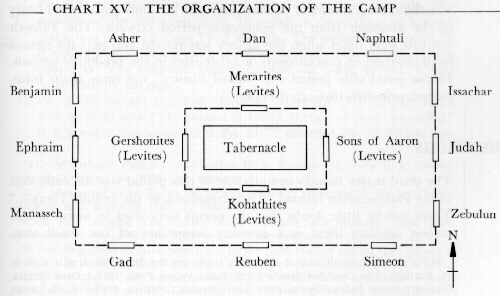
Insofar as possible, P moved away from depicting Yahweh anthropomorphically. There are notable exceptions: man is made in God’s image (Gen. 1:26 f.; 5:1; 9:6) and after the six days of creation God rested (Gen. 2:2) and was refreshed (Exod. 31:17). P’s emphasis is on the transcendence of God, and he stresses the distance between God and man and between the sacred and profane. Yahweh’s revelation is through his glory ( kabod) as in Ezekiel, but the kabod is veiled in a cloud (Exod. 24:15 ff.). Other theophanies or manifestations are drawn with minimal descriptions (Gen. 17:1 ff.; 35:9 ff.; Exod. 6:2 ff.). The transcendent deity is approached through the mediation of cultic ritual and cult functionaries. Cultic patterns are prominent, and even narrative portions relate to the cultus: the creation story leads to the establishment of the Sabbath (Gen. 2:2 f.), the flood account to the prohibition of eating flesh with its blood (Gen. 9:4), and the Abrahamic covenant to circumcision (Gen. 17:10 ff.). Clear-cut rules for sacrifice, for distinction between clean and unclean food and for festal observances, underscore the importance of the cult in maintaining the binding relationship between God and man. Consequently, the priests come into prominence as mediators. In the idealized portrayal of the desert period, the tent sanctuary of Yahweh is walled off from the people by priests and Levites who symbolically stand between God and the people (Num. 2). Yahweh speaks to Moses and Aaron, not to the people, and after the demise of these two heroes of the faith there is no further direct communication. Throughout P there is no hint of the reality of other gods, for between the final editing of P and the other contributions to the Torah were the experience of the Exile and the teachings of Deutero-Isaiah. No altar is recognized but that in Jerusalem. The image of the nation is that of a community of worshipers linked to Yahweh through the cult, its institutions and the clergy.
Within P there are clues that indicate that the final product was the result of editing and selection, perhaps done by one person. There are passages in disagreement, interruptions in continuity and isolated blocks of material. Num. 4:23 ff. states that the age for Levites to begin temple service is thirty years, but Num. 8:24 says twenty-five years. Aaron, as high priest, and only those of his descendants who succeeded him in office are anointed in Exod. 29:7, 29, and Lev. 4:3, 5, 16, recognizes only one anointed priest; but according to Exod. 28:41 and 30:30, Aaron and his sons are anointed implying that all Aaronic priests and not just the high priest were anointed. It would appear that traditions with slight differences were combined.
Distinct units of literature may be recognized within the opening chapters of Leviticus. The first seven chapters deal with sacrifice; Chapters 8 to 10 suddenly turn to the rituals at Sinai; Chapters 11 to 15 consider problems of cultic cleanliness and uncleanliness. The links between these units are weak, and it can be readily seen that small collections of priestly instructions have been combined;12 there is also evidence of even smaller units within the collections. There have been some attempts to trace threads of sources running through P, but these efforts are far too detailed for discussion here and would not be particularly rewarding.13
Scholars usually place the time of the compilation of P in the post-Exilic period14 for a number of reasons. In the writings of II Isaiah, Haggai, Zechariah and Malachi there is no presupposition of the teachings found in P. J and E knew of many cult places, and D sought the elimination of all but that in Jerusalem, but P assumes that the only cult center was at Jerusalem, and is, therefore, at the end of this line of development. On the other hand, some parts of P appear to be pre-Exilic. Certain cultic terms are the same as those found in the temple literature of Ugarit (twelfth to fourteenth centuries), and some of the ceremonial regulations may be drawn from pre-Exilic ritual. Therefore, P contains both pre-Exilic and post-Exilic literature which, merged with JED, constituted a reinterpretation of these previously combined writings.
The identity of the final editor or compiler is not known, but it can be assumed that he was a priest. Ezra has been put forth as a possible candidate, and it is suggested that P was the law that Ezra interpreted and imposed on the people. Unfortunately, these hypotheses cannot be confirmed.
STRUCTURE OF P
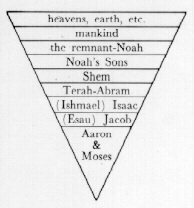 P gives the Pentateuch its chronological framework. Simply stated, the structure of P consists of a development from the general to the particular, from man in general to the chosen of Yahweh in particular, from Yahweh the creator of the world to Yahweh the God of the Jews. The theme may be diagrammed in a number of ways. In the first sketch, God’s narrowing interest is portrayed, beginning with the created heavens and earth, then moving to man (generic), narrowing to Noah and his son Shem (the father of Semites) and to a single family leading to Abraham. Finally, single sons are chosen, and ultimately Jacob, who becomes Israel. Within the family of Israel, Moses and Aaron are singled out as the greatest individuals.
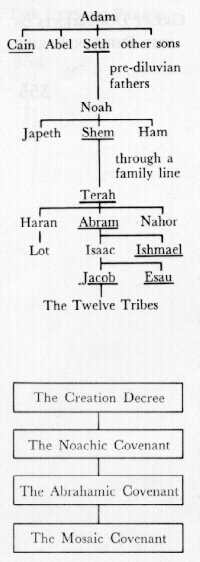 Another chart can be constructed from the genealogical tables.15 Starting with Gen. 5 and the descendants of Adam, the first man, the line is traced through Seth to Noah. Noah’s descendants are listed in Gen. 6:9-10 and Gen. 10. From Shem, the line is traced to Abram (Gen. 11:10 ff.) and with Abram a break with the locale of the past takes place and the lineage becomes Palestinian-centered. The chosen people do not descend from Ishmael, Abram’s first-born by the Egyptian maid Hagar (Gen. 16:3, 15-16; 25:12 ff.), but from Isaac (Gen. 21:3-5; 25:19 ff.), and not from Esau, Isaac’s firstborn (Gen. 36), but from Jacob (Gen. 35:22b-29). The rejection of the first-born can only be explained as God’s free choice (election).
A third diagram, expressing the deepening relationship between Yahweh and his creatures, and beginning with mankind in general and ending with the Hebrews, centers in covenantal relationships. Having created mankind, God decreed that man should have plants for food and should exercise dominion over the animals. When man failed in his responsibilities, God began the human family anew in the chosen line of Noah and made a covenant promising that the new human line would never again perish by floods (Gen. 9:8ff.). In Abraham, God narrowed his choice and made a new covenant embracing only the Abrahamic family and promising nationhood. The Mosaic covenant included only the descendants of Jacob and bound the twelve tribes to Yahweh. At Sinai the most important revelation was given, for here was given the cultic legislation that provided the continual link of the chosen people with Yahweh. The creation decree and the Noachic covenant are general, affecting all mankind. The Abrahamic and Mosaic covenants are particularistic.
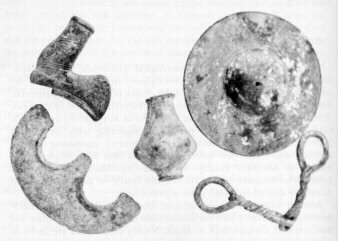 BRONZES FROM PERSIA. These items from Luristan in the Zagros mountains come from tombs dated between 600 and 1000 B.C. The bit in the upper left hand corner indicates that the horse was used. The disc immediately below is a shield boss which was probably mounted in the center of the shield, and the indentation barely visible on the lower edge may have been made from the blow of an axe similar to the one shown in the lower right hand corner. The item in the center is a mace-head, a most formidable weapon. The epsilon-axe blade shown at the upper right was attached to a handle by rivets on the three inner tangs which have long since become oxidized and broken off.
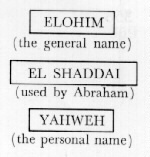 The different divine names used by P signify a development in divine revelation. At first, P used the general designation "Elohim" for the deity. With Abraham, the name "El Shaddai" is introduced and used along with Elohim. The revelation of the personal name "Yahweh" at Sinai was reserved for the chosen people. The use of divine names by P, once again, provided the Jews with a sense of the uniqueness of their divine-human relationships.
The recognition of P’s schematic arrangement of the Torah traditions reveals P’s understanding of Yahweh’s historic relationship to his people. In the final revelation given at Sinai, the significance of the cult in maintaining the binding covenant and in expressing the meaning of election is portrayed.
|
THE P SOURCE
|
|
| From Creation to Noah | |
| Gen. 1:1-2:4a | Creation in seven days. |
| Gen. 5:1-28, 30-32 | Genealogical table from Adam to Noah. |
| The Noah Cycle | |
| Gen. 6:9-22; 7:6, 11, 13-16a, 17-21, 24; 8:1-2a, 3b-5, 13a, 14-19 | Noah and the flood. |
| Gen 9:1-17 | The Noachic covenant (the rainbow). |
| Gen 9:28-29 | The death of Noah. |
| Gen 10:1-7, 20, 22-23, 31-32 | Genealogy of the sons of Noah. |
| The Abraham Cycle | |
| Gen 11:10-27, 31-32 | Genealogy from Shem to Abram. |
| Gen 12:4b-6 | Abram goes to Shechem. |
| Gen 13:6a, 11b, 12a | Editorial expansions. |
| Gen 16:3, 15-16 | The birth of Ishmael. |
| Gen 17:1-27 | The Abrahamic covenant (circumcision). |
| Gen 19:29 | The rescue of Lot. |
| The Isaac Cycle | |
| Gen 21:1b, 2b-6 | The birth of Isaac. |
| Gen 23:1-20 | The death and burial of Sarah. |
| Gen 25:7-1la | The death and burial of Abraham. |
| Gen 25:12-18 | The Ishmaelites. |
| Gen 25:19-20, 26b | Isaac’s descendants. |
| Gen 35:27-29 | The death of Isaac. |
| The Jacob Cycle | |
| Gen 27:46-28:9 | A wife for Jacob. |
| Gen 31:18 | Jacob leaves Laban. |
| Gen 34:1-2, 4, 6, 8-10, 14-17, 20-24, 27-29 | The rape of Dinah. |
| Gen 35:9-15 | Jacob at Bethel. |
| Gen. 35:22b-26 | The sons of Jacob. |
| Gen. 49:28-33 | The death of Jacob. |
| Gen. 50:12-13 | The burial of Jacob. |
| The Esau Cycle | |
| Gen. 26:34-35 | The wives of Esau. |
| Gen. 36 | The Esau genealogy. |
| The Joseph Cycle | |
| Gen. 37:1-2 | The identity of Joseph. |
| Gen. 46:6-27; 47:27-28 | Israel in Egypt. |
| Gen. 48:3-6 | The promise to Joseph. |
| The Moses Cycle | |
| Exod. 1:1-5, 7, 13, f.; 2:23b-25 | Israel in Egypt. |
| Exod. 6:2-13 | The revelation of the divine name. |
| Exod. 6:14-25 | Genealogical table. |
| Exod. 6:26-7:13, 19-20a, 21b-22; 8:5-7, 15b-19; 9:8-12, 35b; 11:9-10 | Moses, Aaron and Pharaoh. |
| Exod. 12:1-20, 28, 43-51 | The institution of the Passover. |
| Exod. 13:1-2 | The law of the firstborn. |
| Exod. 13:20; 14:1-4, 8-9 | Pursuit in the wilderness. |
| Exod. 24:3-8, 15-18a | The covenant ritual. |
| Exod. 25 | The ark of testimony. |
| Exod. 26 | The tabernacle. |
| Exod. 27 | The altar. |
| Exod. 28-29 | The priesthood. |
| Exod. 30-31:18a | The incense altar and other furnishings. |
| Exod. 34:29-35 | Moses descends from Mt. Sinai. |
| Exod. 35-40 | The building of cultic items. |
| Lev 1:1-7:38 | Rules governing making of offerings. |
| Lev 8:1-36 | The ordination of Aaronic priests. |
| Lev 9:1-24 | Aaron as high priest. |
| Lev 10:1-3 | The sin of Nadab and Abihu. |
| Lev 10:4-11:47 | Separation of clean and unclean. |
| Lev 12 | Laws of cleanliness pertaining to women. |
| Lev 13-15 | Laws of health and ritual cleanliness. |
| Lev 16 | The scapegoat and the atonement ritual. |
| Lev 17-26 | The "Holiness Code." |
| Lev 27 | Rules concerning vows and tithes. |
| Num 1-4 | Census taking. |
| Num 5 | Testing by the waters of bitterness. |
| Num 6 | Regulations covering the Nazirite. |
| Num 7 | Offerings at the tabernacle. |
| Num 9 | The purification of Levites. |
| Num 8 | Rules for Passover. |
| Num 10:1-28, 33-34 | The departure from Sinai. |
| Num 13:1-17a, 21, 25-26a, 27 | Spying out Canaan. |
| Num 14:2, 5-10, 33-38 | The forty-year sentence. |
| Num 15 | Laws concerning offerings. |
| Num 16:2b-11, 16-24, 35-50 | Korah’s rebellion. |
| Num 17-18 | Aaronic and Levitical priests. |
| Num 19 | Purification rituals. |
| Num 20:22-29 | The death of Aaron. |
| Num 21:10-13, 19-20, 31-32; 22:1 | Israel in Moab. |
| Num 25:6-18 | Thwarting of intermarriage with Midianites. |
| Num 26 | Moses takes a census. |
| Num 27:1-11 | Inheritance laws. |
| Num 27:12-23 | Joshua is commissioned. |
| Num 28-29 | Festal offerings. |
| Num 30 | Rules governing vows. |
| Num 31 | Vengeance on Midian. |
| Num 32:6-15, 18-19, 28-33 | The settling of Reuben and Gad. |
| Num 33 | Recapitulation of Israel’s journey. |
| Num 34 | The boundaries of the promised land. |
| Num 35 | Cities of refuge. |
| Num 36 | Inheritance rules. |
| Deut. 32:48-52; 34:la, 7-9 | Moses on Mount Nebo. |
Read Gen. 1:1-2:4a
The priestly creation myth presupposes a pre-existent watery chaos out of which the cosmos was formed,16 and thus from its opening reveals an affinity with the Babylonian Enuma elish. The order of creation parallels that of the Babylonian myth: the firmament, dry land, the luminaries and man.17 In the Babylonian account, the gods rest and celebrate at the conclusion of their work, and in P, God rests and sanctifies the Sabbath. Although it is not possible to prove direct borrowing from the Babylonian myth by the Jewish writer, there can be no denying the close relationship between the accounts. Since Hebrew ancestry is traced to Mesopotamia through the patriarchs and as we have noted, the Babylonian Exile left deep imprints on Jewish thought, it is relatively easy to understand the common interpretation of the nature of the cosmos and to postulate a common source for the stories. It is usually conceded that the P account probably existed in the pre-Exilic period, although this idea is open to debate.
The differences between the P myth and the Enuma elish are as marked as the similarities, demonstrating a different handling of the basic material because of different theological convictions. The P account is monotheistic (despite the plural possessive form of 1:2618, which may be addressed to the "court of heaven") and lacks the patterns of divine strife and social upheaval of the Babylonian myth. In P, God creates by fiat without battle,19 although the term "created" in 1:1 (Heb: bara’) may be interpreted as implying "fashioning by cutting" and thus reflect the same division of the basic stuff of the cosmos as Marduk’s splitting of Tiamat, and the Hebrew word for "deep," tehom, in 1:2 has affinities with Tiamat, the Babylonian symbol of chaos. The Jewish story is climaxed with the creation of the Sabbath (the final verse, 2:4a, should probably be placed at the beginning of the account).
There are striking differences between the J and P accounts in the order of creation, and these can readily be seen in the following chart:
|
|
| light | heaven and earth |
| earth and seas | man |
| vegetation | a garden |
| luminaries | |
| fish and birds | animals and birds |
| land animals | woman |
| man and woman | |
| the Sabbath |
The primeval harmonious relationship between primordial man and animals found in J and in the Babylonian story of Gilgamesh20 is reflected in P. The first man does not eat animals, but has a diet restricted to vegetable products (1:29), and only after the flood is man permitted to eat animal flesh (Gen. 9).
The cosmology of P was discussed earlier. The shell of the firmament (a hard substance) holds back the cosmic waters that would ordinarily flood the space between earth and sky. The lack of critical analysis of natural phenomena enabled the writer to envision day and night existing before the creation of the sun, moon and stars. Eight creative acts take place in six days. The pattern of "days" probably does not reflect great time periods, but perhaps refers to specific days during the New Year Festival on which symbolic rites were performed, just as in the Babylonian Akitu festival.
Read the Noah Cycle
Ten heroes span the period between the creation and the flood (Gen. 5).21 Much of the P contribution to the already existing J story of the flood consists of small details pertaining to the structure of the ark, the age of Noah and similar minutiae. Other additions are more significant. For P, the flood comes as a punishment for wickedness, and Noah’s role is clarified as the remnant in which hope is placed for the future. The emergence of land after the flood waters cease mirrors P’s creation story, for, as in Gen. 1:2, the movement of the "spirit" or "wind" (Heb: ru’ah) causes the waters to subside and the earth to reappear (8:1) for the new beginning of the story of mankind. With the new start came new decrees to all living creatures to multiply (8:14-16), and to Noah, as a symbol of the new man, to include animal flesh in his diet. The relationship between man and animal that enabled them to live harmoniously in the microcosm of the ark was past. The Noachic covenant guaranteed that the earth would never again be covered by flood waters, and the symbol of that covenant, the rainbow, served two purposes: as a sign of the covenant for man, and as a reminder to God of his promise.
Read Gen. 17
Most of P’s contributions to the Abrahamic cycle are minor, but Chapter 17 is very important. God’s relationship to Abraham is now set in covenantal form with the sign of the covenant being circumcision. Failure to be circumcised excluded the Jew from the holy community, and even Abraham, at the age of 99, was circumcised.
Read Gen. 22:1-20; 25:7-11a
At the opening of the Isaac cycle, P noted that Abraham circumcised Isaac when the child was eight days old, in conformity with the Abrahamic covenant (17:9 ff., cf. 21:4). Details were added about Sarah’s death and burial (Gen. 23). The conversation with the Hittites may accurately reflect polite forms of speech utilized in business transactions. P added extra details about the death and burial of Abraham.
Read Gen. 27:46-28:9
P explained that Jacob’s visit to Laban was to acquire a wife and to keep the family line clear of foreign ties, and was not, as J had suggested, to escape from Esau (cf. Gen. 27:43-45). Esau, in an effort to please his parents, also chose a wife among his kin-folk, from the Ishmaelitic line (28:8 f.). New details and genealogies were added to the Jacob account, and new information revealed about the burials in the cave purchased by Abraham was attached to the Joseph traditions (49:28-33; 50:12-13).22
P had a separate tradition of the revelation of the divine name to Moses and, as we have noted, introduces a new dispensation with this revelation. The patriarchal covenantal promise was about to be realized and the new covenant that would govern future relationships about to be given. Aaron, as the prototype of the high priest, is depicted as the interpreter of Moses and the agent of God (Exod. 6:28-7:1, 8-13). The tradition of the plagues is heightened, ritual acts are described and new details are provided for historical-cultic observance of the Passover (Exod. 12:1-20, 43-49).
The covenant ceremony (Exod. 24:3-8, 15-18) adds ritualistic details and blood sacrifice to the rather simple J ceremony and no doubt reflects some aspects of the annual covenantal recital observed in the temple. Following the covenant rituals, cultic ceremonies and equipment are discussed, and since for P the cult is the means of maintaining the relationship between Yahweh and his people, details of rites, costumes and accessories are provided by Yahweh. Each item utilized in temple ritual is given a divine origin. The tabernacle or tent of meeting, which in P becomes a fully developed sanctuary, is made of materials more easily obtained in a developed, settled society than in a wilderness setting.23 When the ark of the covenant was built (and P’s description indicates that it is a most ornate structure), the tablets of law were placed within it and the ark was set within the completed tabernacle in a spot corresponding to its location in the Solomonic temple. The primitive tent-sanctuary became, in P, an elaborate portable temple, the idealized magnificence of which was drawn from aspects of the completed temple.24 To imagine the Hebrews carting a structure of this magnitude and complexity about the desert staggers the imagination. The details concerning the priests, priestly apparel and priestly responsibilities do not suggest a wilderness setting either. Indeed, it is possible that in the case of the high priest the various costumes result from a combination of older literary sources in P so that articles of dress come from different historical periods.25
The expansion of cultic and liturgical themes in the book of Leviticus is far too detailed for consideration here, but the analysis of the contents listed above suggests the main themes. In the midst of the discussion of the clean and unclean in the Holiness Code, one of the most significant statements of human relationship in the Bible is found: "You shall love your neighbor as yourself" (Lev. 19:18). Although the major thrust of P’s writings is God-man relationships in a cultic setting, rules for human conduct punctuate the liturgical concerns or are related to ritual (cf. Lev. 6:1-7; 19:9-18).
One of the central cleansing rituals is that for the Day of Atonement26 which provided for Aaron’s (the high priest’s) annual entry into the debir, the holy of holies of the tabernacle or temple. Rites of cleansing for the high priest and the priesthood prepared Aaron, followed by atonement rituals for the temple or tabernacle. Finally, the nation’s sins were purged. The first ritual required the sacrifice of a bullock, which prepared the priest for entry into the presence of the deity. In the second rite, one of two goats chosen by lot was killed, and in the third the sins of the nation were confessed over the second goat and the sin-burdened animal taken into the wilderness to be destroyed, sins and all, by Azazel, presumably a wasteland demon.27 The high priest then reentered the hekal or holy place to bathe and change clothing before returning to the altar in the courtyard to offer sacrifice. It is generally believed that the ritual is post-Exilic, for it is not mentioned in pre-Exilic literature,28 and the impact of the Akitu festival can be recognized in the expulsion of the sin-bearer, here a goat rather than a man. The significance of the rite in providing a complete purging of sin for the nation and permitting an annual new beginning is not to be underestimated. In its present location, it forms a fitting prelude to the Holiness Code, which we have discussed earlier.
Details of camp organization are set forth by P (Num. chs. 2-3). The tabernacle is at the center and is surrounded by orders of Levites. The twelve tribes form a protective ring, with Judah in the favored position on the east, the side of the rising sun (see Chart). Other regulations, including those for testing the virtue of a wife by a jealous husband, and those for persons who become Nazirites, follow (Num. 5-6). Some regulations extend information previously provided (Num. 8, cf. Lev. 8). Provisions are made for a supplementary Passover to accommodate those defiled at the time of the regular observance (Num. 9). Ultimately, the Hebrews left Sinai and prepared for the invasion of Canaan, only to be sentenced to a forty-year desert sojourn because of lack of faith (Num. 14:26-38).
 The seriousness of observing ritual law is exemplified in the story of the Sabbath-breaker (Num. 15:32-36), and perhaps also in the Korah tradition (Num. 16). Events leading to the arrival at the border of the promised land are sprinkled with further legislation strengthening the role of the Levites, guarding the sanctity of the theocracy envisioned by P, or governing human rights and relationships.
TORAH AND CULT
With the addition of P the Torah assumed its final form. Exactly when the point was reached after which no further changes or additions were made cannot be known, but it is not unreasonable to suggest that this occurred before the end of the Persian period (fourth century). Nor is it possible to determine the immediate use of the Torah in the temple cult. However, in time the Torah was given a lectionary form, so that a portion was designated for reading each Sabbath and the entire Torah would be read through in a three-year period. In this manner the theologized history of Israel was constantly recited to the worshipers, and the laws of the holy congregation or nation were made known and sacred festivals interpreted. Proper conduct of temple ritual was derived from the Torah, including everything from priestly responsibilities and dress to proper modes of offering and sacrificing.
It must be assumed, on the basis of the extensive library from the last century of the pre-Christian era and the first half century of the Christian era found at Qumran on the shores of the Dead Sea,29 that copies of the Torah were reproduced in quantity for study in temple schools, as well as for private study.30 The use of the Torah in the temple and the distribution of copies could only serve to freeze the traditions and to establish firmly temple traditions. On the other hand, study of the Law opened the way for discussions of the implications of Torah teachings at all levels of life. This is not to suggest that everyone followed the Law diligently, but rather that the Law tended to enter more and more into everyday life and at the same time played a central role in the cultus. It is, therefore, quite clear that the cultus was the central means of preservation and transmission of the history of the kingdom from the Solomonic period onward. The Yahweh festivals were times when the history was recited and perhaps mimed or dramatized in processionals or other rites in the pre-Exilic periods. In the post-Exilic period the "sacred history" was once again transmitted, primarily through the cult.
THE PSALMS
The third major literary compilation of this period was the collection of the Psalms, often labeled "The Hymnbook of the Second Temple." There can be little doubt that the poems were used in worship, and among scholars there is a growing acceptance of the thesis that, although many Psalms may be post-Exilic, some are of pre-Exilic origin.31 The numerous authors listed in the superscriptions suggests the composite nature of the book, for one psalm is ascribed to Moses (Ps. 90), seventy-three to David (eighty-three in the LXX), twelve to Asaph, a choir leader (Pss. 50; 73-83), one to Ethan, a leader in the temple singers’ guild (Ps. 89), ten to Korah (Pss. 42-49, 84, 85, 87), two to Solomon (Pss. 72, 127), one has a double title (Ps. 88), and fifty are undesignated.
The Hebrew title for the collection, tehillim, comes from a root meaning "to shout" ( hll), so tehillim implies "raising the shout."32 The familiar hallel-u-yah, generally translated "praise (ye) Yahweh," means "raise the (jubilant) shout: ‘Yah (weh)’"33 and helps to convey the idea of the psalms as "songs of praise"-an interpretation that fits some. The term "psalm" comes from the Greek word psalmos, which meant the twanging or sounding of chords on a musical instrument, and was the term used by the LXX translators for the Hebrew word mizmor, which seems to have signified a song or hymn sung to the accompaniment of a stringed instrument. The word "Psalter," which is often used to designate the collection comes from the Greek word psalterion meaning "a stringed instrument." These last titles imply that some psalms were sung and accompanied by instrumental music.
There is evidence of liturgical usage in some of the psalms. For example, the "Egyptian Hallel Psalms" (Pss. 113-118) are used at Passover, and the "Songs of Ascent" or "Songs of Going Up" (Pss. 120-134) may be pilgrim hymns. The division of the Psalter into five sections appears to be the work of the final editor who deliberately imitated the five-fold division of the Torah, ending each section with a doxology:34
- Pss. 1-41 are called "Psalms of David," for most bear this title. The omission of the ascription in Ps. 10 is due to the division of a single psalm into two parts (now Pss. 9 and 10). The superscription of Ps. 33 is missing in the Hebrew but is found in the LXX. This collection is also known as "The Yahwistic Psalter" because the name Yahweh is ordinarily used for the deity.
- Pss. 42-72 contain a second "Davidic" collection (Pss. 51-72), which ends in 72:20 with "The prayers of David, the son of Jesse, are ended." It is possible that at one time Pss. 51-72 preceded Pss. 42-50 and concluded the "Davidic" collection in the first division. This second collection is not uniform and Pss. 66, 67 and 71 lack superscriptions in the Hebrew versions and Ps. 72 is ascribed to Solomon in the LXX. Some repetitions occur in the second "Davidic" collection, for Ps. 53 reproduces Ps. 14, and Ps. 70 is the same as Ps. 40:13-17. Pss. 42-72 form part of "The Elohistic Psalter," which extends into the third division to Ps. 83 and uses the name "Elohim" for the deity about four times as often as "Yahweh."35 The Korahite psalms (42-49) are included in this division. It should be noted that Ps. 43 was once part of Ps. 42 and therefore lacks a title.
- Psalms 73-89 are largely Elohistic and include four Korahite psalms (84, 85, 87, 88), some Asaph psalms (73-83), a hymn of Ethan (89), and one psalm attributed to David (86).
- Psalms 90-106 are mainly songs of praise and do not lend themselves to the type of breakdown exhibited in the preceding sections.
- Psalms 107-150 include the Egyptian Hallel (113-118), the Pilgrimage Psalms (120-134) and a "Davidic" collection (146-149). The final Psalm (150) is a doxology closing the entire collection.
The five-fold division may aid in understanding the way in which the Psalms were used in ritual. We have noted that the Chronicler placed emphasis on the use of music in the liturgy and on the role of the guilds of Levitical singers (cf. I Chron. 6:31 ff.; 25:1, 6; II Chron. 5:12 f.; Ezra 10:24; Neh. 12:47; 13:10) and probably the Psalms were part of the musical repertoire in the Persian period. Korahite Psalms may have been composed by the Korahite guild (II Chron. 20:19) and Asaph Psalms composed and sung by the Asaph guild (I Chron. 16:5, 7 f.). just as the Torah appears to have been divided for reading through a three-year cycle, so the Psalms may have been divided for corresponding use. Genesis was begun on the first Sabbath and Psalm 1, which extols the law and the regular study of the Torah, would be an excellent accompaniment. The initial reading of each of the other books of the Torah begins on a Sabbath that corresponds to a division in the Psalter; the reading of Exodus begins on the forty-second Sabbath, Leviticus on the seventy-third, etc. The last four Psalms, which would fall due every three years, accommodate the difference between the solar and lunar calendars. How early this arrangement was developed cannot be known. At a much later date, it was used in worship in synagogues, but whether it can be pushed back into the ritual of the Persian period is debatable.
Superscriptions and notations within some of the Psalms appear to indicate liturgical usage, but it must be admitted that our understanding of the meaning of these instructions is most limited. For example, the words addressed "to the choirmaster" at the beginning of many songs (cf. Pss. 4, 5, 6, 8, 9) at times designate instruments: "for the flutes" (Ps. 5), "with stringed instruments" (Pss. 4, 6, 55, 61),36 or the festal occasion when the song is to be used (Pss. 38, 70, 92, 100). Other instructions convey no meaning: "according to the Sheminith" (Pss. 6, 12), "according to the Gittith" (Pss. 8, 81, 84), and the label "A Shiggaion" (Ps. 7).37 The word "Selah" appears to call for an interlude, perhaps an instrumental interruption. Analyses of these terms have not aided significantly in the understanding of the use of the psalms in worship, nor have they provided understanding of how singers and instrumentalists cooperated in making the most effective presentation of the poem.
The Psalms have been compared with hymnic poetry from Egypt,38 Babylon,39 Assyria40 and Canaan.41 Clearly, similar principles of rhythm and parallelism were employed in all Near Eastern poetry, and imagery resulting from a common cosmology or the correspondence of many everyday figures of speech tended to produce striking resemblances in poetic expression in the Near Eastern world. Nor can there be any doubt that the literature of Israel was affected by its neighbors. Ps. 104 employs the same theses and many of the same expressions as the Egyptian hymn to the sun of Akhenaten so that one is compelled to agree with J. H. Breasted and others that in some way Akhenaton’s hymn was preserved and was employed by the author of Ps. 104.42 Some scholars have found reminiscences of the cosmic battle reported in the Enuma elish in the Psalms (Pss. 24:1-2; 74:13-14; 93:3-4), or the reapplication of this ancient concept to new perils where enemies of Yahweh are described in terms of the powers of chaos.43 Canaanite influence is, perhaps, more clearly discerned because of the dialectical proximity of Hebrew and Ugaritic,44 but also in what appears to be the direct borrowing of Canaanite imagery by the Hebrews. For example, Ba’al is called "Rider of the clouds"45 and Yahweh is described in the same way (Pss. 68:4; 104:3). The imagery in the Psalms acclaiming Yahweh’s kingship (Pss. 47, 93, 96, 97, 98) is an adaptation of the Canaanite proclamation of Ba’al as king.46
Despite the borrowing of motifs, imagery, terminology and the adaptation of foreign hymnody, the Psalms are uniquely Hebrew and for our purposes must be interpreted primarily in terms of their relationship to the cult and the worshiping community within Israel. The Jewish cult did not accept all of the beliefs of their neighbors and what they adopted they adapted. No doubt in the very borrowing of foreign terms and imagery the concept of Yahweh and the nature of the religion of Israel must have been altered. For example, the concept of Yahweh as king is not a nomadic idea, and the fact that it was borrowed from the Canaanites and used in the Israelite cultus demonstrates a significant and fundamental change in theology and social outlook. We cannot know to what degree the Yahweh cult became Canaanitic in Israel with the establishment of the bull-calf cult at Dan and Bethel, but we can imagine from the prophetic protest, particularly Hosea 2:16; 4:14; 8:5, that much syncretism had occurred. On the other hand, although the Ugaritic myths contain numerous parallels to the Psalms in cultic terminology, the immense distance between Yahwism and Ba’alism, and the distinctive nature of the Hebrew-Jewish religion must be recognized on the basis of myth patterns. Therefore, despite the indications of outside influences, the Psalms must be approached in terms of their Hebrew-Jewish cultic setting.
Form criticism has provided the most penetrating study of the use of the Psalms in worship, and the contributions of the leading exponents of this method of study are worthy of note. Hermann Gunkel, who may be said to have been the first to apply form critical techniques to the Psalms observed that they could be classified according to types and that each type had its own specific function within temple ritual. Thus, a thanksgiving psalm would properly be used in a ritual or sacrifice of giving thanks. Gunkel assumed that psalms were ordinarily employed for public rather than private worship, although some may have originated in individual worship experiences.47 Gunkel listed a number of different categories,48 some of which are:
- Hymns, designed for choral or solo praise of God, such as Pss. 8, 19, 29, 33, etc. A special category in this group was isolated and called "Songs of Zion" (Pss. 46, 48, 76, 84, 87).
- Enthronement Psalms, celebrating the enthronement of Yahweh as king of the world and history (Pss. 47, 93, 97, 99).
- Public Laments, reflecting some public calamity (Pss. 44, 74, 79, 80, etc.)
- Individual Laments, voicing personal problems, illness, persecution (Pss. 3, 5, 6, 7, 13, etc.).
- Individual Thanksgiving Hymns, in which reasons why thanks is given are recited (Pss. 30, 32, 34, etc.).
- Royal Psalms, associated with the activities of the king in the cult (Pss. 2, 18, 20, 45, 132, etc.).
- Psalms of Confidence, which are closely related to the individual laments (Pss. 4, 11, 16, 23, etc.).
- Wisdom Psalms, reflecting the practicality of wisdom writers (Pss. 1, 37, 49, etc.).
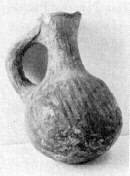 A HEBREW OIL JUGLET FROM THE PERIOD OF THE DIVIDED KINGDOM. These small vessels were usually dark grey or black in color and were baked in an oven in which the fire had been smothered thus forcing the carbon particles back into the clay and rendering it impervious to liquids. The decorative Pattern was added by burnishing. Such juglets may have held perfumed oil used for cosmetic purposes (Amos 6:6; Song of Songs 1:3) or for healing (Isa. 1:6) or for honoring guests (Ps.23:5).
Sigmund Mowinckel, basing his research on Gunkel’s work, studied the Psalms and the Israelite cultus in terms of parallels found in other Near Eastern cultures.49 For the most part Mowinckel’s categories are those of Gunkel, but a most important contribution was made in the theory of the enthronement festival. Mowinckel noted that in Pss. 47, 93, 95-100, Yahweh was referred to as "king" and argued that such terms as "Yahweh reigns" and "Yahweh is a great king above all gods" signified actual enthronement. In these Psalms he found motifs like those used in the Akitu festival: the creation of the world, the defeat of enemies and chaos and divine kingship. Mowinckel suggested that an annual festival of enthronement of Yahweh was observed in Israel in the pre-Exilic period, just as the Akitu festival was observed in Babylon. At the festival the enthronement Psalms were sung which included the cry, "Yahweh has become king." In the initial list of these Psalms were Pss. 8, 24, 29, 46, 48, 50 and 65, to which he later added Pss. 68, 75, 76, 82, 84, 85, 87 and 118, despite the omission of the cry "Yahweh reigns" in some. The enthronement festival, which marked the "Day of Yahweh," was a renewal rite when powers of chaos were overcome and included a processional in which the ark was carried to the temple for enshrinement as a symbol of Yahweh’s presence. In this rite, the central themes of the Yahweh-Israel relationship were renewed and revitalized: election, covenant, promises to the Davidic line.
Artur Weiser is in general agreement with the Gunkel-Mowinckel analysis, but he replaces the enthronement festival with "the covenant festival," which, he says, included rites of covenant renewal, a recitation of sacred history and an emphasis on the necessity of obeying the law (cf. Josh. 24; Deut. 31:10-13; II Kings 23:1-3).50 The festival commemorated the formation of the tribal confederacy as a covenanted people and cannot be reconstructed, but fragments of the liturgy are to be found in some of the Psalms such as Ps. 50.
Hans-Joachim Kraus has proposed a theory of a "royal Zion festival" held in Jerusalem on the first day of Tabernacles, during which the election of Jerusalem and the Davidic line were proclaimed and the ark brought into the City.51 The festival’s origin lay in the transportation of the ark to Jerusalem by David. Pilgrims from distant places came to Jerusalem and, as they stood outside the city, chanted such Psalms as 46, 48, 76, 87 and 122. In the processional of the ark, Psalms 95:1-6; 132:14-18 and 24:1-6 would be used, and at the sanctuary gates in the "entrance liturgy," Psalm 24:7-10 would be antiphonally chanted. The rite was climaxed with a "solemn act of adoration" before Yahweh. Kraus believes that Mowinckel’s list of Enthronement Psalms is too inclusive for only Pss. 47, 93 and 96-99 refer to Yahweh as "king," and that the enthronement ritual is post-Exilic, reflecting the influence of Deutero-Isaiah and the Akitu festival.
No attempt will be made to treat the Psalms chronologically. Recent studies have rendered useless some aspects of former guides to dating.52 The tendency to retain archaisms in liturgy and the use of uniform metrical patterns make identification of early and late materials very difficult. Only occasionally, as in Ps. 137, will internal evidence provide a guide to the period out of which the Psalm came. We will begin our study of the Psalms proper through the "Royal Zion Festival" outlined by Kraus, for not only does this festival offer the most promising approach to our understanding of the cultus, but it also enables us to relate specific Psalms to cultic ritual, and perhaps to gain some appreciation of the significance of the acts of worship. We shall then consider some specific categories of Psalms.
The festival, which was held in the seventh month at the Feast of Tabernacles, can best be understood in terms of the steps developed by Kraus:53
- Read Pss. 42-43
Pilgrimage preparations. As the time for the festival drew near, worshipers, some coming from distant places, began their pilgrimages. Psalms 42-43 (which are really a single Psalm) express the longing of those who are far from Jerusalem. Memory of former festivals strengthened the anticipation of the one at hand, increased the sense of separation from Yahweh and produced fluctuating moods of despondency and anticipation.
Read Ps. 84
As the temple came into view, the pilgrims raised their songs of joy and longing. So intense was the mood that the pilgrims blessed cult officials who ministered in the temple and measured the joy of being in the courts against other pleasures.
Read Ps. 122
Kraus believes that the sentiment in Ps. 122 is anticipatory rather than realized. Two of the central themes of the festival appear in the praise of David and Jerusalem. - Read Ps. 46
The Pilgrims at the Gate: The Songs of Zion. "Songs of Zion" are referred to by Babylonian tormentors in Ps. 137 and therefore appear to be a special category of Psalms. In Ps. 46 Yahweh is praised for his control of nature’s destructive forces, for his presence in Jerusalem which reassured his worshipers, for his action in history and for the sense of his near presence experienced by the pilgrims. The imagery of the streams of Jerusalem is Canaanitic, derived from the descriptions of the dwelling place of the Ugaritic father-god El at the source of the "two rivers."54
Read Ps. 48
Ps. 48 glorifies Mount Zion and employs Canaanite ideas. Mount Zion is, for the singers, the mountain of God (vs. 2), and is symbolic of Mt. Zaphon, the place of divine assembly located in the north in Canaanite mythology.55 There can be little doubt, as Kraus has pointed out, that pre-Hebrew Canaanite mythological concepts associated with Jerusalem were transferred to the Hebrew cultus when David possessed the city and made it the center of Yahwistic religion. Verse 12 may refer to a processional. Statements extolling the security of Jerusalem (vss. 4-8) may grow out of pre-Exilic deliverances from such foes as Rezin and Pekah (Isa. 7:125) and Sennacherib (Isa. 24-27; 29:1-24; 36:1-37:38).
Read Pss. 76; 87; 122
In Ps. 76 Zion is praised as the dwelling place of Yahweh, the God whose judgment is on behalf of his people and against their enemies. Other Psalms express the pride of those born in the holy city (Ps. 87), and offer prayers for the peace of Jerusalem (Ps. 122). - The worshipers brought before Yahweh petitions for the King and temple similar to those found in Pss. 122:6 ff. and 84:9 f.
- The festival proper began at the foot of Mount Zion with a processional, in which the ark was carried to the temple. The ritual included:
- Read Ps. 95:1-6 and Ps. 99
An act of adoration and praise (Ps. 95:1-6), extolling Yahweh’s name, reputation and activities in the sacred history (Ps. 99). - Read Ps. 132
The ascent of the hill, recalling David’s role in bringing the ark to Jerusalem and reaffirming the Davidic covenant and the election of Jerusalem. - Read Pss. 15; 24:1-6
The recitation of the "entrance Torah" at the gates of the courtyard. From the pilgrims rose the query, "Yahweh, who shall sojourn in thy tent? Who shall dwell on thy holy hill?" (15:1) and from the priests the response came in words recalling Yahweh’s law and demanding individual personal examination of motives and actions by the worshipers. Only the righteous could enter through the "gates of righteousness" (cf. Ps. 118:19-20). - Read Ps. 24:7-10
The entrance liturgy. Once again an antiphonal pattern can be discerned, with those bearing the ark demanding entrance for the "King of glory" and those within inquiring "Who is the king of glory?" (vss. 8a, 10a), to which a resounding response is given "Yahweh of hosts, he is the king of glory!" (vss. 8bc, l0bc). - Read Pss. 150; 136
An act of adoration. At this time the musicians, choristers and the entire company joined in a mighty paean (Ps. 150), and the wondrous acts of Yahweh were recited (Ps. 136). - Read Pss. 80; 50
The prayer for a theophany. Ps. 80, which may be one of the hymns preserved from the northern kingdom of Israel since it refers only to northern tribes, expresses the hope for a theophany through which the people will know that Yahweh is favorably disposed toward his people. The revelation of Yahweh (by what means we do not know)56 in the cultic drama must have been a dramatic and traumatic moment. The apparent censure of cultic sacrifice was directed against those who believed Yahweh needed offerings for his sustenance and called for a proper spiritual attitude on the part of the giver. The worshiper was directed to look inwardly to evaluate his righteousness and worthiness to stand among the righteous in the courts of Yahweh. - Read Ps. 65
The presentation of offerings and singing of hymns of thanksgiving. Yahweh was praised not only for his divine goodness but for the blessings of fertility, water and a good harvest, which ensured the physical life of the community. - Read Pss. 8; 134
Nocturnal rituals. The ceremonies did not terminate at sunset and hymns of praise and adoration continued into the night. - Read Ps. 121
Departure hymns. When the time for the pilgrims to depart arrived, hymns of assurance were sung, promising Yahweh’s protection and guidance.
The simplified outline of Kraus’ argument provided here may give the impression that the schema is artificial, but in his detailed treatment of the festival, Kraus amply sustains his thesis. Of course there was opportunity within the festival period and at other times during the year for the individual to join in additional expressions of thanksgiving and praise or to seek help for problems. We will now consider some of the other categories of Psalms established by form critics.
INDIVIDUAL LAMENTS
Lament Psalms are by far the most numerous of all biblical Psalms. Individual laments should be thought of in terms of association with the cult, as suggested by the mention of the sanctuary and offerings and the implication that they were uttered in the presence of gathered worshipers. The pattern of these Psalms is well established:
- The opening is usually an invocation or a cry for help to God in time of need.
- The unhappy situation is explained.
- Faith and trust in Yahweh are expressed.
- Yahweh is petitioned to hear and save.
- The motifs of enemies, the lowly situation of the petitioner, etc., are expressed.
- The petitioner states his assurance of being heard or calls upon Yahweh to act.
- Vows or promises of praise are given, or in instances where it would appear that the one who prays has received a favorable oracle or has had the petition answered, the vows are replaced by direct words of praise to Yahweh. At this point Lament Psalms approach Psalms of Praise which, in reiterating reasons why praise is given, often recall former unhappy situations (see below).
Among the many Individual Laments are Pss. 3, 6, 13, 17, 22, 26, 28, 31, 35, 38, 54, 55, 56, 57, 59, 64, 69, 70, 71, 86, 102, 109, 141 and 143. In these Psalms relief is sought from illness, persecution, mockery, failure, tormentors, rejection by friends, evil doers, reproach, shame, dishonor, loneliness and almost every other misfortune that could come to a man. The petitioners do not hesitate to call upon Yahweh to visit upon those who torment or persecute all manner of evil. The concluding promises of praise, should the requests be answered, in some of the Psalms of Lament should not be interpreted as bargaining, but rather as the recognition of a pattern of worship actually practiced.
PSALMS OF PRAISE UTTERED BY INDIVIDUALS
These give thanks to Yahweh for deliverance from some unfortunate situation. The pattern in these Psalms is as follows:
- A proclamation of praise and trust.
- Recollection of the distress.
- A report of the deliverance often mentioning the individual’s cry and Yahweh’s response.
- The renewal of the vow of praise.
- The statement of praise.
Some of the individual hymns are Pss. 9, 18, 30, 34, 40, 43, 92, 116. The troubles from which the individuals were delivered are similar to those listed under the Psalms of Lament. Perhaps such Psalms were recited before the gathered congregation as testimonials to the wondrous compassion and power of Yahweh on behalf of the individual.
COMMUNAL LAMENTS
These follow an outline similar to that given for individual laments. Yahweh is asked why enemies succeed, why the wicked prosper and the plea is made for deliverance as in former days. The innocence of the group is protested, and the vindictive nature of the enemy responsible for the unhappy situation is described. Some Psalms of communal lamentation are Pss. 10, 12, 44, 60, 74, 79, 80 and 83.
COMMUNAL THANKSGIVING PSALMS
These may be liturgies employed in major festal rites. Such Psalms honor Yahweh as creator of the world, as lord of history and for his mighty saving deeds. They call for joyful sacrifice and songs of praise to Yahweh for his gracious goodness, as they recall the dangers from which Yahweh delivered his people. Communal Psalms of Thanksgiving include Pss. 66, 67, 107, 113, 117, 118, 135 and 136.
ROYAL PSALMS
These are, as Gunkel indicated, associated with the activities of the king. Ordinarily they would be used in Jerusalem when the king participated in the cultus, either in sacrificial rites, or in seeking and receiving oracles, or perhaps at some ceremony in which the covenant between Yahweh and his people was renewed. The hymns include prayers offered by the monarch praising Yahweh or asking the deity for some benefit.
Read Ps. 2
Ps. 2 is a coronation hymn. As we have seen, the death of a ruler and the accession of a new monarch were often times of rebellion by subject states or attack by enemies. This hymn promises the maintenance of order and reinforces the doctrines of the divine choice of Jerusalem and of the Davidic line.
Read Ps. 18
Ps. 18 is in part a royal hymn of praise to Yahweh for deliverance (vss. 1-30) and in part a statement of Yahweh’s protection of the monarch. In the first section, a dramatic and well-detailed theophany is portrayed and the history of divine deliverance reviewed. The second part enables the king to declare before the entire community his dependence upon Yahweh for the power he has received.
Read Pss. 20; 21; 45
Ps. 20 is a prayer for the king recited in a cultic rite, possibly a coronation and Ps. 21 is prayer petitioning Yahweh on behalf of the ruler. These Psalms have also been interpreted as prayers uttered before (Ps. 20) and after (Ps. 21) battle. Ps. 45 is a cultic hymn sung at a royal wedding. Other Royal Psalms are 72, 101, 110 and 144.
WISDOM PSALMS
Read Ps. 1
Teaching hymns which reflect the practical insights and counsel of the wise men of Israel found a place in the Hebrew cultus. They impart to the collection of Psalms a reminder of the way of religion in the life of the people. At times there is an expression of delight in the Torah, and again there is a study of the way of the righteous as opposed to the life of the unrighteous. The first Psalm in the Psalter belongs in this category. It contrasts two ways of life: righteousness and wickedness. It affirms simply that the way of the wicked fails while that of the righteous succeeds. It is clear that this particular "wisdom" writer did not wrestle with the problem of theodicy; rather the cultic setting where this Psalm was used affirmed the theological beliefs of the cult in the style and teaching mode of the wisdom school. Other Psalms in this category include 25, 32, 37, 49, 112 and 119.
OTHER PSALMS AND THE CULTUS
It is impossible to discuss in detail all categories of Psalms recognized by form-critical studies. It is far more important to grasp what the form critics have made clear: that the Psalms are products of the temple cultus and that they must be understood in terms of their relationship to ritual and worship. Israel’s heritage, interpreted as sacred history, was preserved and kept alive in the cult. Not only were worship rites based on events of the past, but in the Psalms the acts of Yahweh were recited. Unfortunately, it is not yet possible to place each Psalm in the festival or festivals where it was used, nor to recreate in any detail the activities of priests and people at any particular moment of the ritual.
Endnotes
- The term "midrash" comes from a Hebrew root meaning "to search" or "to investigate"; therefore, the purpose of midrashic study was to seek out and reveal the inner meaning of biblical texts. Midrash dealing with legal texts of the Bible is called "Halachah"; midrash concerned with non-legal sections is labeled "Haggadah" and is homiletic. Chronicles belongs to the latter category.
- J. M. Myers, I Chronicles, The Anchor Bible (Garden City, New York: Doubleday & Company, Inc., 1965), p. xviii. See also G. von Rad, "The Levitical Sermon in I and II Chronicles" in The Problem of the Hexateuch and Other Essays, trans. E. W. T. Dicken (London: Oliver and Boyd, 1966), pp. 267 ff.
- For a detailed analysis of the unity of language and style, cf. S. R. Driver, An Introduction to the Old Testament, new edition, revised 1913 (New York: Charles Scribner’s Sons, 1913), pp. 525 ff. (now in a Meridian paperback).
- C. C. Torrey, Ezra Studies (Chicago: University of Chicago Press, 1910), pp. 238 ff.
- W. F. Albright, The Biblical Period, p. 54.
- Pfeiffer, Introduction to the Old Testament, pp. 811 f.
- Cf. Myers, I Chronicles, pp. lxxxvii and W. A. L. Elmslie, "The First and Second Books of Chronicles," The Interpreter’s Bible, III, 345 f.
- Cf. above, "The Problem of History," chap. 2.
- It should be remembered that there was no concern about plagiarism or copyrights at this time.
- Apparently at one time the Korahites challenged the authority and control of the temple cultus by Levites. The Chronicler, like the P editors (parts of Num. 16), supported the Levites and subordinated the Korahites by having David and Samuel state their role. For a succinct discussion, see "Korah" in The Interpreter’s Dictionary of the Bible.
- W. Eichrodt, Theology of the Old Testament, p. 56.
- For greater detail, cf. Martin Noth, Leviticus, The Old Testament Library, trans. J. E. Anderson (Philadelphia, Pennsylvania: The Westminster Press, 1965), pp. 9 ff.
- Cf. G. von Rad, "Die Priesterschrift," Beiträdge zur Wissenschaft von Alten Testament, 1934.
- A notable exception is Yehezkel Kaufmann, The Religion of Israel, pp. 175 ff. Kaufmann dates P before D and puts the entire Torah in the pre-Exilic era. See also the last section of the article "Priests and Levites" in The Interpreters Dictionary of the Bible.
- The underlined names indicate first-born sons.
- Older theological interpretations of the P story insisted that God created ex nihilo. For a discussion of this point, cf. E. A. Speiser, Genesis, pp. 12 f.; C. A. Simpson, "Genesis," The Interpreter’s Bible, I, 466-7. However, cf. G. von Rad, Genesis, pp. 46 f.
- For a detailed discussion, cf. Alexander Heidel, The Babylonian Genesis (Chicago: The University of Chicago Press, 1951), now reprinted as a Phoenix paperback, pp. 129 f.
- Cf. Speiser, Genesis, p. 7 where, arguing from silence, it is said that because no other gods are mentioned, the translation must be interpreted in the singular ("in my likeness").
- The dragon battle motif did enter Jewish literature, cf. Ps. 74:12-17; Isa. 51:9-11.
- In Gilgamesh, Enkidu, a type of primitive man, lives and eats with animals.
- This is also true in the Gilgamesh epic.
- The traditional location of this cave is beneath the Mosque of Abraham in modern Hebron. Sepulchral shrines within the Mosque commemorate the patriarchs and their wives. The foundation stones of the Mosque are Herodian (first century B.C.), indicating the long history of veneration of the spot.
- Cf. Martin Noth, Exodus, The Old Testament Library, trans. by J. S. Bowden (Philadelphia: The Westminster Press, 1962), p. 202.
- For a different point of view, see the article "Tabernacle" in The Interpreter’s Dictionary of the Bible.
- Cf. Martin Noth, Exodus, p. 220.
- Cf. Lev. 23:27 f.; 25:9 where the title yom ha-kippurim, Day of Atonement, occurs.
- For the identity of Azazel, see the article "Azazel" in The Interpreter’s Dictionary of the Bible.
- Cf. Martin Noth, Leviticus, The Old Testament Library, trans. by J. E. Anderson (Philadelphia: The Westminster Press, 1965), pp. 119 f.; N. Micklem, "Leviticus," The Interpreter’s Bible, II, 77.
- For details, consult one of the many books on the Dead Sea Scrolls such as M. Burrows, The Dead Sea Scrolls (New York: Viking Press, 1955); Géza Vermès, Discovery in the Judean Desert (New York: Desclee Company, 1956); T. H. Gaster, The Dead Sea Scriptures (Garden City, New York: Doubleday Anchor Books, 1956), etc.
- The persecution of Jews under Antiochus IV about 168 B.C., as recorded in I Macc. 1:54 ff., implies that many private individuals owned copies of the Law.
- Cf. M. Dahood, Psalms I, The Anchor Bible (Garden City, New York: Doubleday and Company, Inc., 1966), pp. xxix-xxx.
- S. Mowinckel, The Psalms in Israel’s worship, trans. by D. R. Ap-Thomas (Oxford: Basil Blackwell, 1962), II, 218, Add. Note 1.
- Cf. Pius Drijvers, The Psalms, Their structure and Meaning (New York: Herder and Herder, 1965), p. 55 for an interesting development of this idea.
- The divisions must have been made by the third century B.C. for they appear in the LXX. It should be noted that the numbering of the Psalms in the LXX differs slightly from the Hebrew because in the LXX Pss. 9 and 10 are united into a single poem, as are Pss. 114 and 115. Conversely, Pss. 116 and 147 are each divided into two parts. A completely different ordering of psalms is found in the Dead Sea Psalm scroll which contains canonical Psalms ranging from Psalm 93 through Psalm 150 plus several non-canonical hymns. Cf. J. A. Sanders, The Dead Sea Psalms Scroll (Ithaca, New York: Cornell University Ilress, 1966).
- The Davidic Psalms (1-41, 51-72) and the Elohist Psalms (42-83) suggest different ways of dividing the Psalter than the present five-fold pattern and appear to represent older separate units or collections.
- Even here the allusions are obscure.
- For a discussion of these terms see the article "Music" in The Interpreter’s Dictionary of the Bible.
- A. M. Blackman, "The Psalms in the Light of Egyptian Research," The Psalmists, ed. D. C. Simpson (London: Oxford University Press, 1926).
- Geo. Widengren, The Accadian and Hebrew Psalms of Lamentation as Religious Documents (Stockholm: Bokförlags Aktiebolaget Thule, 1937).
- C. G. Cummings, The Assyrian and Hebrew Hymns of Praise, Columbia University Oriental Studies, XII (New York: Columbia University Press, 1934).
- J. H. Patton, Canaanite Parallels in the Book of Psalms (Baltimore: The Johns Hopkins Press, 1944).
- J. H. Breasted, The Dawn of Conscience (New York: Charles Scribner’s Sons, 1933), pp. 308 f. For a comparison of the two hymns, see Breasted, op. cit., pp. 281 ff.; Jack Finegan, Light from the Ancient Past, pp. 106 ff., ANET, pp. 309 ff.; and the discussion by Hugo Gressman, "The Development of Hebrew Psalmody," The Psalmists, D. C. Simpson (ed.) (London: Oxford University Press, 1926).
- N. H. Snaith, Studies in the Psalter (London: The Epworth Press, 1934), pp. 97-106; W. O. E. Oesterley, A Fresh Approach to the Psalms, The International Library of Christian Knowledge (New York: Charles Scribner’s Sone, 1937), pp. 30 ff.
- Cf. Patton, op. cit., p. 47.
- Ibid., p. 20.
- Cf. John Gray, Archaeology and the Old Testament World (New York: Thomas Nelson and Sons, 1962), reprinted as a paperback by Harper and Row, 1965, pp. 105 ff. For a detailed study of Ugaritic influence, see M. Dahood, Psalms 1.
- The use of "I" in the Psalms should be understood in the light of the concept of corporate personality, whereby a group can be symbolized in the first person singular. For example, note the fluidity of the "we" and "I" in Pss. 44, 60, 66, etc.
- Hermann Gunkel and Joachim Begrich, Einleitung in die Psalmen, Göttinger handkommentar zur Alten Testament (Gottingen: Vandenhoeck & Ruprecht, 1933).
- S. Mowinckel, The Psalms Vols. I-II.
- Arttir Weiser, The Psalms, The Old Testament Library, trans. H. Hartwell (Philadelphia: The Westminster Press, 1962).
- Hans-Joachim Kraus, Worship in Israel, trans. G. Buswell (Richmond, Virginia: John Knox Press, 1966), pp. 208 ff. For a more detailed statement, see his Die Königsherrschaft Jahwes im Alten Testament (Tüibingen: Mohr, 1951).
- For example, the precise categories utilized by M. Buttenweiser, The Psalms (Chicago: University of Chicago Press, 1938) are no longer acceptable.
- Kraus, Worship in Israel, pp. 208 ff.
- Ibid., p. 101. For references to the mythological "streams" from Jerusalem, cf. Ezek. 47:1; Joel 3:18; Zech. 14:8.
- The Hebrew term zaphon is translated "north" in the Revised Standard Version. See, however, the translation in Dahood, op. cit., p. 288 and cf. Isa. 14:13.
- Cf. Artur Weiser, The Psalms, pp. 394 f.
Old Testament Life and Literature is copyright © 1968, 1997 by Gerald A. Larue. All rights reserved.
The electronic version is copyright © 1997 by Internet Infidels with the written permission of Gerald A. Larue.