



(2006)
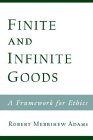 Review: Robert Merrihew Adams. 2002. Finite and Infinite Goods: A Framework for Ethics. New York: Oxford University Press. 428 pp.
Robert M. Adams’s Finite and Infinite Goods: A Framework for Ethics (Oxford University Press, 1999) is derived largely from eighteen previously published essays in ethics, philosophy of religion, and philosophical theology. But those essays have been revised and reshaped into a coherent whole that is impressive in its breadth and depth, originality and thoughtfulness, fairmindedness and humaneness. Intelligent nonbelievers and believers can only benefit from carefully and critically working their way through this important book.
Adams devotes his first three chapters to developing interesting and unfashionably objectivist and theistic-Platonist accounts of the good. On the former account, individual well-being is “enjoyment of the excellent” (section 3.2); on the latter, the deeper nature of finite intrinsic goods consists in resemblance to the perfect good, which Adams identifies with God (chapters 1-2). It is noteworthy that here and elsewhere in the book Adams eschews giving any direct arguments for God’s existence[1]; his announced aim is to develop a partly theistic framework for ethics that makes an indirect case for theism by illuminating a variety of ethical topics (pp. 5-7). Religious skeptics are very unlikely to find this case persuasive, but may nevertheless be impressed or intrigued by many elements in the framework, such as Adams’s critique of desire-satisfaction theories of individual well-being (section 3.1).
In moral philosophy Adams may be best known for his defense of a modified divine-command theory that appeals to the commands of a loving God. Chapters 10-12 give this theory its fullest elaboration; especially noteworthy are Adams’s replies to a number of standard objections to divine-command ethics and to some of his critics. These chapters, among others, are essential reading for anyone interested in whether morality does or could depend on religion.[2]
Adams also offers perceptive reflections on many familiar philosophical topics: St. Anselm’s ontological argument for God’s existence (pp. 42-44); the plausibility of natural-law ethics (pp. 53, 306-308); the Gilbert Harman/Nicholas L. Sturgeon debate on moral explanation (section 2.3); the legitimacy of reflective equilibrium (sections 3.2, 15.2) and the role of feelings in ethical thinking (pp. 358-361, 387); the intrinsic value of species (pp. 114-115, 347-348); the nature of love (chapters 5-7), including parental love (pp. 144-149) and friendship (pp. 142-145, 155-156, 196-197); moral sainthood (pp. 180-182) and seemingly admirable immorality (pp. 203-208); the nature of ethical universalizability (pp. 294-296); the defensibility of welfare-state liberalism (chapter 14); and the nature of faith (chapter 16). Few open-minded readers will come away from this book without a better understanding of these topics.
Religious skeptics may be especially struck by Adams’s (partly religious) defense of liberty of conscience and church/state separation (section 14.3), and by his emphasis on the importance of critical thinking in ethics and religion (pp. 78-82, 211-212, 263-264, 273-274, 314, 358, 361, 375, 387). Here is a Christian philosopher in the analytic tradition who is free of the sophisticated dogmatism of so-called Calvinist or Reformed epistemologists such as Alvin Plantinga, and who does not engage in the aggressively muddled apologetics of fundamentalist philosophers like William Lane Craig. Noteworthy, too, is Adams’s humane respect for individuals in loving, same-sex relationships and his acknowledgment and abhorrence of the persecution they have faced (pp. 106, 125-127, 308, 327).
Among the most interesting parts of the book are Adams’s examinations of some neglected topics in ethics. He offers a fascinating account of moral horror and its relevance to respect for persons (chapter 4), and an insightful one of the moral significance of symbolic value (chapter 9 and section 14.3). He develops an intriguing theory of personal duty or “moral vocation” (chapter 13). And he argues thoughtfully for the need for several forms of moral faith (chapter 16), such as faith that morality “is not a massive socially induced delusion” (section 16.1). Any discussion of these topics will have to address what he says about them.
For all my praise of Adams’s book, I do find much to question and criticize in it–even besides his assumption that God exists. I will focus on metaethical issues; other readers may prefer to direct their attention elsewhere.
In his semantics of evaluative terms such as ‘intrinsic goodness’ and ‘moral obligation,’ Adams acknowledges his indebtedness to Hilary Putnam’s well-known causal theory of reference (perhaps better described as causal-explanatory) and the affinity of his semantics to Richard N. Boyd’s “epistemic access” development of that theory (pp. 15-18, 23-24, 58-59, 233-236, 256-257).[3] The gist of such theories is that if a term refers to a feature of the world, it does so in virtue of the fact that its use by at least some members of the relevant linguistic community is causally connected to that feature in ways that give those speakers knowledge of the feature. Adams’s own semantics of ‘moral obligation’ may be summarized–largely in his own words–as follows:
-
“The nature of moral obligation is not given by the meanings of the words, such as ‘right,’ ‘wrong,’ ‘obligation,’ and ‘ought,’ that are used to express it. What we understand if we understand what those words mean in the relevant contexts is rather a complex role that moral obligation plays in a scheme of things” that includes not only “straightforwardly empirical features such as human actions, feelings, and utterances” but also evaluative or normative features such as rights, guilt, and excellence (p. 234).
-
“[T]he semantics of obligation leaves metaphysical questions open, regarding the reality and nature of obligation. We can understand the role of obligation and still ask, ‘Is there really something that is suited to fill this role? And if so, what is the best candidate?'” (p. 234).
-
The role in question is constituted by the following requirements:
(a) Moral obligation is something that we “can be motivated to comply with” and should take seriously, and that “ground[s] reasons for compliance” (p. 235; cf. 241 on reasons).
(b) “If an act [violates a moral obligation], then in the absence of sufficient excuse, it is appropriate for the agent to be blamed, by others and by himself” (p. 235; cf. 238-241 on guilt).
(c) “[F]ulfilment of obligation … should be publicly inculcated” (p. 236).
(d) “[M]oral obligations are [largely objective] features of people’s situations” (p. 247).
(e) “The types of action that we confidently believe to be right and wrong are an important determinant of the role of moral obligation…. [A] theory could be rejected out of hand if most of the obligations it assigned us were to perform actions that have always been regarded by most people as wrong. There is a limit to how far pretheoretical opinion can be revised without changing the subject entirely” (p. 246; cf. 76-77, 256, 360).
(f) “[F]acts of moral obligation should play a part in our coming to recognize actions as right and wrong” (p. 257; cf. 247 and also 70, 363).
And, of course, as a divine-command theorist, Adams contends that it is the property of being commanded by God that–under certain conditions–is best suited to fill the conceptual role of moral obligation (pp. 234, 246-247, 249-250, 252-258).
Putting aside Adams’s interesting arguments for the foregoing contention, I have two qualms about his moral semantics. One concerns his questionable appeal to analytic truth, the other his surprising ambivalence about the causal element of the causal-explanatory theory of reference.[4] So far as I can see, he can readily eliminate both problems by abandoning the unnecessary claims that create them.
A striking feature of Putnam’s account of reference for natural-kind terms is that competent users of such terms have or are aware of an initial conception or “stereotype” of what they refer to that may or may not turn out to be accurate.[5] This is roughly what a term “means” in the sense of meaning linked to what competent speakers understand; but since the stereotype needn’t be true of the referent, it would be misleading to speak of analytic truth in this connection. But Adams does speak this way in talking about the semantic or conceptual role of moral obligation (pp. 234, 236); and his departure from Putnam on this point is a doubtful improvement at best.
Admittedly, some of the role requirements Adams specifies–especially (a) and (b)–are plausible candidates for analytic truths known by competent speakers. But others–(c) and especially (d)–seem to be pieces of semantic legislation designed to shut down substantive debates over the nature of morality. Surely the falsity of subjectivist relativism in ethics–on which I wholeheartedly agree with Adams–cannot simply be established by the partial “analytic” definition given in (d)! Moreover, requirements (e) and (f), even if analytic, concern the way in which moral terms refer, rather than beliefs that competent users of those terms have about moral obligation.
My other qualm about Adams’s moral semantics is that despite his use of Putnam, he seems to question whether the referential connection between moral terms and the features of the world is a causal one (pp. 16, 24, 59)–apparently mainly because he thinks such a connection would entail that moral features are natural kinds (p. 59). This entailment is far from obvious, and in any case Adams himself sometimes talks fairly comfortably and plausibly of causal connections between our ethical beliefs or linguistic practices and objective features of the world (pp. 70, 247, 257, 363).
There is so much more to be said about this rich, stimulating, and highly debatable book; it is only with regret that I must stop here.
ENDNOTES
[1] In “Moral Arguments for Theistic Belief” (in Rationality and Religious Belief, ed. C. F. Delaney, University of Notre Dame Press, 1979), Adams does defend (to various degrees) several theistic proofs, including an argument based on the divine-command theory of morality. I have offered a rebuttal of the latter argument (as well as criticism of Adams’s version of the divine-command theory) in “Robert Adams’s Theistic Argument From the Nature of Morality,” Journal of Religious Ethics 33 (1993); Adams replies in the same issue.
[2] In “Why Adams Needs to Modify His Divine-Command Theory One More Time,” Faith and Philosophy 11 (1994), I offer a critical assessment of Adams’s theory. I believe his elaboration of it in the chapters under consideration remains vulnerable to some of my criticism, as evidenced, for example, in his continued willingness–albeit tentative–to countenance the arbitrariness of the moral status of euthanasia (pp. 255-256). Ironically enough, in a different context (concerning theistic Platonism) Adams himself insists on the importance of “preserv[ing] nonarbitrariness of divine choice” (p. 37).
[3] In Moral Realism and Naturalized Metaethics (University Microfilms, 1990), Chapter 2, I elaborate a causal-explanatory semantics for moral terms that relies heavily on the work of Putnam and especially Boyd.
[4] In my unpublished paper “Adams’s Version of the Open-Question Argument,” I criticize another element of his metaethics that is related to his moral semantics.
[5] See his Philosophical Papers, Vol. II: Mind, Language, and Reality (Cambridge University Press, 1982), esp. Ch. 12 (“The Meaning of ‘Meaning'”), pp. 247-252.
Copyright ©2006 Stephen Sullivan and Internet Infidels, Inc. All rights reserved.