

The First Coming: How the Kingdom of God Became Christianity (1986–electronic edition 2000)
Thomas Sheehan
II
How Jesus Was Raised From the Dead
Soon after Jesus died, something dramatic happened to his reputation: His followers came to believe that he had been raised from the dead and was alive with his heavenly Father. This enhancement of Jesus’ reputation is a historical fact, observable by anyone who studies the relevant documents.
But according to Christians, something dramatic happened not just to Jesus’ reputation but above all to Jesus himself. They believe he actually was raised from the dead, was taken into heaven, and is now reigning there as the equal of God the Father. These, however, are not observable historical facts but claims of faith.
The purpose of this central part of our study is to distinguish between the facts of history and the claims of faith, between what certainly happened to Jesus’ reputation after he died and what allegedly happened to Jesus himself. There is no doubt that Christianity formally began with the disciples’ claim that Jesus had been rescued from death. Our question, however, is what that claim meant in the early church and what historical experiences lay behind it. (When speaking of resurrection, the New Testament writers generally use the passive
92
construction “Jesus was raised [by God]”–in Greek êgerthê or egêgertai--rather than the active-voice “Jesus rose” [anestê]. In what follows I use the word “resurrection” in the New Testament’s passive sense: Jesus’ “being-raised” by God.[1])
Here, in the search for the historical origins of Christian faith in the resurrected Jesus, what I said in the [Introduction] holds especially true: I rely upon the scientifically controllable results of contemporary Christian exegesis of the New Testament texts that bear upon the resurrection. However, I also go beyond that exegesis by using its results as data for my own interpretation.
The last event in Jesus’ life was his death, but even in death his fame began to grow. We now study the first stirrings of the movement that transformed Jesus, in the eyes of his followers, from the crucified prophet into the ruling Son of God. First, under the rubric of “Simon’s Experience,” we investigate the scriptural claim that Jesus appeared to Simon Peter after the crucifixion. Second in “The Empty Tomb,” we study the story in Mark’s Gospel that Jesus’ tomb was found empty on Easter Sunday morning.
93
SIMON’S EXPERIENCE
95
1. The Myth of Easter
Popular Christian piety holds that Jesus’ existence on earth extended beyond his death on Good Friday and spilled over into a miraculous six-week period that stretched from his physical emergence from the tomb on Easter Sunday morning, April 9, 30 C.E., to his bodily ascension into heaven forty days later, on Thursday, May 17, 30 C.E.[2]
To judge from the Gospels, it would seem that the activities of the risen Jesus during the forty days after he died included: one breakfast; one and a half dinners; one brief meeting in a cemetery (in fact with his clothes off: John 20:6, 14);[3] two walks through the countryside; at least seven conversations (including two separate instructions on how to forgive sins and baptize converts)–all of this climaxing in his physical ascension into heaven from a small hill just outside Jerusalem. Impossible though the task is, if we were to try to synthesize the gospel stories into a consistent chronology of what Jesus did during those hectic six weeks between his resurrection from the dead and his ascension into heaven, the agenda would look something like this:
96
SUNDAY, APRIL 9, 30 C.E.: THE JERUSALEM AREA
| MORNING
1. Jesus rises from the dead early in the morning (Mark 16:9). Mary Magdalene, alone or with other women, discovers the open tomb. Either she informs Peter and another disciple, who visit the tomb and find it empty (John 20:1-10); or she and the others meet one or two angels inside, who announce the resurrection (Mark 16:5-6; Luke 24:4-6). 2. Later, outside the tomb, Jesus appears to Mary Magdalene alone, who at first mistakes him for a gardener. He tells her to inform the disciples that he is ascending at that moment to his Father (John 20:17; Mark 16:9). 3. Jesus also appears to Mary Magdalene and another Mary, who grasp his feet and worship. Jesus tells them to send the brethren to Galilee, where they will see him (Matthew 28: 10). 4. Sometime during the day Jesus appears to Simon Peter (Luke 24:34). AFTERNOON AND EARLY EVENING 5. Jesus walks incognito through the countryside for almost seven miles with two disciples. He starts to eat dinner with them in Emmaus but disappears as soon as they recognize who he is (Luke 24:13-31; Mark 16:12-13). EVENING 6. Back in Jerusalem, Jesus appears to the disciples in a room even though the doors are locked. He tries to overcome their doubts by showing them his wounds and by eating broiled fish and honeycomb. He either gives them the Holy Spirit and the power to forgive sins (John) or does not (Luke), and either sends them out into the whole world (Mark) or tells them to stay in Jerusalem for a while (Luke). The disciple Thomas either is present (Luke and Mark, by implication) or is not (John). (Luke 24:36-49; John 20:19-23; Mark 16:14-18). 7. Jesus ascends into heaven that night from Bethany (Luke 24:51; Mark 16:19). |
SUNDAY, APRIL 16, 30 C.E.: STILL IN JERUSALEM
| 8. Jesus appears again to the disciples behind locked doors, and invites Thomas, who now is present, to put his fingers and hands into the wounds (John 20:26-29).
|
OVER THE NEXT WEEKS
| 9. Jesus offers the disciples many other proofs and signs, not all of which are recorded in the Gospels (John 20:30).
|
97
LATE APRIL OR EARLY MAY, 30 C.E.: GALILEE
| 10. Early one morning Jesus makes his “third appearance” (sic, John 21:14), this time to Simon and six others on the shore of Lake Galilee. He miraculously arranges for them to catch 153 large fish and invites them ashore for a breakfast of broiled fish and bread, which he has prepared. Jesus instructs Simon, “Feed my lambs, feed my sheep,” and discusses how Simon and the Beloved Disciple will die (John 21:1-23).
11. Jesus appears to the eleven disciples on a mountain, but some still doubt. He commissions them to baptize all nations and assures them, “I am with you always, to the close of the age.” He does not ascend into heaven (Matthew 28:16-20) |
THURSDAY, MAY 17, 30 C.E.: BACK IN THE JERUSALEM AREA
| 12. Jesus appears again and tells the disciples to wait in Jerusalem until they receive the Holy Spirit (even though, according to John, they had already received the Spirit on April 9: John 20:22). Then he ascends into heaven from Mount Olivet, just west of Jerusalem (Acts 1:1-12).
|
SUNDAY, MAY 27, 30 C.E.: JERUSALEM
| 13. God sends the Holy Spirit upon the twelve disciples, Mary the mother of Jesus, and about 107 other people (Acts 2:1-4; cf 1:13-15, 26).
|
It is clear that the scriptural stories about this six-week period contradict one another egregiously with regard to the number and places of Jesus’ appearances, the people who were on hand for such events, and even the date and the location of the ascension into heaven. Despite our best efforts above, the gospel accounts of Jesus’ post mortem activities in fact cannot be harmonized into a consistent “Easter chronology.” Nor need we bother to ask if the miraculous events of this Easter period could have been observed or recorded by cameras or tape recorders, had such devices been available. The reasons both for the patent inconsistencies and the physical unrecordability of these miraculous “events” come down to one thing: The gospel stories about Easter are not historical accounts but religious myths.[4]
I say this not at all out of disrespect for Christian faith or for the
98
doctrines that it holds. Rather, I mean to indicate the general literary form of the Easter accounts. They are myths and legends; and it is absurd to take them literally and to create a chronology of preternatural events that supposedly occurred in Jerusalem and Galilee during the weeks after Jesus had died. My purpose here is not to undo the meaning of Easter but precisely to reconstruct it by interpreting the myths that have been used to express that meaning.
In anticipation of what we shall see later, it is worth noting at this point that the New Testament does not in fact assert that Jesus came back to life on earth, or that he physically left his grave after he had died, or that faith in him is based on an empty tomb. What is more, almost forty years would pass after Jesus’ death before the Christian Scriptures so much as mentioned an empty tomb (Mark 16:6, written around 70 C.E.), and it would take yet another fifteen years after that (ca. 85 C.E.) before the Gospels of Matthew and Luke would claim that Jesus’ followers had seen and touched his risen body. I hope to show that (1) even though Jesus’ tomb was probably found empty after his death, that fact says nothing about a possible resurrection; and (2) the stories about Jesus showing his disciples his crucified-and-risen body are relatively late-arriving legends in the Christian Scriptures and in the final analysis are not essential to Christian faith.
But if Christianity stands or falls with the resurrection, may we ask “when” Jesus was raised from the dead? The Scriptures make no attempt to date the resurrection to Easter Sunday morning, nor do they claim that anyone saw it happen.[5] They do not even assert that the resurrection took place at Jesus’ tomb. In fact, catechetical popularizations aside, the church does not claim that the resurrection was a historical event, a happening in space and time.
Nonetheless, about 150 years after Jesus’ death the so-called Gospel of Peter (an apocryphal work which the church does not accept as authentic Scripture) did offer what purports to be an eyewitness account of what happened at Jesus’ grave on the first Easter. The narrative has had considerable influence on Christian iconography, but all that notwithstanding, the story remains pure legend.[6]
According to the Gospel of Peter the resurrection took place during the Saturday night after the crucifixion. As the legend tells it, the drama started with a loud voice that rang out from heaven and startled
99
the soldiers who were guarding Jesus’ tomb. Then the extraordinary action began:
They [the soldiers] saw the heavens open and two men [angels] come down from there in a great brightness and draw nigh to the sepulcher. The stone that had been laid against the entrance to the sepulcher began to roll by itself and gave way to the side. The sepulcher was opened, and both the young men entered in. (8:36-37)
The soldiers, understandably taken aback by all of this, awaken the Jewish elders who are also guarding the grave, and the group witnesses a spectacular procession featuring a giant-sized Jesus and two only slightly shorter attendants.
And they saw three men come out of the sepulcher, two of them [the angels] sustaining the other [Jesus], while a cross followed them, the heads of the two reaching to heaven, but the head of [Jesus, whom] they were leading by the hand overpassing the heavens.
And they heard a voice out of the heavens crying, “Thou hast preached to them that sleep.” And from the cross was heard the answer, “Yes.” (8:39-42)
The tale continues in an equally fanciful vein, but the point is clear: This eyewitness account of the resurrection is a myth. Nonetheless, the fiction is correct in at least one matter: If any witnesses had observed such a bizarre scene, it would have convinced them of absolutely nothing relevant to Christian faith. According to the Gospel of Peter, the Roman soldiers and Jewish elders who allegedly saw the resurrection did not thereby become believers but rather ran off in confusion and reported the scene to Pilate. In other words, whatever religious intentions moved the author of the apocryphal book to concoct this graphic description of the resurrection, the text itself shows that physically witnessing Jesus’ alleged emergence from the tomb on Easter Sunday morning would not have moved anyone to believe. As we shall see later, the Gospels of Mark and John show that the sighting of an empty tomb by women on Easter Sunday morning neither provided them with evidence of a resurrection nor motivated them to believe
100
in it. But the Gospel of Peter shows that even viewing the resurrection (if that were possible) would not of itself elicit Christian faith.[7]
Quite apart from the apocryphal Gospel of Peter, the accepted scriptural accounts of Easter are themselves riddled with contradictions, as we saw above–proof, according to the village atheist, that the Gospels are frauds, and evidence, according to the fundamentalist believer, that God is indeed mysterious. But the naive historical positivism that characterizes both camps is simply a category mistake–like looking up “poetry” in the dictionary and expecting to find rhyming verse, or searching for mathematics in the phone book because it is full of numbers. Both sides miss the point of the apocalyptic literary forms in which the writers of the New Testament couched early Christian faith–a matter to which we shall return.
Granted that the gospel accounts of Easter are myths rather than historical accounts, what actually did happen after the crucifixion? Bereft as we are of historical access to the “resurrection,” we find ourselves thrown back on the claims of Simon Peter and other early believers that they had certain supernatural experiences (“appearances”) which convinced them that Jesus was alive after his death. The first recorded claim of such appearances (I Corinthians 15:5-8) was not written down until some twenty-five years after the crucifixion; we shall turn to that text in a moment. First, however, let us attempt to reconstruct the historical events that actually took place in the days and weeks after Jesus died.
101
2. The Birth of Christianity
The last historical event in the life of Jesus of Nazareth was his death on April 7, 30 C.E., following the torture of crucifixion. No coroner was present to record the medical facts, but the Scriptures and the Christian creed put the matter simply and directly: He died and was buried.
Jesus had not fainted. He was dead. And in the spirit of the New Testament we may add: He never came back to life.[8]
As a deterrent to crime the Roman authorities usually left the bodies of the crucified hanging on the cross until they had decomposed, but in Palestine this practice was suspended out of respect for a Jewish law that mandated the burial of a hanged man on the day of his death.[9] As criminals, the victims of crucifixion were usually buried in a common grave rather than in individual tombs, and Jesus’ corpse may have suffered that fate. This possibility is increased by the fact that the Jewish law considered hanged or crucified men to be accursed by God (Deuteronomy 21:23; cf. Galatians 3:13).[10] In fact, one scripture text indicates that Jesus was buried not by his disciples but by his enemies, the very ones who had arranged for his death (“those who live in Jerusalem and their rulers,” Acts 13:27, 29). This rough burial would
102
thus have constituted the final rejection of the prophet by those to whom he had preached.
On the other hand, there may well be historical truth to the gospel stories that before evening fell and the Passover began, Joseph of Arimathea, a member of the Sanhedrin, removed the body from the cross with Pilate’s permission, wrapped it in linen cloths, and sealed it in a tomb hewn out of rock.[11](Matthew’s story that the high priests set guards the next day at Jesus’ tomb is a later legend, as we shall show below.)
The Passover festival of 30 C.E. came and went, and life returned to normal. Caiaphas and the Sanhedrin, no doubt with some remorse over the brutal turn of events, went back to their religious duties. Pilate and the Roman garrison breathed more easily as the pilgrims poured out of Jerusalem and the city resumed the routine of everyday life.[12] Across Palestine farmers began the spring planting, workers pursued their trades, Zealots continued to hatch their revolutionary plots against the Roman Empire.
Jesus’ closest disciples probably knew of the prophet’s death only by hearsay. Most likely they had not been present at the crucifixion and did not know where he was buried. Having abandoned Jesus when he was arrested, they had fled in fear and disgrace, probably immediately to Bethany, where they had been living with Jesus in the previous days, and then a few days later to their homes in Galilee. There, grieving at their loss and struggling to pick up the scattered bits of their lives, they faced the crushing scandal of those last days in Jerusalem.[13]
The scandal was not that God’s eschatological prophet had been condemned to die on the cross. Traumatic as it was for the disciples, the murder of Jesus was not entirely a surprise; indeed, it seemed to be almost inevitable. Death was the price that prophets had long paid (John the Baptist was only the most recent case) for threatening the tidy, cherished world of the religious establishment and the vaunted omnipotence of empire. Jesus had known what was in store for him, and he accepted it with courage. By proclaiming the revolution of God-with-man to people who preferred the security of religion and power, he had sealed his fate.
But he had also secured his reward. By trusting himself entirely to the present-future, by giving himself without reserve to the cause of God-with-man–that is, by living the kingdom and becoming what
103
he lived–Jesus proclaimed that not even the grave could cancel God’s presence. “You will not abandon my soul to hell, you will not let your holy one see corruption” (Psalm 15:10; Acts 2:27). This is what Jesus finally meant by “Abba”: that everything, even death, was in the hands of his loving Father, with whom he was as one.
Thus, as Jesus prepared the disciples for his inevitable fate, they came to believe, even before the crucifixion, in a higher inevitability: No matter what happened, God would have to awaken his servant from the sleep of the tomb and take him into heavenly glory (Mark 8:31; Luke 24:26).
No, the scandal of those last days in Jerusalem was not that the prophet was crucified, but that the disciples lost faith in what he had proclaimed. Jesus’ every word had been a promise of life, but they fled when threatened with death. He had trusted utterly in God; but they feared men. On the night before Passover, they abandoned the prophet to his enemies, just after sharing with him the cup of a fellowship that was supposed to be stronger than death.
We may imagine the disciple Simon, later to be called Cephas or Peter–a fisherman perhaps thirty years of age–now returned to Capernaum, his village on the Sea of Galilee.[14] He thinks of the prophet, his friend, whose body is rotting in a grave outside Jerusalem. He recalls their last meal together.
Simon declared to Jesus, “Though they all fall away because of you, I will never fall away!” Jesus said to him, “Truly, I say to you, this very night, before the cock crows, you will deny me three times.” Simon said to him: “Even if I must die with you, I will not deny you.” (Matthew 26:33-35)
Simon remembers the darkness of Gethsemane that same night as Jesus went ahead into the grove to pray. Suddenly the arrival of armed men, the torchlight red on sweaty faces, a kiss of betrayal. Then the cowardly flight through the olive grove and away into the night.
But Simon followed Jesus at a distance, as far as the courtyard of the high priest, and going inside, he sat with the guards to see the end.
104
And a maid came up to him and said, “You also were with Jesus the Galilean.” But he denied it before them all: “I do not know the man.
When he went out to the gateway, another maid saw him and said to the bystanders, “This man was with Jesus of Nazareth.” And again he denied it with an oath, “I do not know the man!”
After a while the bystanders came up and said to Simon, “Certainly you are one of them, for your accent betrays you.” Then he began to invoke a curse on himself and to swear, “I do not know the man!”
And immediately the cock crowed, and Simon remembered the saying of Jesus, “Before the cock crows, you will deny me three times.” And he went out and wept bitterly. (Matthew 26:58, 69-75)
Jesus had said, “if the light inside you is darkness, what darkness that will be!” (Matthew 6:23).There in Capernaum Simon, the young fisherman, felt that inner darkness: It was like being storm-tossed on the night sea, when the savage waves lash your face and you watch helplessly as the sail tears loose from the mast and the rudder breaks free of your grasp. You are lost and there is nothing to do. [15]
Then Jesus, followed by his disciples, got into the boat, and without warning a storm broke over the lake, so violent that the waves were crashing right over the boat. But Jesus was asleep. So they ran to him and shook him awake, saying, “Save us, Lord, we’re going under!” (Matthew 8:23-26; cf. 14:28-33)
In those dark days after Jesus’ death, Simon had an insight, a “revelatory experience” that he took as a message from God’s eschatological future.[16]
We cannot know exactly how the insight dawned on him. But we do know that the spirit of apocalypse was in the air and that Simon had breathed it deeply. He was convinced that these were the final days before the end, and he knew that God had promised:
In the last days
__ I will pour out my Spirit on all flesh,
105
And your sons and daughters shall prophesy,
__ and your young men shall see visions. (Joel 2:28)
In the apocalyptic spirit of the times, pious Jews felt at home with a broad spectrum of ecstatic visions and eschatological manifestations: theophanies (Acts 7:55), angelophanies (Luke 1:11), revelations (Galatians 1:12),epiphanies of returning prophets (Mark 8:28),and stories about how Gentiles had converted to Judaism after having visions of blinding light (the way Saint Paul turned to the Jesus-movement: cf. Acts 9:3).It was this lexicon of apocalyptic revelations that Simon spontaneously drew upon when he first tried to put into words the “Easter experience” that he had undergone there in Capernaum.[17]
Simon hastened to share his experience with Jesus’ closest followers. He gathered them together at his house, to reflect on what they had earnestly hoped for and to renew their faith. They spoke of their master, recalled his extraordinary message, and prayed his eschatological words: “Abba, thy kingdom come!”
Simon told them his Easter experience: In his despair, when he felt like a drowning man pulled to the bottom of the sea, the Father’s forgiveness, that gift of the future which was God himself, had swept him up again and undone his doubts. Simon “saw”–God revealed it to him in an ecstatic vision–that the Father had taken his prophet into the eschatological future and had appointed him the Son of Man. Jesus was soon to return in glory to usher in God’s kingdom!
And having “turned again” under the power of God’s grace, Simon “strengthened the brethren” (Luke 22:32). Jesus’ disciples began to call him “Simon Kepha,”therock of faith. They clung to that rock, and they too sensed the gift of God’s future undoing their lack of faith. They too “saw” God’s revelation and had the Easter experience.[18]
There in Capernaum–without having laid eyes on Jesus since the moment he was dragged off to his trial, without seeing Jesus’ tomb in Jerusalem or hearing that it was supposedly empty[19]–Simon and the other disciples experienced Easter. We cannot know with certainty the psychological genesis of that experience, but we do know its result. They believed that Jesus had been designated the coming Son of Man. God’s reign would soon be realized.
The Jesus-movement was born–or rather, reborn–and it came forth proclaiming the message of the prophet in the same synagogues
106
of Capernaum, Chorazin, and Bethsaida where he himself had preached it. “Repent!” they exhorted the people. “The kingdom of God is at hand!”[20]
How did Simon (and the other disciples) put the Easter experience into words?[21] We should not conclude too hastily that Simon proclaimed that Jesus had been physically raised from the dead. The “resurrection” was not a historical event but only one possible way, among many others, in which Simon could interpret the divine vindication of Jesus that he claimed to have experienced.[22] In fact, “resurrection” was probably not the first term that he used to express what he had “seen.” Probably the earliest way that Simon put into words his renewed faith in God’s kingdom was to say that God had “glorified” his servant (Acts 3:13), that he had “exalted” him to his right hand (2:33), that he had assumed him into heaven and “designated” him the agent of the coming eschaton (3:20)–without any mention of a physical resurrection. Later believers would say merely that Jesus had “entered heaven” and “appeared before God” (Hebrews 9:24) or simply that he was “alive” (Acts 1:3). Simon and the disciples probably used all these ways to express their Easter experience, the revelation that Jesus had been rescued from death and appointed God’s eschatological deputy.[23]
Of course, the language of resurrection was also available, but in the apocalyptic context of the times a resurrection did not necessarily mean that a dead person came back to life and physically left his grave. Some rabbis, to be sure, did promise a dramatically physical resurrection at the end of time, when bodies would return with the same physique that they formerly had (including blemishes) and even with the same clothes. But these fanciful hopes were only one part of the broad spectrum of eschatological hopes, which included as well the promise of resurrections that entailed no vacating of the gravel.[24]
The Gospels, for example, say that Herod Antipas thought Jesus was really John the Baptist raised from the dead (cf. mark 6:16). Today we might suggest that the tetrarch could have allayed his fears by making a trip to the Dead Sea and having John the Baptist’s body exhumed. But that thought probably did not even occur to Herod, any more than it occurred to Simon to go down to Jerusalem from Galilee to check whether Jesus’ bones were still in the tomb. In first-century Palestine, belief in a resurrection did not depend on cemetery records
107
and could not be shaken by exhumations or autopsies. Resurrection was an imaginative, apocalyptic way of saying that God saved the faithful person as a whole, however that wholeness be defined (see, for example, I Corinthians 15:35ff.). Resurrection did not mean having one’s molecules reassembled and then exiting from a tomb.
Regardless of whether Simon used the apocalyptic language of exaltation or of resurrection to express his identification of Jesus with God’s coming kingdom, neither of these symbolic terms committed Simon to believing that Jesus went on existing or appearing on earth after his death. Affirmations of resurrection or even appearances are not statements about the post mortem history of Jesus but religious interpretations (in fact, secondary ones) of Simon’s Easter experience. And for Christianity, Simon’s experience is the first relevant historical event after the death and burial of Jesus.[25]
In other words, according to the popular and mythical “Easter chronologies” that some Christians try to establish from the Gospels, the putative order of events after the crucifixion is as follows:
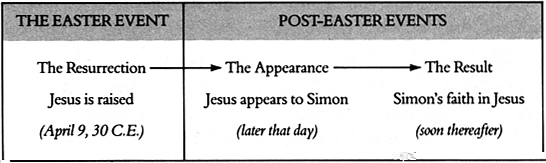
However, the actual sequence of events after the death of Jesus seems to be quite different, and on our hypothesis would look like the following:
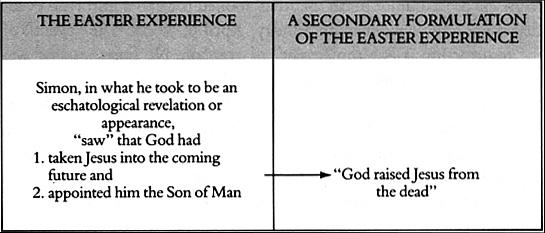
108
Some remarks are in order about this second–and, I maintain, correct–hypothesis concerning the sequence of “Easter events.”[26]
THE EASTER EXPERIENCE: Something happened to Simon and the other disciples in the order of space and time, perhaps even over a period of time–an experience that could have been as dramatic as an ecstatic vision, or as ordinary as reflecting on the meaning of Jesus. In any case it was an experience to which no one else, whether believer or nonbeliever, could have direct, unmediated access. In fact, not even Simon could claim unmediated access to the experience he underwent: He knew it only by interpreting it. Eventually Simon and/or the others would speak of his experience in one of the many apocalyptic symbols that were at hand: “Jesus has appeared to Simon.” As we shall see below, such an appearance need not have been a physical-ocular manifestation of Jesus. Simon understood his experience as an eschatological revelation that Jesus had been appointed the coming Son of Man. Simon now believed that God had taken his prophet into the eschatological future and would send him at the imminent end of time to usher in the kingdom.
A SECONDARY FORMULATION OF THE EASTER EXPERIENCE: The rescue of Jesus from death and his exaltation to the status of Son of Man soon came to be codified in yet another of the available apocalyptic formulae: “God has raised Jesus from the dead.” Eventually “resurrection” became the dominant and even normative term for expressing what Simon and the disciples believed had happened to Jesus.[27]
But even then, for the early believers to speak of Jesus’ resurrection from the dead did not mean that they looked back to a historical event that supposedly happened on Sunday, April 9, 30 C.E. The “event” of the resurrection is like the “event” of creation: No human being was present, no one could or did see it, because neither “event” ever happened. Both creation and the resurrection are not events but interpretations of what some people take to be divine actions toward the world. Thus, all attempts to “prove the resurrection” by adducing physical appearances or the emptiness of a tomb entirely miss the point. They confuse an apocalyptic symbol with the meaning it is trying to express. For Simon and the others, “resurrection” was simply one way of
109
articulating their conviction that God had vindicated Jesus and was coming soon to dwell among his people. And this interpretation would have held true for the early believers even if an exhumation of Jesus’ grave had discovered his rotting flesh and bones.[28]
In short, the grounds for Simon’s Easter faith were neither the discovery of an empty tomb (Simon most likely did not know where the prophet was buried) nor the physical sighting of Jesus’ risen body (this is not what an eschatological appearance is about). Easter happened when Simon had what he thought was an eschatological revelation, which overrode his doubts and led him to identify Jesus with the coming Son of Man.[29]
What I have stated thus far is obviously a hypothesis, and the question now is whether the Scriptures support such an interpretation or whether it too is only a fanciful reconstruction with no more basis than the mythical “Easter chronologies.” To test the hypothesis, we must turn to the New Testament texts. As we noted earlier, the first recorded mention of Simon’s experience was written down twenty-five years after the fact. The claim is found in an epistle of Paul, an itinerant Jewish evangelist who had converted to the Jesus-movement a few years after the crucifixion. Let us turn now to Paul’s text in order to see how he interpreted Simon’s experience.
110
3. An Early Formula of Faith
Within a few years of Jesus’ death a kerygma (a proclamation of faith in Jesus) began to circulate in certain synagogues of Palestine and Syria. It declared that Jesus, having died and been buried, had been raised up on the third day and–here was the first mention of it–had appeared to his followers. Paul himself learned the formula soon after he joined the Jesus-movement around 32-34 C.E., and he both recorded and expanded it in his First Letter to the Corinthians, which he dictated some twenty years later, around 55 C.E.[30]
In its expanded form, Paul’s kerygma went beyond the mere statement that Jesus had appeared. It went on to list those who had experienced an appearance of Jesus. Stated in direct discourse, the expanded kerygma that Paul recorded in First Corinthians declared that Jesus
died for our sins
__ in accordance with the Scriptures,
and was buried.
111
And he was raised on the third day
__ in accordance with the Scriptures,
and appeared to Cephas
__ and then to the Twelve.Afterward he appeared to more than five hundred brethren,
__ most of whom are still alive, though some have fallen asleep.Afterward he appeared to James,
__ and then to all the missionaries.Last of all, as to one untimely born,
__ he appeared also to me. (I Corinthians 15:3-8)
This formula, which is among the earliest written statements of Christian faith, is striking for one thing that it does not say: It neither mentions nor presumes the discovery of an empty tomb on Easter Sunday morning. The kerygma says merely that Jesus “was raised”–that is, was taken up (in whatever fashion) into God’s eschatological future–but not that he physically came out of his grave. Paul does not mention the empty tomb in any of his writings, and it is far from clear that he even knew of it. It is clear that an early Christian evangelist could preach the triumph of Jesus, his entry into God’s eschatological presence, without mentioning the alleged emptiness of Jesus’ grave.[31]
In this section we shall put two questions to this early kerygma. First, we must ask whether the Pauline kerygma, insofar as it is cast as a sequence of events, intends to provide an “Easter chronology” of historical happenings running from Good Friday through Easter Sunday and beyond. That is, our first question is whether Paul’s kerygma necessarily commits believers to some chronological progression like the following:
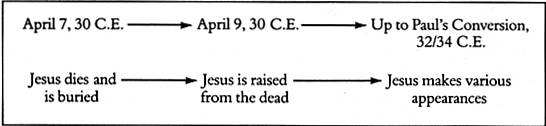
Second, given the emphasis that the formula puts on the appearances to Simon and the other disciples, we shall ask what this text can tell
112
us about the way or ways in which Jesus allegedly appeared to his followers after he died. Specifically, we shall ask whether Paul’s kerygma in First Corinthians is committed to physical, visible manifestations of the risen Jesus.
AN EASTER CHRONOLOGY?
The kerygmatic formula recorded in First Corinthians almost gives the impression of an inchoate Easter chronology, a mythical sequence of events in which first Jesus died and was buried, then he was raised from the dead, and afterward he appeared to Simon and the other disciples. But such is not the case. Consider the following points:
First: Paul’s formula makes no statement about either the time or the place of Jesus’ being raised. As regards the “time” of the resurrection, the phrase “on the third day” is not a chronological designation but an apocalyptic symbol for God’s eschatological saving act, which strictly speaking has no date in history. Thus the “third day” does not refer to Sunday, April 9, 30 C.E., or to any other moment in time.[32] And as regards the “place” where the resurrection occurred, the formula in First Corinthians does not assert that Jesus was raised from the tomb, as if the raising were a physical and therefore temporal resuscitation. Without being committed to any preternatural physics of resurrection, the phrase “he was raised on the third day” simply expresses the belief that Jesus was rescued from the fate of utter absence from God (death) and was admitted to the saving presence of God (the eschatological future). The raising of Jesus has nothing to do with a spatio-temporal resuscitation, a coming-back-to-life in Jerusalem on Easter Sunday morning. “Resurrection” is an apocalyptic term for “being definitively saved by God.”[33]
Second: If, in keeping with the above interpretation, the raising of Jesus is conceived of as a divine act of supernatural, eschatological salvation that took place outside space and time, then no one, whether a believer or not, can have natural, historical access to it as if it were an event that took place one day in the past. We have historical access not to such a supposed event but only to certain faith-claims, made first of all by Simon and then by other of the disciples, that God saved Jesus
113
from the dead. What is more, neither Simon nor any other of the original believers had any natural, historical access to the raising of Jesus. In fact, no scriptural text describes the resurrection and no one claims to have witnessed it. Simon, the original believer, came to hold that the kingdom which Jesus had preached was soon to be fulfilled–indeed, that Jesus was now living in God’s future–on the grounds of an experience that Simon interpreted as an eschatological revelation. The experience and Simon’s first interpretation of it constitute his “Easter experience.” But that interpretation does not, and on its own terms could not, commit Simon to a date in time when an alleged raising of Jesus–a nonhistorical, eschatological act of salvation by God–would have taken place. As we suggested earlier, this “raising” was not an event at all but a secondary apocalyptic interpretation of what Simon had experienced about Jesus.
Third, therefore: In searching out the origins of Christianity, the furthest back we can go in history is not the “resurrection of Jesus,” not even the alleged appearance of Jesus to Simon, but only Simon’s interpretative claim to have received a revelation that the words and works of Jesus were definitively vindicated by God. Earlier than Simon’s “Easter experience” the only relevant event to which we have historical access is the death and burial of Jesus.[34] The text in First Corinthians gives us no warrant to postulate a historical event called “resurrection” which occurred between Jesus’ death and Simon’s experience, and the text gives us no grounds for saying that Jesus’ alleged resurrection took place chronologically before his alleged appearance to Simon.
The terms “resurrection” and “appearances” do not indicate temporal happenings at all. They express faith-interpretations rather than historical events, and they point to apocalyptic eschatology rather than to natural history. Moreover, these two apocalyptic interpretations can be neither separated one from the other nor dated relative to each other. Paul and the other believers of his time could not credibly assert that Jesus had been taken up into God’s future without also claiming that Jesus had been made manifest from there (how else would they have known that Jesus had been raised?). Nor could they claim that Jesus had appeared from the eschatological future without likewise asserting that he had been assumed into it (otherwise they could not
114
claim that Jesus had been revealed as risen). But this interconnectedness of resurrection and appearance does not entail a temporal sequence (“first he was raised, then he appeared”) or even a causal one (“because he was raised he therefore appeared”).
Thus Paul’s text says nothing about earthly activities of Jesus after his crucifixion and gives us no grounds for constructing an Easter chronology in which the resurrection would be a historical event that happened before yet another historical event called the appearance to Simon. Indeed, if both the resurrection and the appearance of Jesus are only derived apocalyptic interpretations of what Simon “saw” in Galilee and what other believers “saw” after him, then as regards the origins of Christianity the only relevant historical event following Jesus’s death was Simon’s experience. If Paul’s kerygma points us backward at all to any “Easter events” in the historical past, it leads us not to a resurrection in Jerusalem one Sunday morning, not even to subsequent appearances of Jesus to Simon and others, but only to the disciples’ interpretative claims that they experienced the triumphant Jesus. The text points us to hermeneutics rather than to history.
Even though Paul’s text is, in fact, innocent of a mythical “Easter chronology” of the risen Jesus, it nonetheless seems to record the church’s first halting step in that misguided direction. As we shall see in the next chapter, the codified interpretation “Jesus was raised on the third day” would eventually be taken as a datable, historical event that took place once at a specific point in time at Jesus’ tomb in Jerusalem. And the formula “Jesus appeared to Cephas” would quickly develop into the elaborate gospel stories of Jesus’ postresurrection apparitions throughout Palestine.
HOW DID JESUS APPEAR?
According to Paul’s list, Simon was the first person to experience an eschatological manifestation of Jesus; and in asking now about the way or ways in which Jesus showed himself after he died, we shall focus entirely on that appearance to Simon. (When I speak about “appearances” in what follows, I am of course referring to alleged appearances–experiences that Simon and the others claimed to have had–with
115
out passing judgment on whether or how those “appearances” actually happened.)[35]
In mentioning Jesus’ appearances to Simon and the others, Paul in I Corinthians does not relate how or where these manifestations took place. To be sure, elaborate narratives about such appearances would eventually make their literary debut in the Gospels of Matthew and Luke (ca. 85 C.E.), but that would not be until some thirty years after Paul’s First Epistle to the Corinthians and at least fifty years after the events these stories purport to recount. By contrast, in this earliest mention of Jesus’ appearances, written around 55 C.E., Paul does not provide narratives of such appearances but only bare formulaic statements stripped down to a personal subject (Jesus), a descriptive verb (“appeared”), and a personal object or dative (the people who had the experience).[36]
The verb “he appeared” is the most important element in the formula. Paul uses the Greek word ôphthê which is the third person singular, passive voice, of the aorist (past) tense of the irregular verb horaô “I see.” Ôphthê can mean equally that someone “made himself seen,” “showed himself,” or, when used with the dative, as it is here, “was seen by” or “appeared to.” Scholars point out that in the Septuagint (the Greek translation of the Jewish Scriptures), ôphthê renders the niph’al (simple passive) of the Hebrew verb ra’ah, “see,” which, when used with le, means “appear.” The Jewish Scriptures frequently use this Hebrew verb and its Greek translation to describe manifestations of God or angels, and the verb always puts emphasis on the divine initiative underlying the appearance rather than on the psychological or physiological processes by which the recipient experienced the manifestation.[37]
In Exodus 6:3, for example, Yahweh says to Moses, “I am the Lord, I appeared [ôphthên]to Abraham, to Isaac, and to Jacob, as God Almighty.” The finite verb here does not describe how God appeared to the patriarchs, whether by means of dreams or physical visions or spiritual insight. In fact, Genesis implies that God first “appeared” to Abraham as a voice: “Now the Lord said to Abram, ‘Go from your country … ‘” (12:1). in short, in these Old Testament contexts the verb horaô and its aorist form ôphthê indicate simply that God actively reveals something that was heretofore hidden. The verb leaves open the
116
question of how (that is, by what physical or psychological processes) the recipients experienced the manifestation.[38]
The same holds true in the text from First Corinthians. In the context of the passage, the verb ôphthê doesnot necessarily indicate the visual sighting of a physical object. For example, Paul lists himself as the last person to receive an appearance of Jesus. He is referring to his experience on the road to Damascus, which, for all its differences from Simon’s experience, is here described with the same verb (ôphthê kamoi, “he appeared also to me,” I Corinthians 15:8). However, in Luke’s three accounts of that scene, Paul hears a voice but sees nothing. In fact he is rendered temporarily blind by “a light from heaven, brighter than the sun” (Acts 26:13; cf 9:3, 22:6). Even more important, when Paul himself described this experience some fifteen years after it happened, he called it not a “vision” but more neutrally an apocalyptic “revelation” (apokalypsis, Galatians 1:12). “He who had set me apart before I was born, and had called me through his grace, was pleased to reveal his son in me [apokalypsai … en emoi]” (1:16).
What is more, the usage here of the verb ôphthê has a particularly eschatological sense to it that forces us to rethink the “temporality” of the appearances. The revelations or appearances to Simon and the others were not understood by them as proofs of a past event (a physical resurrection three days after Jesus’ death). Nor, strictly speaking, did these revelations point to an eternal present in heaven from which Jesus had manifested himself. For Simon, the Jesus in whom he believed had “future” written all over him: The “raising” of Jesus meant that he was already living in the final state of things that was soon to dawn on earth. As far as Simon was concerned, Jesus had appeared from that future, from God’s coming eschatological kingdom; and he was calling them into that future and into the apostolic mission of preaching its imminent arrival. Not to see that eschatological future meant not having seen the risen Jesus at all.[39]
I stress this last point in order to bring out the difference between, on the one hand, Paul’s bare formulaic statement “Jesus appeared to Simon” and, on the other hand, the elaborate and mythological apparition-narratives that emerge in the Gospels of Matthew, Luke, and John some fifty to seventy years later. These later legends, which are the basis of so much Christian art and popular mythology, would almost have
117
the reader believe that at a certain point in time Jesus “came back to life” in a preternatural body that could walk, talk, eat, be touched, and even levitate–with the effect that for six weeks Jesus was able to drop in on his disciples at any time or place (in a graveyard or along a country road or in the middle of a Sunday dinner) and disappear just as quickly.
For Simon, on the contrary, Jesus did not wander through Palestine in a resurrected body for forty days after his death. As far as Simon was concerned, the “appearance” he claimed to have had came from the eschatological future into which Jesus had already been assumed. Simon understood his “Easter experience” as a prolepsis of that future, an anticipation of the kingdom which was soon to arrive in its fullness. That is why neither Simon nor any of the other early believers claimed to see Jesus ascend physically into heaven, and why three of the four gospel writers do not even mention such an ascension [Luke is the exception: 24:50-51; Mark 16:19 is part of the ending added by a later author (16:9-20) and is not part of the original Gospel–ed.]. Such a journey was unnecessary, for the early believers held that God’s rescue (or “raising”) of Jesus from the dead meant that the prophet had thereby been taken into his Father’s eschatological future.
In conclusion: The text from First Corinthians–the first recorded mention of Jesus’ “appearances”–does not tell us how Jesus manifested himself after his death. The verb ôphthê simply expresses the Christian claim that Jesus “was revealed” from the coming eschaton in an entirely unspecified way. The manner in which he was made manifest is not mentioned and is not important. The text does not assert that Jesus appeared in any kind of body (be it natural or preternatural) that the disciples could see or touch, nor does it say that Jesus spoke to the disciples. In fact, since Paul makes no claims here about “visions,” with their physical and ocular connotations, it would be more accurate to speak not of “appearances” of Jesus but more neutrally of eschatological “manifestations” or “revelations.”[40]
To judge from Paul’s early formulation of faith, then, the raising of Jesus from the dead has no chronological date or geographical location ascribed to it and no connection with an empty tomb. In fact, the raising of Jesus seems to be no event at all, but only an expression of what Simon had experienced in Galilee. And as regards the appearance
118
to Simon, the text in First Corinthians, upon closer examination, calls into question the notions (1) that such an appearance was an “event” that occurred after Jesus had physically left his tomb and (2) that Jesus was made manifest to Simon in any visible or tangible way. Jesus’ “appearance” to Simon refers to the eschatological revelation that Simon claimed to have had in Capernaum. It names what we have been calling Simon’s Easter experience.
In other words, when we search for the origins of Christianity, we find not an event that happened to Jesus after he died (“resurrection”), or supernatural actions he allegedly performed (“appearances”), but only apocalyptic interpretations of an experience of Jesus that Simon and others claimed to have had. And the original interpretation underlying these later interpretations seems to have been that God had rescued Jesus from death and appointed him the coming Son of Man. Simon was not theologically equipped to devise an elaborate theology of what had happened to Jesus; rather, he was content to say that God still stood behind what the prophet had preached and would soon send him again. In that sense, the Father had “glorified” Jesus and had let him be “seen” as such.
The text in First Corinthians does not take us very far toward positively interpreting the meaning of Easter, but it does ward off some of the more extreme notions of popular Christianity concerning what happened to Jesus after he died. Now we take the next step. We have seen that Paul’s text incorporates a formula of faith that probably goes back to at least 32-34 C.E., that is, to within two to four years of the crucifixion. But we must tryto burrow even further back than that. We shall continue to probe Simon’s experience, but now we try to capture him in the last few hours before the crucifixion, on the night when Jesus was arrested and when Simon last laid eyes on the prophet.
119
4. The Denial of Jesus
We are trying to return to the very birth of Christianity, to the event that began the enhancement of Jesus’ reputation from eschatological prophet to divine cosmocrator. We have no illusions that we can return to supposed historical events called the “resurrection” or the “appearances” of Jesus. The furthest back we can go in history is Simon’s assertion of his belief that God had vindicated Jesus and that the kingdom was soon to come–an assertion which took the form of various apocalyptic statements, such as “Jesus appeared [from the eschatological future]” and “Jesus was raised from the dead.”
Behind Simon’s assertion of his renewed faith in the kingdom there presumably lay an as yet undetermined experience that could have extended over some period of time and could have been as simple as Simon’s reflection on the life and message of the dead prophet. Whatever the experience was, we have no access to it in an uninterpreted state; we cannot discover the raw psychological processes that Simon went through “before” he understood them in terms of Jesus and the kingdom of God. Such an interpreted experience is unavailable not just to us but to Simon as well, and in fact it is a contradiction in terms.
120
Human experience–that is, history–is not an “objective” succession of happenings in the world. Such happenings, whatever they might be, become history–that is, experience–only when they enter the sphere of human interpretation, which we call “language” in the broad sense (Greek logos). We know only what we interpret, and there is no way out of this predicament, this “hermeneutical circle,” for human beings essentially are the act of making sense (= logos or hermêneia). We cannot peek over the edge of our interpretations to see things or happenings “in the raw,” any more than we can step outside of our logos and see the world as it is without us.
Therefore, our effort to discover the birth of Christianity within Simon’s original Easter experience remains ineluctably caught in a hermeneutical web. As we look back to the origins of Christianity we see not pristine, untouched events but only interpretations: human experiences articulated in human language. Caught as we are within interpretations, our task is, first, to uncover Simon’s primordial interpretation of Jesus both before and after the prophet died, and then to interpret that interpretation. At the birth of Christianity we find–whether as believers or as nonbelievers–not happenings observable in the raw but a hermeneutical task.
What, then, was the original content of Simon’s Easter experience? To answer that question we must enter into the dynamics of Simon’s denial of Jesus on the night of the Last Supper. The matter is of paramount importance, for with Simon’s sin and eventual repentance we come to the innermost secret of the original Easter experience and thus to the birth of Christianity.[41]
The Gospels retrospectively put in Jesus’ mouth a prediction that Simon’s faith would falter when Jesus was arrested–but that he would “turn again” after Jesus had died. Luke, for example, has Jesus say,
Simon, Simon, behold, Satan demanded to have you that he might sift you like wheat, but I have prayed for you that your faith may not fail. And when you have turned again, strengthen your brethren. (Luke 22:31-32)
121
The text does not suggest that Simon’s failure would be an apostasy or loss of faith. Perhaps it was more a loss of nerve, a fall into doubt that severely tested his faith but did not entirely undo it. Simon’s movement from faith to doubt and his turning again to faith begin to reveal to us the content–that is, the primordial interpretation–of Simon’s eschatological Easter experience.
What, then, was Simon’s failure? Was it that, after protesting his loyalty so loudly at the Last Supper, he abandoned Jesus in the Garden of Gethsemane when the guards from the Sanhedrin came to arrest him? No, the flight from the garden had certainly been the wisest course, for how could a handful of perhaps tipsy and certainly sleepy men have fended off a band of armed soldiers? All things considered, the wisest course was not to mount a futile show of strength but to flee and save oneself for the future.
Or did Simon’s failure lie in the fact that later that night, when he was questioned in the high priest’s courtyard, he denied that he knew Jesus? No, that too was a prudent decision. The bystanders in the courtyard had no right to know who Simon was or whom he was with. Had they known, they might have seized him too, perhaps even had him crucified. No doubt Simon felt degraded by the incident, but it would be wrong to blame him for what was, after all, an expedient subterfuge. He might be faulted, perhaps, for not organizing a guerrilla band to storm the Sanhedrin and rescue Jesus (even though that would have been entirely contrary to the prophet’s wishes); but he should not be condemned for saving his life instead of needlessly throwing it away.
The Gospel says that after Simon had denied Jesus in the courtyard,
the Lord turned and looked straight at Simon, and Simon remembered the word of the Lord, “Before the cock crows today, you will deny me three times.” And he went out and wept bitterly. (Luke 22:61-62)
Much has been made of this wordless encounter between the guilty Simon and his captive master. It would seem that with that silent gaze Jesus was confronting Simon with his sin of abandoning Jesus. Is that indeed the case?
122
What was in that gaze of Jesus’? Was it anger at Simon for doing what Simon had to do? Was it sadness that Simon had denied knowing him? It is difficult to imagine that Jesus could have been so foolish and resentful–or that he so badly wanted a fellow martyr–that he would expect Simon to stand up in the courtyard of the Sanhedrin and declare, “I’m with him! Take me too!” If Jesus’ gaze was meant to confront Simon with his sin, that sin could not be the petty lie of denying that he knew Jesus.
Or did Simon’s sin consist in his not being at the foot of Jesus’ cross the next day? Perhaps Simon did feel regret at not assisting at Jesus’ final agony, but what difference would it have made if Simon had been there? His presence might have been a gesture of solidarity, a last act of friendship, perhaps even a chance for the disciple to purge himself of his grief. But as far as the history of salvation goes, it would have been an indifferent act.
Such attempts to identify Simon’s failure by sentimentalizing his sense of guilt–as, for example, Bach does in the Saint Matthew Passion--lead nowhere. Whatever remorse Simon may have felt for those acts, his failure was not that he abandoned Jesus or denied that he knew him. These acts in no way touch on Simon’s real flight and his denial of Jesus. To know how Simon sinned, we must see what he sinned against.
Simon had learned one major lesson from the preaching of Jesus: The apocalyptic line had been crossed, the dead past was over, God’s future had already begun. As we have seen, the name for the crossing of that apocalyptic line was “forgiveness”: the gift of God himself to his people, his arrival among them. Therefore, the entire point of the kingdom was to live God’s future now. But this did not mean looking up ahead toward the future in an effort to glimpse the imminent arrival of God, for he was no longer up ahead in time, any more than he was up above in heaven. He was with his people, in their very midst: “The kingdom of God is among you.” In that sense there was no more waiting, for forgiveness meant that the future–God himself–was becoming present among those who opened a space for him. Crossing the line into the future meant no longer searching for God in the great Beyond, but living the present-future with one simple rule: “Be merciful as your Father is merciful” (Luke 6:36).
123
Simon’s sin, his denial of Jesus, consisted in fleeing from and forgetting what he and all Jesus’ followers had become: the place where the future becomes present. His sin lay not in abandoning Jesus but in abandoning himself. If anything, he did not deny Jesus enough.
Simon’s sin was to have momentarily forgotten where Jesus dwelled, in fact where Simon himself had dwelled. Simon put his hopes on Jesus rather than on what Jesus was about. “Follow me,” the prophet had said, and he meant ” … into God’s present-future.” But Simon was a literalist. As the soldiers dragged his master away, he got up his courage and “followed at a distance” (Luke 22:54). In so doing he began walking back into the past. The Gospel records Jesus as saying: “No one who puts his hand to the plow and then looks back is fit for the kingdom of God” (Luke 9:62). Ironically, Simon was doing just that–looking back toward the dead past–when he followed Jesus from the Garden of Gethsemane through the dark streets of Jerusalem.
Simon’s sin did not lie in abandoning Jesus in Gethsemane or in denying him a few hours later but in following Jesus to the courtyard of the Sanhedrin. His fault was not that he denied Jesus but that he affirmed him too much and feared that if Jesus died, God’s kingdom would come undone. Simon had focused his attention so intensely on Jesus that he ended up taking Jesus for the kingdom and thereby mistaking the kingdom itself. In his desperate effort not to lose Jesus, Simon lost himself and his grip on the presence of God.
Once, when Jesus had told his disciples that his death was inevitable, Simon took him aside and tried to argue him out of it. But Jesus rebuked him: “Get behind me, Satan! You are on the side of men, not the side of God” (Mark 8:33). The point was clear: The only way to save Jesus was to let him die, and then to go on living the kind of life that Jesus had led, a life set entirely on the present-future, on God-with-man. For the rest, “Leave the dead to bury their dead” (Matthew 8:22).
This, I believe, was the real denial: Simon forgot that the kingdom of God-with-man was not any one person, no matter how extraordinary that person might be, that the kingdom could not be incarnated in any hero, not even in Jesus. By following his master to the courtyard of the Sanhedrin, Simon was setting his heart on Jesus rather than on the kingdom. He was turning Jesus into the last thing the prophet
124
wanted to be: a hero and an idol, an obstacle to God-with-man. Simon failed to see that the future had been given unconditionally and could not collapse with the death of one man–because the kingdom was not Jesus but God.
Simon’s threefold “denial” of Jesus in the courtyard of the Sanhedrin was a morally neutral and even a prudent act. The real denial of Jesus lay in holding on to Jesus and thereby forgetting what Jesus was about. Simon erred not in abandoning Jesus but in not abandoning him enough. The right way to acknowledge Jesus would have been to forget him, to let him go, to let him die, without regret. Simon had missed the point: Jesus “was” the kingdom only because he lived his hope so intensely that he became that hope, became the very thing he lived for. And having made his point as well as he could, Jesus had the good sense and courage to die and get out of the way.
After his failure, Simon “turned again.” He did see Jesus again–but only in the sense of remembering, re-seeing, the present-future that Jesus, by living out his hope, had once become. This was not a vision but a re-vision, Simon’s renewal of his former insight into the kingdom. This re-vision was the Easter experience, the rebirth of what Jesus had preached, just as what Jesus preached was a renewal of what had always been the case since the beginning of the world. This re-vision gave Simon his vocation to preach the same message as his master: The sinful past is over; God’s future becomes present wherever men and women live in justice and mercy. While Jesus was alive, he had become what he preached. Now that he was dead, his words were reborn in Simon’s proclamation.
The content of Simon’s eschatological experience was summarized in the simple message that he proclaimed, the same invitation and response that Jesus had preached. The offer was captured in the sentence “The kingdom of God is at hand,” and the demand was even simpler: “Repent” (Mark 1:15). These two parts of the message are reducible to each other, just as all later Christian doctrines are reducible to them. The message that “the kingdom is at hand” meant that God was with his people; but God was with mankind only if they “repented,” that is, changed the way they lived, and enacted the kingdom now.
What Simon experienced-both before and after Jesus’ death-was
125
not a “vision” but an insight into how to live. The question that gave birth to Christian faith was: “Master, where do you dwell?” (John 1:38). Following Jesus did not mean having a vision of the future but rather realizing that God’s future was already present wherever justice and mercy were enacted. Faith was not a matter of possessing the kingdom, but of living the kingdom by enacting one’s hope in charity. The kingdom could not be verified by any kind of “proof” except the proof of how one lived. The proof was all in the doing. In Jesus’ preaching, eschatology had been removed from the mythical context of apocalypse and had become a simple but radical appeal to be as merciful as the Father was. Therefore, for Jesus’ disciples to preach the nearness of the kingdom did not mean to pass on information about an imminent end of the world, but to live an exemplary life “worthy of God, who calls you into his own kingdom” (I Thessalonians 2:12). It meant dissolving eschatology into ethics.
But something else came of Simon’s insight. The core of his re-vision had been that the present-future was still a reality after the crucifixion, that Jesus’ word–the way he lived the kingdom of God-with-man–was true. But the manner in which Simon and the first believers articulated that insight came to be focused not on Jesus’ way of living but on Jesus himself. They announced that his word had been vindicated; and they expressed that vindication by saying that Jesus had been rescued, that is, taken into the eschatological future, and was living there now with God.
This reinterpretation of the kingdom was the first momentous step toward personifying the present-future and turning God-with-mankind into a single individual. In that sense, Simon continued his denial of Jesus by creating Christianity. He reified Jesus’ word, his way of living, into the man himself, and then identified the man with a kingdom that was not present but still to come. Simon gave God back his future by personifying that future as Jesus, who was soon to return. Henceforth, preaching the kingdom of God-with-man meant preaching Jesus as the one to come.
Here the prophet’s original message of God-with-man began edging toward the later Christian doctrine of God-with-one-particular-man. It was not yet a full-blown “ontological christology,” a doctrine of the nature of Jesus as divine (although that would come soon enough). At this point Simon and the others were interested in Jesus only for
126
the role he would play in ushering in God’s eschaton. For the earliest believers the name “Jesus” became a code word for the imminence of that eschaton. This was a portentous shift of focus. Now, alongside the prayer Jesus had taught the disciples–“Father, may thy kingdom come!” (Luke 11:2)–there stood another one: “Maranatha: Come, Lord Jesus!” (cf. I Corinthians 16:22, and Revelation 22:20).
This first step toward founding Christianity was a retreat from Jesus’ original message: It reinserted his trans-apocalyptic preaching into the apocalyptic expectations of the age. There is no doubt that Jesus himself was a child of his times and that his message was clothed in some apocalyptic imagery. But that garment fit loosely and not well. Jesus’ preaching transcended its own language: Its true meaning lay more in the way he lived than in what he said. After Jesus’ death Simon had an opportunity to rescue the core of that message–a unique way of living–from the symbols in which it was couched. But Simon, even more than Jesus, was a child of the age, and ultimately he missed his chance insofar as he interpreted his renewed insight in the apocalyptic terms of a future kingdom, perhaps an “appearance” and even a “resurrection.” He reified the future, sent it up ahead again in time, and identified that future with the Jesus who, he believed, was soon to return. The prophet’s message of urgency and immediacy–“Live the presence of God’s future!”–fell back into an apocalyptical eschatology, the awaiting of a future kingdom. Christianity is built on that mistake.
With Simon’s experience we are present at the turning point: the end of Jesus and the beginning of Christianity. That topic will concern us in a later chapter, but for now we must remain a while longer with the question of the resurrection, the “event” that Christianity proclaims as the basis for the dramatic change in Jesus’ reputation.
There is a text in Saint Mark’s Gospel that seems to overcome the hermeneutical distance that separates us from Jesus’ “resurrection” and that may allow us to discover an uninterpreted “Easter event.” That text, to which we now turn, recounts the story of how Jesus’ tomb was found empty on the Sunday after he died.
127
THE EMPTY TOMB
129
The appearance of Saint Mark’s Gospel, around 70 C.E., brought something radically new into the Scriptures: the first legends about what happened on the Sunday morning after Jesus had died. This event is of paramount importance, for it marks the first literary appearance of what was to develop into the “Easter chronologies” of Jesus’ postresurrection activities.
Mark’s Gospel was the first of the four to be written; the Gospels of Matthew and Luke would follow about fifteen years later (ca. 85 C.E.), and the Gospel of John would be written toward the end of the century. The only Christian Scriptures predating Mark’s Gospel are the epistles of Saint Paul, his ad hoc letters written during the fifties to bolster the faith of his converts. Whereas Paul’s writings hardly mention the life of Jesus except for his crucifixion, Mark’s Gospel presents the putative words and deeds of Jesus from his baptism in the Jordan to his death and burial. Strictly speaking, however, it is not a historical record of Jesus’ ministry but a faith-charged theological treatise that reflects the beliefs and concerns of later Christians, mostly Greek-speaking Jewish converts in the Mediterranean Diaspora.
130
Our concern here is with Mark’s last chapter, his narrative of what happened at Jesus’ tomb on the Sunday after his death. Before this Gospel appeared, scriptural proclamations of Jesus’ resurrection were limited to brief and simple formulaic sentences, such as “God raised him from the dead” (I Thessalonians 1:10). Mark continued the tradition of kerygmatic brevity with regard to the resurrection itself, but he also launched the new biblical genre of narrating stories about what took place immediately after the resurrection.[42] A close look at the final chapter of Mark’s Gospel and at other material in the New Testament may lead us to what actually happened at the tomb on April 9, 30 C.E.
131
1. Easter According to Mark
The Easter story that appears in the last chapter of Mark’s Gospel is brief, bare, and deeply disturbing. Besides failing to mention most of the events that traditional Christian piety associates with the first Easter morning, the gospel story ends without the disciples believing that Jesus had been raised from the dead. It concludes instead with the confusion and disbelief of the women who had gone to visit his grave: “They said nothing to anyone, for they were afraid” (Mark 16:8). Given their reaction, we might find ourselves, as we reach the last word of the Gospel, wondering how faith in the risen Jesus came about at all.
It was precisely this question that moved a later, anonymous Christian writer to flesh out Mark’s concluding chapter (16:1-8, the “first ending”) with eleven more verses (16:9-20, the “second ending”) that bring it into line with the elaborate appearance stories in the later Gospels of Matthew, Luke, and John.[43] However, the original Easter story in Mark–the one we shall focus on in this chapter–is about the confusion and fear that overcame the three women who visited Jesus’ tomb on Sunday morning with the intention of giving him a proper burial. The “first ending” runs as follows:
132
MARK 16:1-8
| I. SATURDAY NIGHT (VERSE 1)
And when the Sabbath was past, Mary Magdalene and Mary the mother of James, and Salome, bought spices, so that they might go and anoint him. II. SUNDAY MORNING (VERSE 2) And very early on the first day of the week they went to the tomb when the sun had risen. III. THE STONE (VERSES 3-4) And they were saying to one another, “Who will roll away the stone for us from the door of the tomb?” And looking up, they saw that the stone was rolled back; for it was very large. IV. THE ANGEL’S TWOFOLD MESSAGE A. The resurrection (verses 5-6) And entering the tomb, they saw a young man [= an angel] sitting on the right side, dressed in a white robe; and they were amazed. And he said to them:
B. A future appearance (verse 7) “But go, tell his disciples and [especially] Peter that he goes before you to Galilee; there you will see him, as he told you.” V. THE REACTION (VERSE 8) And they went out and fled from the tomb; for trembling and astonishment had come upon them. And they said nothing to anyone. For they were afraid. |
There is no more to the earliest recorded account of Easter Sunday morning, and no more to the written Gospel. Mark’s narrative ends there, abruptly. The events at the tomb provoke confusion and fear rather than joy and proclamation, and the women retreat into a hermetic silence. With no report of the birth of Easter faith, Mark’s account seems to leave Christianity stillborn at Jesus’ grave.
Moreover, when we compare Mark’s final chapter with the Easter accounts of the later Gospels and above all with the popular legends about Easter that have grown up over the centuries, the account strikes
133
us as stark and minimalistic. There are no guards at the tomb, no emergence of Jesus from the grave, no burial shroud left behind to prove that the prophet had risen from the dead. Notice what Mark’s Gospel fails to say:
First, Mark’s final chapter does not describe Jesus’ resurrection. As we have already seen, it was well over a century after Jesus’ death before the apocryphal Gospel of Peter (which the Church does not, in fact, accept as authentic Scripture) attempted to describe Jesus’ emergence from the tomb. There is no text in the New Testament that describes the resurrection of Jesus or that claims there were any witnesses to it. For if it indeed was an eschatological event, there would have been quite literally nothing to see. Mark stays within that tradition when he has the angel say simply, “He has been raised.”[44]
Second, Mark’s Easter story is characterized by a stunning absence: The risen Jesus does not appear at all. Indeed, according to this Gospel, once he was sealed in his tomb, Jesus was never seen again. It is true that the angel in the story does allude to a future appearance in Galilee (“there you will see him, as he told you”), but this may well refer to Jesus’ universal appearance at the end of time.[45] In any case, Mark’s Gospel gives no description of such an appearance and has nothing more to say about it. Nor, to be precise, does the angel tell Jesus’ followers to go to Galilee; and judging from the account of the women’s reaction, we get the impression that no one went. In fact, within the rhetorical structure of the narrative, the prediction of the future appearance seems to be tacked on as an afterthought to the centerpiece of the story: the announcement that whereas, yes, Jesus has been raised, he is in fact absent and unavailable to visitors. “He has been raised; he is not here.”
Third, we are struck by the effect that the angel’s message has on the women–or perhaps better, the lack of effect. As far as Mark’s story goes, the women do not believe the angel’s message about the resurrection, and they ignore his order to pass on the word to the disciples. They tell absolutely no one what they have seen and heard (oudeni ouden eipon, verse 8). This passage is the earliest account we have of the events of the first Easter morning; and if it were the only account, we might be left wondering how faith in the resurrection of Jesus originated among his disciples. In any case, Mark is clearly saying that
134
Jesus’ empty tomb is not the origin of that faith, and that if some women did discover such a tomb on Easter Sunday morning, the event led to confusion rather than to faith.[46]
Thus the earliest gospel account of Easter Sunday provides no description of the resurrection, only an announcement that it had happened; no description of a resurrection appearance, but at best only a prediction of one to come; and no indication that the scene at the tomb (if such a scene ever really took place) gave rise to Easter faith.
Nonetheless, for all these apparent defects, the genius of Mark’s story is precisely that it raises more questions than it answers. Mark’s story casts Easter in the interrogative mode, and yet his account may say more about Christian faith than the more mythological accounts that the later Gospels provide. According to the majority of exegetes, all the gospel accounts of the first Easter morning are legends, with or without an original historical base. It is unfortunate, however, that the church has usually preferred to read the later legends, and not this barer and more evocative one, at the annual celebration of Easter.
135
2. An Earlier Legend
Mark’s account of Easter morning occupies a vantage point midway between the elaborate Easter stories that are found in the later Gospels and the even starker oral narrative that exegetes generally agree preceded Mark’s own Gospel. For a moment let us stand at that middle point and look both forward and backward in time.
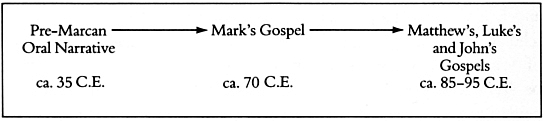
Looking forward in time from Saint Mark (70 C.E.), we find that the Gospels of Matthew, Luke, and John (written fifteen to thirty years later) make a qualitative leap in the way they treat Easter, in that they offer the first descriptions of Jesus’ postresurrection appearances. Those later Gospels give at least eight accounts of such apparitions, characterized by increasingly concrete physical details of Jesus’ apparitions (ingestion of food, showing of wounds, ascension into heaven, and so forth). But while these legendary additions to Mark are noteworthy, even more
136
important is what the later Gospels omit, namely, Mark’s story about the women’s scandalous disbelief and their frightened flight into silence.[47]
For example, fifteen years after Mark’s Gospel, Luke dropped the women’s disbelief altogether and changed their confused flight from the tomb into a simple “return” to Jerusalem in order to inform the apostles (24:9). Matthew, writing at about the same time as Luke, chose to have it both ways: the women are filled with both fear and “great joy,” and even though they still run from the tomb, it is to tell the disciples what they have seen (28:8). It is as if Mark’s stark account of the women’s fear and incredulity was too troubling for later generations of believers and therefore had to be changed.
Those later revisions of Mark unquestionably resulted in beautiful and moving stories–for example, Saint John’s sublime account of the meeting of Jesus and Mary Magdalene on Easter Sunday morning (20:13-18). But for all their mythological richness, these later Easter stories still leave us wondering about Mark’s startling claim that the first proclamation of the resurrection (by an angel, no less), along with the discovery of the empty tomb, failed to instill faith in the women. Where did Mark’s story come from, and what does it say about the resurrection? To answer those questions we must look backward in time from Mark’s Easter account to the oral story that preceded it.[48]
Whereas the final chapter of Saint Mark’s Gospel is the earliest written narrative of Easter morning, the tale about the women, the angel, and the empty tomb did not originate with him. Biblical scholars, using form- and redaction-criticism, have managed to sift out of Mark’s narrative what they believe is an earlier oral version, which he drew on and expanded, a legend that dates back to the primitive community of believers who lived in Jerusalem during the first few years after the crucifixion. The process whereby exegetes have arrived at this hypothetical earlier version is largely a matter of subtracting the editorial elements that Mark appears to have added to an earlier narrative. The process is complex, and here we shall only allude to some aspects of it, while keeping the details for later. For example, as we shall see below, minor details of the gospel version–such as the women’s purchase of spices with the intention of anointing the body (verse 1) and their discussion about the stone as they walk to the tomb
137
(verses 3-4)–seem to be later (and generally incongruent) additions that Mark edited into an earlier and simpler narrative that he inherited. And most important, the striking contrast in Mark 16 between the angel’s prediction of a future appearance of Jesus (“But go, tell his disciples … that he goes before you to Galilee; there you will see him,” verse 7) and the conclusion of the narrative (“And they went out and fled from the tomb … and said nothing to anyone,” verse 8) seems to indicate that the promise of a future appearance of Jesus is a Marcan addition to an earlier story that neither narrated nor alluded to any appearances at all. When these presumably later elements are subtracted from the last chapter of Mark’s Gospel, the original oral legend that the evangelist drew upon looks like this:
THE EARLIER, PRE-MARCAN ORAL VERSION
| I. SUNDAY MORNING (= MARK 16:2, 4)
Very early on the first day of the week Mary Magdalene [and perhaps some other women] went to the tomb when the sun had risen. They saw that the stone was rolled back. II. A SIMPLER MESSAGE: ONLY RESURRECTION (= VERSES 5-6) Entering the tomb, they saw a young man [= an angel] sitting on the right side, dressed in a white robe; and they were amazed. He said to them:
III. THE SAME REACTION (= VERSE 8) They went out and fled from the tomb, for trembling and astonishment had come upon them. They said nothing to any one. For they were afraid. |
This story is even starker than the one found in Mark’s final chapter, for the women flee from the tomb not only without faith in the resurrection but also without Mark’s promise of a future appearance that might eventually lead them and others to believe that Jesus had been raised.
Have we, with this earlier version, arrived at “what really happened” on the first Easter morning? We must remember that this hypothetical oral tale is still a religious legend that makes no claim to giving a historical account of what actually transpired at the tomb on
138
Easter morning. As regards the origin of this pre-Marcan tomb narrative, some exegetes have made the plausible case that the original occasion for the telling of this story was a liturgical celebration held at least annually at Jesus’ tomb. Within that liturgy, the story functioned as an “etiological legend,” a narrative that justified the religious service by explaining its alleged origins.[49]
In the first decades after Jesus’ death, the theory claims, believers made pilgrimages to Jesus’ grave “very early in the morning on the first day of the week,” presumably on what we now call Easter, but perhaps even more frequently. At the tomb they would hear a story about women who came there after the crucifixion, found the tomb open, and encountered an apocalyptic messenger who announced that Jesus had been assumed into God’s eschatological future. The pilgrimage reached its climax when the liturgical storyteller proclaimed, “He has been raised,” and then pointed to the tomb: “He is not here; see the place where they laid him.” The pilgrims’ trip to the tomb to “seek Jesus of Nazareth, who was crucified” was meant to end with the insight that the journey in a sense had been fruitless–for why should they seek the living among the dead?
Before delving into this earlier narrative, we would do well to pause for a moment and consider the various stages in the evolution of the Easter story over the sixty years between the death of Jesus and the writing of the last Gospel. (See the accompanying chart.)
It would seem that, whatever may have happened in the days and weeks after Jesus died, the narratives that purport to relate the Easter period developed incrementally from
(1) a pre-Marcan story in which an apocalyptic angel announces that Jesus has been raised, but does not mention any appearances at all, to
(2) Mark’s story, in which the angel, after announcing the resurrection, also alludes to a future appearance in Galilee (which is never described), to
(3) the later evangelists’ narrations of a variety of appearances that allegedly take place in Jerusalem and Galilee.[50]
The increment between Stage One and Stage Two is relatively modest, whereas the leap to Stage Three–that is, from the allusion to an
139
THE EVOLUTION OF THE EASTER STORY
| First Stage: An oral story is invented by the community in Jerusalem (ca. 35 C.E.?).
The pre-Marcan narrative (perhaps an etiological legend): __ The resurrection is proclaimed. Second Stage: The oral story is expanded and written down by Mark (ca. 70 C.E.). The Marcan narrative (16:1-8): __ The resurrection is proclaimed. Third Stage: The story grows; elaborate appearance-narratives are added in the Gospels of Matthew, Luke and John (85-100 C.E.). For the first time appearances are narrated, in the Gospels of Matthew, Luke and John and in the appendix to Mark (16:9-20). __ Details and physical concretion increase. |
140
appearance (which, in fact, may refer to the parousia) to the concrete description of multiple appearances in Palestine–is quite dramatic. The years between 70 and 85 C.E. seem to have been the period when the elaborate “Easter chronology” of popular Christian piety was born.
Our first step back behind Mark’s Gospel has provided us not with a historical record of what “really happened” on the first Easter Sunday but only with another, if earlier, religious story. Whether or not we believe the story’s message, it is necessary, if we hope to understand its point, that we stay within its rhetorical boundaries, at least initially, rather than try to look over its edges for an underlying historical event. In other words, we must perform a “phenomenological epoche,” a provisional suspension of concern about the historical realities that may lie behind the tale. Our purpose in performing this suspension of concern is to find out first of all what the legend is saying, before we look into the question of where it came from and whether it is true. Let us begin, then, with some general remarks about the way this early, pre-Marcan legend works.
Like any story (but unlike a historical report), this narrative has a double focus, one explicit and the other implicit. Its explicit or “thematic” focus is set on certain narrative events, specifically the visit of some women to Jesus’ tomb on the Sunday after he died. But it also has an implicit and unthematic focus, which is directed not upon the narrated events but upon the person who is listening to them. We may call this the “rhetorical focus,” not only to call attention to the story’s forms and styles of narration but also to emphasize the effect those forms and styles are meant to have on the person who is listening to the tale.
Whereas the original, pre-Marcan Easter story is thematically focused on the women’s visit to Jesus’ tomb on the first Easter Sunday, it is rhetorically geared to building up faith in the listener. That is, the narrative’s final purpose is precisely not to refer the listeners to an event that supposedly happened in time past but rather to confront them with their own faith-decision in the present moment. To be sure, it is quite legitimate to seek out whatever historical events may lie behind the narrative; but such an enterprise requires that the inquirer, at least
141
provisionally, step outside the story and, to that degree, miss its point. However, the rhetorical structure of this narrative is calculated to hold the reader within the tale and, from within the tale, to confront the reader with the possibility of believing in the resurrection. The narrative effects that purpose in part by allowing the listener to understand more than the subjects of the story do. Whoever follows the story line–peeking over the characters’ shoulders, as it were, and overhearing the dialogue–is expected to get the point, even if the protagonists do not.
What, then, is this early oral story attempting to say?
You, the listener, are the story’s rhetorical focus, its reason for being told. The narrative is directed entirely to you. It confronts you with a question as you too accompany the women on their visit to the tomb. You listen, and whether or not you share the storyteller’s faith, simply by listening you are drawn into the movement of the narrative and are invited to get its point. And no doubt you do. You realize that the story is urging you to believe that “Jesus, the crucified one whom you seek, has been raised” (cf. Mark 16:6).But you also notice–this is equally the point of the story–that the women who are the narrative’s thematic focus do not understand the message. Instead of believing, they run away in fear and tell no one what they have seen. It would seem, then, that the story is confronting you with a decision and inviting you to do precisely what the women did not do: to believe that Jesus has been raised rather than to flee in confusion.
But is it as simple as that? It is true that the listener is faced with a straightforward decision to believe or not to believe in the resurrection–but he or she is also faced with a puzzling question: What about those who came looking for Jesus and, despite an angel’s assurance, fled without believing he was raised? How did such a scandalous story of disbelief find its way into a narrative that ultimately seeks to inspire people to an act of faith in the resurrection? The question about the women’s disbelief is not peripheral to the story but is an essential element of its rhetorical appeal for faith. That is, the question arises from within the story’s rhetorical boundaries and, if it is to have meaning for faith, must ultimately be answered from within those boundaries.
We could, of course, deal with the question of the women’s disbelief
142
by stepping outside the rhetorical confines of the original oral narrative–either by historical deconstruction or by literary reconstruction.
The first option would be to attempt to go back behind the story: to demythologize or deconstruct the narrative and search for the historical events that gave rise to it in the first place. For example, as a first step we might postulate that the women who actually came to the tomb on the first Easter morning did in fact find it empty–without, of course, seeing an angel or hearing him announce the resurrection–and that their response was to flee in confusion. Then we might surmise that this historical fact was so well known in the early Jerusalem church that the author of the original oral legend could not ignore it. And finally we might propose that in the interest of Christian belief the author invented the angel and the angel’s announcement of the resurrection in order to provide a faith-explanation for the emptiness of the tomb. Such a historical-“deconstructive” interpretation does have the advantage of helping to clarify how the element of the women’s incredulity found its way into the original legend. However, it fails to explain the rhetorical function of that incredulity within the story.
The second way to deal with the women’s faithless flight from the tomb is the method chosen by the four evangelists. It too entails stepping outside the original legend, but this time not in the backward direction of the historical past but rather in the forward direction of the literary future. This option consists of changing future versions of the story so as to play down the element of disbelief. Utilizing this option, Mark, of all the evangelists, stays the closest to the original legend. He does retain the (arguably historical) element of the women’s confusion and flight, but he also minimizes the starkness of it, at least somewhat, by adding the promise of a future appearance (Mark 16:7). Unlike Mark, however, the other evangelists either omit the women’s disbelief altogether (Luke) or dispel it by rewriting the story so as to have Jesus appear to the women soon after they leave the tomb (Matthew).[51] These later revisionist myths may have the advantage of edifying the faithful by covering over the element of doubt and confusion; but they do not help us at all to understand the narrative structure either of Mark’s Easter story or of the pre-Marcan oral legend.
143
Whatever their advantages, both of these options overstep the boundaries of the original legend and therefore cast no light on the rhetorical function of the women’s confusion in the original story. Therefore, I propose a third option: Rather than stepping outside the pre-Marcan narrative, let us remain within it for a moment and allow it to speak to us in the way it spoke to the proto-Christian community in Jerusalem. Since the question of the women’s disbelief arises within the story, let us see whether the story itself provides an answer to that question.
The original legend clearly implies that the emptiness of the tomb does not of itself inspire faith. Presumably the women in the story accept the angel’s invitation to “see the place where they laid him.” They look, and yet the sight of the empty tomb does not move them to believe that God raised Jesus from the dead. At this point in the narrative the rhetorical sequence is of utmost importance. Notice that the angel’s proclamation “Jesus has been raised” (verse 6a) comes before he draws the women’s attention, for the first time, to the fact that the tomb is empty: “He is not here; see the place where they laid him” (verse 6b). In a strict sense the emptiness of the tomb is not discovered by the women; it is pointed out to them by the angel, in fact after his proclamation of the resurrection.[52] This matter is very important, and some conclusions may be drawn from it.
First: The empty tomb is not a proof of the resurrection. The angel does not say that the tomb is empty and therefore Jesus has been raised, but that Jesus has been raised and therefore the tomb is empty. It is the resurrection that explains the tomb, not vice versa. Of itself the empty tomb leads to confusion rather than faith.
Second: Not just the empty tomb but even the angel’s announcement that Jesus has been raised does not bring about faith. Having heard the proclamation and seen the empty tomb, the women simply flee without believing that Jesus has been raised. As listeners, we are expected to understand that if the angel’s kerygma did not bring the women to believe, neither will it instill faith in us. That is, if one does not have faith already, neither the pronouncements of angels nor the emptiness of tombs can provide it. The source of Easter faith must lie elsewhere.
Third: The listener is therefore meant to understand that the women’s confused flight and subsequent silence is in fact the appropriate response to
144
the scene at the tomb. It is rhetorically understandable that the women tell no one what they have heard and seen, for the point of the story is that angels’ words do not effect faith (they did not for the women in the legend, and they will not for the listeners) and that empty graves of themselves say nothing about a resurrection. The women’s flight in disbelief is not an embarrassment to Christian faith but rather is the very point of the story: Those who go looking for Jesus in a tomb (be it empty or occupied) are left in the dark.
Therefore, what may have seemed at first to be an improper ending for a Christian Gospel turns out to be appropriate and illuminating: It shows that one approach to the resurrection is a dead end. The legend refers the listener not to the empty tomb or the angel’s message but primarily to his or her own faith–or lack of it. Upon reflection we see that the women could not believe the angel and that optimally the listener does not need to. The story is narrated not in order to effect faith in the listeners but in order to strengthen the faith that they are presumed to have already. And if one does not have that faith, the angel’s pronouncement is useless.
The legend does not say what the source of that faith might be, but since this is an eschatological story, we may deduce that that source of Easter faith is God’s “future” (that is, God himself) insofar as it is becoming present. It is clear that the narrative does indeed point beyond itself–not, however, to an alleged happening in the past, since the story’s purpose is precisely to show that such past “events” do not bring about faith. The point of the story is that it is nothing but a pointer; and the listener gets the message by following that pointer, that is, by looking not into the tomb but into God’s present-future.
The pre-Marcan oral legend about Easter is a gem of storytelling which brilliantly subverts its own apparent theme. Far from being a deficient skeleton that needs to be fleshed out with the promise of appearances (as in Mark) or even with appearance stories (as in the other three evangelists) in order to communicate its message, this stark oral narrative is one of the richest parables about the kingdom of God-with-man to be found in the Christian repertoire. Like all parables, it confronts the listener with a question and a decision, and its narration of thematic “events” is solely for the sake of leading the listener to insight and commitment. Like many of the parables, it hinges on surprise and the reversal of expectations. Here the parable
145
destroys the hope that seeing an empty grave could lead one to believe that Jesus has been raised from the dead. It subverts the theme of a pious visit to Jesus’ tomb in order to deliver a very different message: that something other than an empty sepulcher is required to motivate Easter faith.
The emptiness of the tomb does have a positive function in the legend, but it is not an apologetic one. The sentence “See the place where they laid him” was not an invitation to look outside the parable and into the tomb for a historical “proof” that Jesus had been raised. The listeners were expected to see that the absence of a corpse does not prove the resurrection any more than the presence of one disproves it. The narrative invited them to believe in the victory of Jesus regardless of the empty tomb.
If the story presumes that its listeners already believe in the resurrection before the angel’s announcement and apart from the empty tomb, where does that belief come from? The genius of the pre-Marcan parable was that it did not answer the question, either for the women who appear in the narrative or for anyone who listens to it. The community that originally recounted the oral story was content to leave the question unanswered. That is, their legend says nothing about appearances of Jesus that might lead people to believe that he had been raised from the dead.
Even Mark’s later revision of the legend did not answer the question of how Easter faith came about. His Gospel does have the angel allude to a future appearance of Jesus (” … go to Galilee; there you will see him,” verse 7), but Mark describes no such appearance, and in fact the angel’s allusion may well refer to Jesus’ hoped-for second coming at the end of time.[53] We have, in that verse, the mere hint of an answer to the question of how Easter faith arose. Mark points to Galilee, the place where Jesus had preached the kingdom and where Simon had his Easter experience of Jesus’ role in the eschatological future. Mark may be suggesting that all faith in the resurrection goes back to a single source, which is not an “event” that happened to Jesus three days after he died. The source of Easter faith, both for Simon and for all believers since, is not the historical past but the eschatological present-future.
However, just as hearing the angel’s announcement did not move the women to believe, so neither will hearing the news about Simon’s eschatological experience lead anyone else to faith. Such proclamations
146
might set the stage for belief, or reinforce an already existing faith, but each new believer must undergo the experience for himself. Jesus must be revealed-and-believed to have been raised into God’s future, or otherwise everything is beside the point–angels’ messages, empty tombs, and apostolic proclamations included. This was already the unspoken point of the original Easter legend, and Mark’s reference in verse 7 to the experience in Galilee merely drew out the implication. He made no attempt to describe the revelation, for it can only be experienced. Therefore, he simply pointed into the eschatological future where Jesus “goes before you.”
147
3. What Really Happened
We have already taken one step behind the first written account of Easter to a hypothetical earlier version. Can we now take another step, even further back, and arrive at the original historical event that happened at the tomb on Easter Sunday morning?
The primitive pre-Marcan narrative that we have just discussed offers little help in taking such a step back. Although we can establish the story’s relative antiquity, it is the antiquity of a legend, not a historical record.[54] It is quite possible that the pre-Marcan Easter narrative is based on some historical memory of what actually happened at the tomb on the first Easter, but that recollection has been so totally assimilated into the legend that it is difficult to distinguish the authentically historical elements. Moreover, if the legend did indeed function as an etiological justification of a liturgical visit to the tomb, then the possible historicity of the recollection is even further blurred. The symbiotic relation of the liturgy and the etiological legend tends toward a closed circle: The legend exists to explain and justify the liturgical cult, and the cultic practice codetermines the form and content of the legend that explains it. Using the original legend
148
to establish facts about the first Easter morning is somewhat, if imperfectly, analogous to using the Genesis legend to reconstruct the creation of the universe. Both legends–that which describes the creation of the world and that which describes the “new creation” effected by Jesus’ resurrection–exist not to recount events that took place in the past but to inspire faith in God in the present.
However, even though all the gospel accounts of the first Easter morning are legends, some recalcitrant historical factors still push through the surface of those narratives.
First, the women. All the Gospels give the names of certain women who first came to the tomb; and even though the lists of names differ from and even contradict one another from Gospel to Gospel, one name, that of Mary Magdalene, appears in every account. Could this fact reflect an accurate historical recollection of at least one person who came to the tomb on the first Easter morning?[55]
Second, the tomb. The existence of the pre-Marcan etiological account, with its phrase “See the place where they laid him,” would seem to argue that the Jerusalem community claimed to know the location of Jesus’ tomb–or at least the location of a tomb which they venerated as that of Jesus. But was the venerated tomb the same one in which Jesus had actually been buried? We must note at least three things.
First, if the Acts of the Apostles is correct in stating that the religious authorities, not the disciples, buried Jesus, then it is very possible that those buriers disposed of the corpse in a common grave. In that case, it is not likely that the tomb that the Jerusalem community venerated (which presumably was not a common grave) was the one in which Jesus had been buried. Second, it is also possible, as all the Gospels assert, that Jesus was buried in a private grave by a sympathetic (or at least law-abiding) member of the Sanhedrin, Joseph of Arimathea. In that case, given the possible haste of the burial and the desire not to contaminate other already interred bodies with the corpse of a criminal, it could well be true that the tomb in which Jesus was buried was a new one, “where no one had ever been laid,” as John asserts (19:41). Thus the chances would be increased that the Jerusalem community would know the tomb in which Jesus was buried.[56] Third, regardless of whether Jesus was buried in a common grave or a private tomb, it seems that the women disciples did not help with his burial and that
149
they may not, in fact, have witnessed it. But Mark does assert that “Mary Magdalene and Mary the mother of Joses [or Joset] saw where he was laid” (15:47), even if they did not see him being laid there. The Gospels of Matthew and Luke, which draw upon Mark’s, follow him on this matter; John’s Gospel stands alone in not mentioning it.[57] It seems plausible, therefore, that if Jesus was buried in a private tomb rather than a common grave, the early church did know where that tomb was and did venerate the site.
Finally, the date. It was the custom in Palestinian Judaism to visit the graves of relatives and friends for some time after burial to ensure that the deceased had not been entombed alive.[58] Some scholars believe that mourning reached its height on the third day, when, at least according to certain rabbis, the soul was thought to leave the body definitively. A visit to the tomb on the Sunday after the crucifixion would correspond to contemporary custom and thus may reflect a historical fact.[59]
It is possible, therefore, that the Easter story preserves a historical memory of at least the “who,” the “where,” and the “when” of an original event. That is, (1) Mary Magdalene (2) went to a certain tomb (3) on the Sunday after Jesus’ death. However, other elements of the legends, both in the gospel accounts and in the early oral version, seem to be historically questionable. Let us look at some of those.
THE ANOINTING
The motive Mark gives for the visit to the tomb–to anoint Jesus’ body–is of dubious historicity.[60] In the first place, it is not certain that the anointing of bodies was customary in Palestine at the time of Jesus; and even if it was, we may presume that the women knew that, given the warm Palestinian climate, Jesus’ body would already be in an advanced state of decomposition by Sunday morning. Secondly, in the days of Jesus, even the crucified were carefully buried in accordance with Jewish law, and Mark’s account gives no indication that Joseph of Arimathea neglected any of the Jewish customs in burying Jesus.[61] Thirdly, the Gospels do not agree about the anointing. Matthew, who was familiar with Mark’s Easter narrative, omits mention of the
150
anointing altogether; in his telling, the women go to the tomb simply to see it (28:1). Luke retains the anointing as the women’s motive for visiting the grave, but he has them prepare the spices late Friday afternoon (Luke 23:56), rather than on Saturday after sunset, as in Mark (16:1). Although John does not mention Mary Magdalene’s reason for going to the tomb, it certainly was not to anoint the body, for according to John’s Gospel (19:39), Joseph of Arimathea and Nicodemus had already given Jesus what amounted to a royal burial on Friday, using “a mixture of myrrh and aloes, about a hundred pounds [!] in weight.” All of these elements cast into doubt the historicity of the anointing as the women’s motive for going to the tomb.[62]
THE GUARDS
Matthew is the only one of the four evangelists who claims that the religious authorities set a guard at Jesus’ tomb, and virtually all modern exegetes consider this story to be a relatively late apologetic legend.[63]
According to Matthew’s story, on the day after Good Friday the chief priests and Pharisees–at the risk of violating the Passover Sabbath–went to Pilate and told him:
Sir, we remember how that imposter said while he was still alive, “After three days I will rise again.” Therefore order the sepulchre to be made secure until the third day, lest his disciples go and steal him away and tell the people, “He has risen from the dead,” and the last fraud will be worse than the first. (27:63-64)
Pilate tells them to use their own guard (presumably Roman soldiers detached to the high priests) to secure the tomb. “So they went and made the sepulchre secure by sealing the stone [presumably this too would have violated the Sabbath] and setting a guard” (27:66).
The next day, according to Matthew’s story, an earthquake struck as the women approached the tomb, and an angel descended from heaven, rolled away the stone, and sat on it. “And for fear of him the guards trembled and became like dead men” (28:4). The guards remain
151
unconscious during the angel’s message to the women (“He is not here, for he has risen as he said”)–but afterward “some of the guard went into the city and told the chief priests all that had taken place.” The religious authorities then bribe the guards to keep quiet about the event:
Tell the people, “His disciples came by night and stole him away while we were asleep.” And if this comes to the governor’s ears, we will satisfy him and keep you out of trouble. (28:13-14)
The story is rich in apocalyptic imagery (the earthquake, the angel, the fainting of the soldiers) and equally full of questionable elements: How did the priests know about Jesus’ prediction? Would they have violated the Passover Sabbath as they did, first by visiting Pilate and then by sealing the tomb? Did Roman soldiers actually witness the appearance of an apocalyptic angel? How could they have reported “all that had taken place” if, as the Gospel says, they “became like dead men”?
Matthew’s purpose in devising this legend is revealed at the end of the story: “So [the guards] took the money and did as they were directed; and this story has been spread among the Jews to this day” (verse 15). Matthew’s tale was created in order to answer the widespread Jewish charge that the resurrection of Jesus was a hoax. Among other things, Matthew wanted to claim that the religious authorities admitted the emptiness of the tomb but explained it away by saying the disciples stole the body.[64]
THE STONE
The stone at Jesus’ tomb raises a number of questions that bring us to the heart of what happened on the first Easter morning. All the gospel accounts of Easter use the stone as a prominent stage prop, almost as a character in the drama. However, its role is negative. Like the leader of a Greek chorus (in this case, a silent choragus) or like Socrates’ daimon, the stone acts as a negative “voice of conscience,” not telling us what is going on but warning us away from erroneous interpretations.
152
It casts its shadow over the entire scene and leads to some questions about what might have happened.
Let us grant the historicity of the claim that after the burial on Friday afternoon, a stone was rolled in front of Jesus’ tomb.[65] But at that point the problems begin. In the first place, if indeed the stone was “very large” (megas sphodra, Mark 16:4), its size throws doubt on Mark’s story about the women’s intention to anoint the body of Jesus. If, as Mark relates, Mary Magdalene had already seen Jesus’ tomb on Friday (15:47), it is highly unlikely that she and other women would set off to anoint Jesus and only along the way begin to wonder “Who will roll away the stone for us from the door of the tomb?” (16:3). This incongruity between the women’s intention to anoint the body and their initial oblivion to the problem of moving the stone may explain why the later Gospels change Mark’s story. It could be the reason why Luke, although (for whatever reason) retaining the motif of anointing, omits the query about the stone, and why Matthew and John entirely drop the women’s intention to anoint the body of Jesus.
Second, the stone compels us to make some distinctions about the resurrection. Granted the likelihood that there originally was a stone in front of Jesus’ tomb, does it matter for the resurrection of Jesus whether or not the stone was rolled away? No, not at all. For surely a resurrected Jesus would not require that the exit be cleared in order for him to leave the tomb. If his body was still such a prisoner of space that he would have been trapped inside the tomb unless the stone had been removed, then either he did not have a risen body or he was in for some bedeviling problems in the days and weeks ahead.
Whether the stone was found rolled away or in place says nothing one way or the other about a resurrection. if the tomb was still sealed, at most the women would have been unable to discover whether or not the tomb was empty–that and nothing more. They probably would have spent some moments mourning outside the tomb (cf. John 20:11) and then gone home. But as they wept outside the tomb, with the entrance blocked, the tomb could have been empty because Jesus had been raised; or the corpse could have been inside without Jesus having been raised; or the corpse could have been inside even though Jesus had been raised; or, if someone had rolled the stone back in place
153
after rolling it away, the body could be gone (for example, it could have been stolen) without any “resurrection” at all.
Third, if the stone was in fact rolled away, how did that come about? Was it by divine or human intervention? (Of course, it could have been moved by a natural occurrence–an earthquake–but the results would have been the same as those discussed below.)
Regarding divine intervention, we have seen that Jesus himself, if risen, would not have required a way out of the tomb. In fact, if we take Matthew’s Gospel (even with its apocalyptic trappings) as a clue, the stone was rolled away after Jesus was raised from the dead (Matthew 28:2). Nor can we seriously imagine that God arranged for the stone to be removed so that it would serve as a sign for the women (or the guards) that Jesus had been raised from the dead, for in neither case did it work to that end. Apparently, then, there was no reason or need for God to intervene and roll the stone away. A risen Jesus would not have required it and the women would not have understood it.
Therefore, if we postulate that the stone was in fact rolled away, and if we ask how that was done, we are left with the answer: It was moved by human hands. Here a number of possibilities present themselves.
First, the stone might have been moved by a still living and unresurrected Jesus, with or without the help of others (the trance theory or, in a more spectacular form, the “passover plot”). According to such theories, Jesus was not actually dead but only in a faint when he was put in the tomb. When he regained consciousness and got back his strength, he, either by himself or with the help of people outside, removed the stone so that he could get out. Then he left the tomb and died elsewhere. Later, when the grave was found empty, it was said that Jesus was risen from the dead.[66]
Second, the stone could have been moved by Jesus’ followers sometime after Jesus’ death and burial (the stolen-body theory). To be sure, there was an acute problem of grave-robbing in Jesus’ time, but who would want to steal an entire corpse? The answer: only the disciples, who imagined that the absence of Jesus’ body might convince some people that he had been raised from the dead. In fact, some members of the religious establishment did accuse the early disciples of precisely
154
this hoax, and Matthew’s legend of the guards at the tomb was devised as a response to this accusation.[67]
Finally, the stone might have been moved by Joseph of Arimathea or others (the double-tomb theory). Perhaps after the crucifixion Jesus’ dead body was hastily buried in a makeshift grave and then, over the weekend, was moved to a different tomb, without his followers being told. On Sunday morning the women found the first grave empty and proclaimed a resurrection.[68]
In short, the stone at the sepulcher plays an important role in the Easter drama and lets us draw the following conclusions about the original historical event. First, the fact that there once was a stone in front of Jesus’ tomb casts doubt on the anointing motif. Second, whether or not the stone was moved says nothing one way or the other about a “resurrection.” And finally, if it was removed, it seems probable it was done, for whatever reasons, by human beings.[69]
At the end of this attempt to step out of the legend and back into the underlying events, we see how little has been gained. If we had any expectations of finding historical evidence that Jesus was raised from the dead, those hopes have been thoroughly dashed. Perhaps a historical residue can be found in the story, but it is very meager: Mary Magdalen and possibly some other women may have visited Jesus’ tomb on the Sunday after he died, found the stone removed from the entrance, perhaps even found that the corpse was gone, then fled in confusion and told no one. That much and no more may be the historical fact underlying the Easter legend.[70] But we cannot establish historically whether the tomb was indeed open and empty; and if it was, we cannot say why. All we can establish–with a very high degree of historical probability–is that to those who may originally have seen it, the empty tomb did not signify that Jesus had been raised from the dead. If indeed the tomb was found empty three days after the crucifixion, its emptiness originally had no “Easter meaning.”[71]
Has this attempt to step out of the pre-Marcan legend of Easter and to arrive at the historical fact of Easter been worthwhile? Yes, very much so, at least insofar as the failure of the effort has blocked yet another attempt to escape from hermeneutics and to seek refuge in
155
pristine “Easter events.” Just as Paul’s First Letter to the Corinthians opened no passageway back to such events, so neither does the Easter legend, even in its reconstructed original form. When we look behind the legend for historical events, we find not the resurrection but, at most, an unexplained empty tomb that provoked confusion and silence rather than faith that Jesus had been raised.
The original Christian community in Jerusalem was deeply troubled by that deathly silence of the tomb, that utter absence of Jesus. They began to speak into the dark cavity of the tomb and give it a meaning born of their disappointment and their hope. The women had fled into a silence that corresponded to the absence of Jesus; but the Jerusalem community began to fill that silence with words. They invented a story of an angel who appeared inside the empty tomb. Notice the probable steps in the creation of that marvelous legend:
First, the community of people who had followed Jesus during his lifetime heard about an apocalyptic revelation (“appearance”) that Simon had after Jesus’ death (cf. the formula, “The Lord has been raised indeed, and has appeared to Simon,” Luke 24:34). They too came to believe, quite apart from seeing an allegedly empty tomb, that God had vindicated his prophet, had taken him into the eschatological future, from which some day soon this Jesus would reappear as the apocalyptic judge.
Gradually, they and others began to use one particular apocalyptic formula (among the many available) in order to express their eschatological conviction. They said: “Jesus has been raised from the dead.”
Finally, they concretized that apocalyptic formula by connecting it with the site of the empty grave: They invented the story of an apocalyptic angel who was made to recite the resurrection formula to the women who had originally found the tomb empty. Only at that point did the otherwise confusing phenomenon of Jesus’ grave–if indeed it was found empty–first assume, at least for believers, an eschatological meaning: The tomb was empty because Jesus had been raised from the dead and taken into God’s future. Jesus was indeed absent, but he could be found: He was present with God in heaven.[72]
156
4. An Apocalyptic Messenger
It is not very likely that anyone who went to the grave on the first Easter Sunday met an angel who announced that Jesus had been raised from the dead. Modern exegetes are unanimous in interpreting the angel as a legendary figure, drawn from apocalyptic literature and used as a mouthpiece for the faith of the early church. The angel was born of the same disappointing conclusion that we reached in our step back into history, namely, that the empty tomb says nothing about a victory of Jesus over death. The early believers in Jerusalem realized that fact, and they invented the angel and his proclamation in order to turn the puzzling story about the emptiness of the tomb into a vehicle for their faith that Jesus had been taken by God into heaven.[73]
But mythical though he is, the angel is the centerpiece of the story, and if we interpret his role properly we will have answered many of the historical and theological questions that cluster around Jesus’ tomb. In contrast to the stone at the tomb, which functions in the Easter drama like a silent Greek choragus who warns us how not to interpret the scene, the angel has a speaking part and he directs us positively
157
to what the Jerusalem church thought was the significance of Jesus’ grave. The angel was invented to act as a role model for the listener, and he speaks forth what the community thought was the proper response to the empty tomb, namely the affirmation “Jesus has been raised.”
Who, then, is this angel? I propose that we take him for what he really is: not a supernatural being who actually appeared in a tomb one Sunday morning, but a dramatis persona who was invented to play a role in an early Christian legend. Later readers of the legend who mistake him for a real angel who appeared to some women on the morning of April 9, 30 C.E., misunderstand the literary form, and therefore the point, of Mark’s Gospel.
The Easter narrative, both in its pre-Marcan oral form and in the gospel version, is a legend, not a historical account. It is structured in the form of a drama, a religious play, and therefore could be mistaken for a piece of history. However, in order to grasp the story according to its proper literary form (and therefore according to the way it was originally meant to be understood), I propose to treat the text of Mark 16:1-8 explicitly as a drama, which I shall call “Easter at the Tomb.” If we look at the Easter legend as a religious play, the “angel” who appears at the tomb is, in fact, an actor who recites dramatic lines that were created for him, first by the early Jerusalem community (in Aramaic) and then by the evangelist Mark (in Greek). This approach may be strained at points, but it does help to clarify how the Easter legend developed from the early oral version to Mark’s written account and beyond.
To begin with, the actor who appears inside the tomb is not called an “angel” in either the oral or the written version of “Easter at the Tomb.” However, we may presume that no one in the original audience was confused about his identity. The early Jewish Christians had seen him on stage, as it were, many times before in intertestamental apocalyptic works such as Tobit or The Testament of Abraham, and he always had the same role. He was a stock character playing a stock part. He was the Apocalyptic Messenger, always disguised as a young man, always dressed in white robes, and he usually frightened those to whom he appeared. There was no misunderstanding in the original audience’s mind when they saw this character appear on stage in “Easter at the
158
Tomb”: He was playing a messenger from the eschatological future, and they knew that once he began to speak, they were in for an apocalyptic pronouncement from God.
Like any good actor, he read only the lines that were written for him. In the early Aramaic version of “Easter at the Tomb,” which appeared in Jerusalem some decades after Jesus had died, his role was not only to proclaim the community’s faith in the resurrection, but also to add some local color to that faith. The community set his role within the context of their own cultic veneration of Jesus ‘ tomb, and they had him say a word or two that went beyond the usual and rather bare formula of resurrection faith (“Jesus has been raised”). They had him point to the empty tomb and say, “He is not here. See the place where they laid him.”
In other words, this Apocalyptic Messenger was employed not simply to proclaim a resurrection (the community did not need him for that) but also to make that proclamation in such a way that it would shed light on the emptiness of the tomb and give it an eschatological meaning. But in the original Aramaic version of “Easter at the Tomb,” the actor’s role ended there. Even though the Jerusalem community probably knew of another, coequal formulation of faith (“Jesus has appeared to Simon”), it chose not to add that formula to the script–perhaps because that formula arose in Galilee, whereas the play was set in Jerusalem. In short, the resurrection formula (“He has been raised”) plus the added local color (“He is not here. See the place where they laid him”) were enough to express the Jerusalem community’s faith in the victory of Jesus.
But in Saint Mark’s Greek revival of this Aramaic “play” (in Antioch or Rome, around 70 C.E.), the evangelist created another line for the Apocalyptic Messenger in order to express the evangelist’s own theological viewpoint and the religious concerns of his Hellenistic audience. Mark and his community were interested in Jesus’ appearance after he died (whether that appearance was Jesus’ revelation to Simon in Galilee or his expected return on the last day), and the gospel writer felt he should at least allude to such an appearance. Therefore, while retaining the original lines written for the Apocalyptic Messenger, Mark also added another verse. After the “angel” proclaims the resurrection and points to the empty tomb, Mark has him continue:
159
But go, tell his disciples and [especially] Peter that he goes before you to Galilee; there you will see him, as he told you. (16:7)
And this is the version of the story that stuck. Mark’s “play” had a wider audience and a much longer run than the original Jerusalem version, and, as so often happens when particular interpretations of a role become well established, the script was revised–in this case fleshed out with the allusion to a future appearance–and became the accepted text.
We may draw some conclusions from this development of the Easter drama. First of all, at least two distinct interpretations of the Easter experience (of Simon and the other believers) circulated in primitive Christianity, and they took the form of brief kerygmatic sentences: “Jesus appeared” and “Jesus has been raised.” Where and how they originated we cannot say precisely, but it is probable that the appearance formula is earlier than the resurrection one. In any case, the two interpretations were equivalent ways of putting the eschatological experience into apocalyptic language. Neither formula, of course, was a substitute for the experience itself; that, the church insisted, was what made someone a Christian: the “Easter experience,” which Simon was the first to undergo.
The second conclusion that we can draw is that the drama of the empty tomb was merely a local illustration of one interpretation of that eschatological experience. As we saw, the members of the Jerusalem community gave the angel a script that combined the general resurrection formula with more specific elements relating to their veneration of Jesus’ tomb. In this way they localized the resurrection interpretation by associating it with a particular place (the tomb) and quasihistoricized it by connecting it with a specific moment in time (the Sunday after the crucifixion). Whether or not the community thought Jesus had actually been raised at that place and on that day (later Christians would certainly think he was) is irrelevant. The point is that this pseudo-localization and -historicization of the resurrection made sense only within the Jerusalem community that venerated the tomb. The legend originally had no function outside of Jerusalem and had
160
no binding power over the rest of the Jesus-movement. Simon in Galilee came to believe in the vindication of Jesus without even knowing about the grave of Jesus, and Paul never mentioned the empty tomb in his proclamation of the resurrection.[74]
The third conclusion is that when Mark absorbed the Jerusalem legend into his Gospel, he linked it with the other widespread tradition: the “appearance” of Jesus. To be sure, Mark did not effect a complete synthesis of the two traditions, since the apocalyptic angel in his Gospel merely alludes to a future appearance in Galilee. Nonetheless, by synthesizing these two very different formulae–the tomb scene and the appearance–in one and the same text, Mark launched the idiosyncratic local legend of the Easter angel (who would soon become two angels: Luke 24:4) on a much broader literary career, one that would eventually make that legend the normative way to proclaim the Christian faith. It seems that as late as 70 C.E., when Mark wrote his Gospel, an “appearance” still meant a “revelation from God’s eschaton,” and it did not necessarily have to have physical or visual connotations. As far as we can tell, no written descriptions of apparitions of Jesus were available at that time, only simple formulae such as “Jesus appeared.” However, by connecting the Jerusalem community’s localized and historicized interpretation of the resurrection-from-the-tomb with an appearance formula (“you will see him in Galilee”), Mark licensed the later evangelists to go a step further and create the elaborate mythical stories of how Jesus “physically” appeared to his disciples after he (and his body) had left his grave.
Fourth, by synthesizing three originally separate interpretations–a resurrection formula, an appearance formula, and a local tradition about the empty tomb–Mark’s Gospel helped reduce the plurality of interpretations of the eschatological experience to a single normative one and helped transform that increasingly normative interpretation into an “event” that had happened one Sunday morning in the past. Thus the final chapter of Mark’s Gospel opened the door to the creation of a narratable Easter chronology: “First Jesus rose, then he appeared, and then he ascended into heaven.”
Finally, Mark’s Easter account contributed significantly to the growing tendency to force Jesus’ eschatological message back into the Procrustean bed of apocalyptism which Jesus, to a large degree, had
161
managed to avoid. We shall take this matter up in the next chapter, but for now we may simply point out three stages in the reapocalyptizing of Jesus’ message.
(1) JESUS’ MESSAGE: GOD AS THE DAWNING ESCHATOLOGICAL KINGDOM.
Jesus’ preaching, like the Jewish tradition of which it was a part, was entirely about God–but not God as a nationalistic deity who intervened in history on Israel’s behalf, nor as the somewhat legal-minded divinity of the Pharisees, nor as some apocalyptic avenger who would soon destroy the world. Jesus preached God as a loving Father who was already reigning among his people. It was an eschatological message with a minimum of apocalyptic baggage.
(2) SIMON’S REVISION: THE KINGDOM BECOMES APOCALYPTIC.
By identifying Jesus with the coming Son of Man, Simon and the early believers reinserted Jesus’ transapocalyptic message of God’s presence into the myth of an apocalyptic future. Jesus, the proclaimer of God’s now-dawning kingdom, became identified with the apocalyptic judge who was to come at the end of time. The grammar and syntax of this new belief was apocalyptism, and it found expression in a number of coequal formulae, among them: Jesus is the coming judge, Jesus has appeared from the future, and Jesus was raised from the dead.
(3) CHRISTIANITY’S DOCTRINE: THE APOCALYPTIC BECOMES HISTORICAL.
Later believers narrowed that reapocalyptized vision even further by turning the resurrection into a historical event. They eventually took one local apocalyptic legend–a resurrection from a tomb–and made it a normative formulation of faith. They forced the message of God’s presence among men into the narrow framework of a local myth. Notice the levels of devolution:
A proposal of how to live
(“Be as merciful as your Father”)
which was originally expressed in
an eschatological symbol
(“The kingdom of God is among you”)
was revised into
162
an apocalyptic belief
(“Jesus will be the Son of Man”)
which was further narrowed to
one apocalyptic formula
(“Jesus has been raised from the dead”)
which was concretized in
a very local legend
(the empty tomb).
That legend eventually became the “thing itself ” Christianity took a local and idiosyncratic myth about what allegedly happened one morning in a tiny corner of Palestine, and turned it into a supernatural event that supposedly transformed the ontological structure of the world.
Jesus’ message, which had started as an invitation to live God’s future in the present, devolved into a dogma about what had happened in the past. What began as a challenge to work God’s mercy in the world was reduced to an apocalyptic myth. A movement that should have accepted the fact that Jesus was dead, and then gone on from there, ended up trying to hope him out of the grave.
Christianity has never pretended to be easy. It demands a difficult choice in the face of a stark either/or: Either Christ was physically raised from the tomb on Easter Sunday morning, or your faith–which means your life–is in vain (cf. I Corinthians 15:14). Christianity proposes, as an object of faith, the hard paradox of the resurrection, with the valence “Take it or leave it.” Over the centuries millions have chosen to take it. We can understand why others, both Jews and Gentiles, have preferred to leave it.
163
5. The Meaning of Easter
What we have just said is to a certain degree unfair. Popular devotions and bad theology notwithstanding, Christians do not believe in the resurrection of Jesus because of the empty tomb. No matter how vigorously the church may proclaim the Easter stories found in the Gospels, she does not believe in what those stories say. She believes, rather, in what the stories mean. Saint Thomas Aquinas is clear on this point: The object of faith is not the words of a text but the divine reality they point to. Thus, the church herself acknowledges that her scriptural texts and doctrinal pronouncements are only interpretations that require further interpretation.
If we allow, despite appearances to the contrary, that the “official” Christian interpretation of Easter is not the literalist one of a physical resuscitation on Sunday morning, April 9, 30 C.E., we are faced with the double task of discerning what that official interpretation is and whether or not we agree with it. However, the problem here is that the church has never clearly stated what she means by the “resurrection.” Or rather (and this comes down to the same thing), her theologians have very clearly stated what it means, but in very different and often conflicting ways.
164
Let us begin by surveying the spectrum of interpretations of Easter offered by Christian theologians in our own day. Our treatment is necessarily schematic. It covers three major positions, which I shall call the “traditionalist,” the “moderate,” and the “liberal.”
The traditionalist, or conservative, understanding of the resurrection is roughly the one outlined above, characterized by a literalization of the Bible’s apocalyptic imagery. It accepts the gospel texts at face value and insists that the resurrection was a historical event that happened on the first Easter Sunday. In its more extreme form the traditional position maintains that the resurrection included the resuscitation of Jesus’ body and its exit from the tomb, an event that could have been seen by eyewitnesses, or at least by believers. In this popular form, the traditionalist position goes beyond the New Testament and follows the lead of the Gospel of Peter. But whether in such extreme form or more moderate forms, the traditional approach takes the resurrection as an event that happened ante nos–before us in time.
The middle ground of the spectrum is occupied by the moderates, who maintain that something happened objectively to Jesus after his death, but that this “something” was not a historical event but an eschatological or supernatural happening that lay beyond time and human perception. That is, Jesus is somehow alive with God because of his resurrection; and this resurrection is generally taken to mean that Jesus, by his own divine power, overcame death and “physically” (the meaning of this is left somewhat open) entered into eternal glory.
In other words, moderate theologians tend to interpret the resurrection ontologically rather than apocalyptically: They purport to say what in fact really happened to Jesus after his death, but without emphasizing the Bible’s mythical imagery. The moderates hold that the resurrection is not historically ante nos but ontologically extra nos (outside of us), that is, a supernatural reality that objectively “happened” to Jesus, quite apart from whether or not anyone believes in it.[75] By saving what they think is the religious sense of resurrection (Jesus’ triumph over death) and relativizing the apocalyptic language in which it was originally cast, these moderate theologians remove some of the obstacles that the biblical accounts, especially when taken literally, put in the path of modern people who wish to believe in Jesus.
The third, or liberal, position tends to bypass the resurrection not
165
only as a historical event ante nos but also as an ontological happening extra nos. Liberal theologians are concerned not with the “resurrection” so much as with the genesis of the early church’s faith in Jesus. They emphasize less the objective and historical (what really is or was the case with Jesus himself) and more the subjective and functional, that is, how Jesus continued to have significance for his disciples after he died, what he meant to the early believers and could mean to Christians today. The focus is on the significance of Jesus pro nobis (for us), almost without regard to what may have happened to him after the crucifixion.
In other words, the liberal position not only deemphasizes the resurrection but also tends to relativize Jesus himself by making his meaning for believers more important than his personal history either before or after he died. Some liberal theologians, like the late Rudolf Bultmann, say that Jesus rose only “into the kerygma,” and that the ” resurrection” is only a proclamational symbol for the salvific meaning his death had for early Christians. Others, like the German theologian Willi Marxsen, argue that “resurrection” is merely an apocalyptic way of saying that the “cause” of Jesus–his message of the kingdom of God–continues to have meaning today.[76] What may have happened to Jesus “after” he died is not particularly emphasized by these liberal theologians. The more cautious will assert that Jesus is somehow alive with God; the more radical will assert that Jesus is presumably dead; and almost all of them will insist that the question is irrelevant to the point being made: that the meaning of Jesus is still alive regardless of what happened to him. Nonetheless, even the radicals who presume that Jesus is dead still consider themselves Christians insofar as they believe in the “cause” of Jesus, if not in his continuing personal existence. They believe that Jesus was fundamentally right in what he said and did and that he is a timeless example for others, even if he ended up permanently in the grave.
The interpretation of the resurrection that I propose draws on the best elements in all three of these positions but then goes beyond them. Like the traditionalists, I take the gospel text seriously–but as a text, a work of religious literature and not a document of history. Like the
166
moderates, I recognize that Christian faith, at least on its own claims, is based on something that is independent of an individual’s subjective psychological states. I maintain, however, that this “something” is not that Jesus is alive with God. Like the liberals I believe that the resurrection texts are about present meaning rather than past history. I hold, however, that the resurrection texts are not about the meaning of Jesus for Christians but about the end–the fulfillment and therefore the undoing–of both Jesus and Christianity. With reference to these three positions as a whole, I hope to show: that the Easter legends are not about the “resurrection”; that they proclaim the fundamental datum of faith to be the absolute absence of Jesus; and that they show the futility of searching for Jesus at all.
What, then, is the meaning of “Easter”? In what follows I use the word “Easter” as a heuristic device, a stand-in for the as-yet-unknown “X” that is the object of Christian faith and that has been interpreted apocalyptically in such legends as the resurrection story. Was Easter a historical event that took place three days after the crucifixion? Or a transhistorical “happening” in which Jesus somehow triumphed over death? Or the birth of faith in Jesus? Or is it something else? To answer these questions, let us return once more to the Easter legend and the historical events that underlie it.
SEEKING
Of the five lines the angel recites in Mark’s Easter legend, the most important one is not “He has been raised” but the preceding sentence: “You seek Jesus, the one who was crucified” (16:6). The word “seek” (zêteite, zêteis) appears in all the gospel accounts of the empty tomb, whether it is spoken by an angel, as in the Synoptic Gospels (Matthew 28:5, Luke 24:5) or by Jesus himself when he appears to Mary Magdalene (“Whom do you seek?”: John 20:15; cf. 1:38).
It is significant that in all these accounts the word “seek” always comes before any mention of either the resurrection or the appearances of Jesus. We have seen that both those formulae–“He has been raised” and “He has appeared”–are secondary and tertiary apocalyptic interpretations of a prior experience. Even the primary interpretation
167
(“Jesus will usher in the kingdom”) is an apocalyptic one. But behind all these apocalyptic interpretations, we find the meaning of Easter expressed nonapocalyptically within a hermeneutical circle of a “seeking” and a “sought-for.” To put the matter in general and formal terms, Easter is the “object” of a certain kind of seeking, it is something correlative to and inseparable from that seeking. With this we come to the “origin” of Easter, that is, to a primordial, preapocalyptic interpretation of what it means. And at these origins we find not history but hermeneutics, a circle of interpretation consisting of a certain kind of experience and its inseparable content. There is no way of knowing what that content is apart from the experience of seeking.
This much may not seem like a significant step toward understanding Easter, but in fact it is. By discovering that “Easter” is inseparable from the seeking which all the Gospels mention, we have accomplished two things. On the negative side, we have called into question the notion that Easter is an objective event, whether historical or eschatological, that happened to Jesus; that is, Easter is not about the “resurrection.” We have also challenged the idea that Easter was an “appearance” in the sense of an objective revelation that befell the disciples like a bolt from heaven. Easter (whatever it may be) “happens” only to those who seek it (whatever that seeking may be). At the origin of Easter we find not a past historical event but an ongoing hermeneutical task.
On the positive side, we have at last found what seems to be the primordial “place” where the first Easter happened, and it is not a tomb but a hermeneutical circle. It is here at this nonapocalyptic site that we must construct our own interpretation of Easter. And from now on, everything we can say about Easter comes down to what is meant by “seeking.”
In general and formal terms, all seeking is bound up with some kind of absence. No one seeks for what is already present and is known as such. But on the other hand, no one can search for what is totally absent, entirely unknown or unknowable. Plato makes the point in a negative way when he has Meno say to Socrates: “A man cannot search for what he knows, for since he knows it, there is no need to search for it. And he cannot search for what he does not know–because he does not know what to look for” (Meno 80e). To put this negative
168
thesis in positive terms: What makes the seeking possible is something sought-for which is absent but not totally absent. All seeking is initiated and guided by the absent as seekable, something desired but not possessed, something guessed at but not fully known, something partially present in its absence. Even if it is only an idea or an illusion, this absent “sought-for” is what prompts the search, gives it meaning along the way, and perhaps finally fulfills the search by being found at the end. The sought-for is the meaning of the search, inseparable from it and yet, in a logical sense, “prior” to (the a priori of) the search. And yet it can be known–to whatever degree that is possible–only by understanding the seeking, by following out its teleology.
THE END OF THE SEARCH
Let us flesh out these formal remarks on “seeking” with what the gospel text says about it and with what we ourselves can supply. The Easter legend is about two kinds of seeking and, therefore, two kinds of absence. The interpretation I shall give of Easter is based on yet a third kind of absence.
At the beginning of the Easter story the women are engaged in one kind of search that is guided by one kind of absence: the absence of the Jesus who was once alive. Like all who mourn for the dead, the women come to the tomb not primarily to look for the corpse but above all to look for what can no longer be found: the person they loved, who is gone forever. Their mourning is their search–their way of living into an absence that is excruciatingly present precisely because the absent loved one is not. These mourning women cling to two forms of the already fading presence of the now absent Jesus: a corpse–the tangible presence of a no longer tangible life–and a memory.
But in the legend (and apparently on the first Easter morning as well) that search was caught up short: no body, no vestige of his life to be seen and touched. Let us leave aside for a moment what may actually have happened to the body. What counts at this point is that the women’s search for Jesus was doubly frustrated because Jesus was doubly absent: Not only was he dead, but his corpse was gone. There were no remains at all. This search had come to absolutely nothing.
169
At this point there are two choices: either to invent an angel who will declare a resurrection, or to accept that Jesus is quite dead (wherever his corpse may be) and to draw out the consequences of that.
The church chose the first possibility. Enter the angel, and the meaning of the Christian search for Jesus is elevated to a higher, heavenly level. The Apocalyptic Messenger, speaking for the Jerusalem community, informs the women that the absence which brought them to the tomb was the wrong kind of absence, and that their search is the wrong kind of seeking. Jesus is absent from life, and his body is gone from the tomb, because the whole of him is present with God: “He has been raised, he is not here.” To this new level of absence there corresponds a new kind of search, and so Mark has the angel say: “He goes before you; you will see him.” In these Christian interpretations, Easter is Jesus, raised to a higher presence, the object of a higher search. For those left behind, Jesus’ presence in heaven means that his current absence from earth is only temporary, and it calls forth a temporary and provisional seeking, which will one day be rewarded with a final find.
Before we decide whether or not to follow the church’s path, let us for a moment step outside the Christian legend of Easter. Let us stand at the tomb with the women who actually came there on the first Easter Sunday. What do we find? No angel, no proclamation of the resurrection–and no corpse. This empty grave has, of and by itself, no resurrectional meaning. But to whoever discovers it, whether the women who were originally there in person or we ourselves who read a text, the historical fact of the emptiness of the tomb does have some meaning, even if it is only negative. What was the significance of the empty tomb before that emptiness came to be interpreted in terms of a resurrection?
Some women came to the tomb on April 9, 30 C.E., seeking the corpse of Jesus. They found nothing. They did not discover that Jesus was alive elsewhere, in heaven. They found, quite simply, that Jesus was unfindable. After his burial he was never seen again in any form, dead or alive. The primordial, preapocalyptic meaning of that scene at the grave on that Sunday morning is the utter absence of Jesus and the futility of the women’s search for him.
It is worth standing for a moment in front of that empty hole before
170
we decide to invent an angel to interpret it for us. Jesus is gone, and there is no forwarding address. He is lost, and, short of a miracle, he will never be found again. Some people did dream of such a miracle, and we can easily understand why. It is hard to lose a person who has so dramatically freed you, who has shown you the ultimate scheme of things and your place at the center of it. It is hard to lose a hero, an extraordinary man who woke you up from the pettiness of the everyday and led you beyond yourself, a liberator who proclaimed that you were living at the denouement of a cosmic drama that was being realized in his very words and deeds: God himself, your loving Father, was arriving and would live with you forever. It is hard to see all that die, to hear the prophet’s words fade into silence, to feel his presence dissolve into an utter and total absence. If, as the disciples hoped, these were the “last days,” the moment of the eschatological arrival of God, and if Jesus identified himself so entirely with that hope that he seemed to become it, could his Father really desert him in death? Would not God have assumed Jesus into the eschatological future which the prophet had so perfectly embodied when he was alive?
If God did not save Jesus, who was so close to God that he could call him “Abba,” what hope could there be for the rest of us? The confusion provoked by the empty tomb almost had to be turned into the certainty of Jesus’ resurrection; the women’s silence had to give way to the angel’s words, “He has been raised.” The seeking of Jesus that motivated the first pilgrimage to the tomb demanded an angelic messenger who would direct the search to a higher level: Jesus’ abiding presence with his Father, his merely temporary and provisional absence from those who sought him.
ABSOLUTE ABSENCE
The Easter legend is focused on two kinds of seeking that are correlative with two kinds of absence: the women’s fruitless search for the dead body of the crucified Jesus, and Christianity’s faithful search for the risen body of the glorious Jesus, who is absent from earth because he is present in heaven. In the Christian understanding of the tomb, the hopefulness of the second search is the answer to the despair that
171
motivated the first one. The correlation of the provisionally absent Jesus and the faithful search for him is what believers mean by “Easter,” that fundamental “X” which lies at the base of Christianity. Easter is neither an event that happened to Jesus in the historical past (as traditional theologians believe) nor some transhistorical triumph that he experienced after he died (as the moderates maintain).
Then, does Easter “happen” (as some liberal theologians hold) whenever a person interprets the meaning of his or her own life in terms of the experience of “seeking Jesus”? This third position poses as many problems as the other two. In the first place, what does “seeking Jesus” mean? It is open to any number of interpretations, ranging from “looking for him in heaven” to believing that “his cause goes on” even though Jesus is dead.
Is there, underlying these three strands of interpretation, some basic and normative interpretation of Easter, some solid criterion of faith by means of which we could decide what is and what is not a life dedicated to “seeking the risen Jesus”? If there is, who would supply that interpretation? Roman Catholics, for example, hold that Jesus, in his revelation, established an official teaching authority (the pope and the bishops) and gave them the divinely delegated power to make infallible pronouncements on what “seeking Jesus” properly means. But since the New Testament is, at best, ambiguous on the question of episcopal authority, those allegedly infallible interpreters of revelation must first interpret revelation as constituting them infallible before they can start making universally binding pronouncements about the correct way to “seek Jesus.”
In short, from its Easter foundations upward, Christianity is caught in a hermeneutical circle–in fact, Christianity is that circle–and you are either inside or outside. What is more, it is impossible to know whether you are inside or outside. At the very best you can declare–that is, interpret–yourself as being in one place or the other.
The problem (if it is that) of the hermeneutical circle of Easter lies in Christianity’s insistence that the ultimate meaning of human seeking is bound up with Jesus. And the only way out of that problem is to surrender Jesus: to leave him dead and to see that the meaning of Jesus is that Jesus himself no longer matters.
One last look, then, at the empty tomb–the real tomb of history,
172
not the one of the Christian legend. As we peer into that emptiness, the absence of the living Jesus and even of his dead body allows us to identify a unique form of seeking: the desire for that which can never be had. This unique kind of seeking is the experience that makes human beings different from any other kind of entity, and we see it exemplified in the women who actually found the tomb empty on the first Easter Sunday. Such seeking is not something we occasionally get caught up in; rather, it is what makes us human, constitutes us as the futile passion, the unfulfilled and presumably unfulfillable desire that we are. If we were not this endless eros, either we would be God, who cannot seek because he has already found everything, or we would be animals, those living entities that lack an “ontological imagination” and therefore never have a desire that exceeds the possibility of being fulfilled.
This fundamental desire, this seeking that constitutes human nature, is correlative to what I shall call “absolute absence.” Others might call this absence “the absurd,” that which is absolutely deaf (surdus) to our desire to render it present in any way. Absolute absence would seem to annul any search for itself–because it annuls itself. It does not and cannot exist. But the amazing thing is that the desire for it refuses to be quenched. This absolute absence, even though it does not exist in itself, continues to live a parasitic life within our futile desire for it. It dwells like a ghost in the rooms of our everyday lives, haunting all our doings with the dream of the impossible. Thus, beyond all our seeking for things that can be found (whether or not we actually find them), we find ourselves still directed to a “more” that does not exist. We remain, fundamentally, an act of questioning to which there is no answer. We find this endless and unfulfillable seeking, for example, in all kinds of faith, and in more ordinary forms of fruitless nostalgia, such as mourning for the dead. Perhaps its most dramatic manifestation is mysticism (from the Greek myein, “to keep silent”), that form of devotion to the absolutely unreachable in which the devotee is confined not just to silence about the “object” of his or her search, but even to silence about that silence.[77] If we prescind from the usual Christian interpretations, the historical fact of the empty tomb is about such mysticism and such silence. The alternative to inventing a resurrection is accepting the fact that Jesus,
173
regardless of where his corpse ended up, is dead and remains dead. This historical fact of the complete absence of Jesus does have religious significance: it means the end of religion. In a symbolic sense, the empty tomb was the last word that Jesus the prophet uttered. His mission had been to undo religion and its God and to put radical mercy, the living of the present-future, in its place. And at the end of his mission he, so to speak, dissolved even himself, wiped out every trace, left not even a corpse, only an absolute absence.
There is no Jesus to be found anywhere anymore, neither here nor elsewhere. The women who went to the tomb and found absolutely nothing–and we too who observe their pilgrimage–may leave the grave with the awareness that, as regards Jesus and his God, there is nothing to be found and therefore nothing to be searched for. The meaning of the dead prophet is an unsurpassable absence that cannot be changed into any form of presence. The absolute absence of the prophet and his God makes room at last for silent, unadvertised, and groundless mercy.
No one knows what happened to the body of Jesus. Stolen? Buried elsewhere? Miraculously resurrected? The point is that it does not matter and that we should not care. For believers, indeed for anyone who would seek the real meaning of Jesus, the proper response to the empty tomb is silence, even silence about that silence. The women who came to the tomb had the correct reaction. They took the path that led away from the tomb and away from Jesus himself. They went back to their own lives and to the meaning that Jesus’ message had taught them to find therein. Oudeni ouden eipon (Mark 16:8): They did not say anything to anyone.
Back to Part One—Back to Table of Contents—Go to Bibliography
NOTES
253
[1] For example, egeirô (to arouse, awaken, raise/make to rise) is used in the aorist passive voice (êgerthê: Jesus was raised [by God]) in Mark 16:6, Luke 24:6 and 34, Romans 4:25 and 6:4; and in the passive perfect (egêgertai) in I Corinthians 15:4 and 17. It is used in the active voice (êgeiren: God raised Jesus) in, for example, Acts 4:10, 5:30, 1 Thessalonians 1:10, I Corinthians 6:14. The verb anistêmi (to raise up), is used, for example, in Acts 2:24 and 32; 13:32 and 34; and once in Paul: I Thessalonians 4:14. Cf. Albrecht Oepke, “egeirô,” in Kittel, II, especially 333-337. Kremer argues that êgerthê is in the middle (rather than the “divine passive”) voice: “Auferstanden–auferweckt,” 97-98. For bibliographies on the resurrection see Bode, 186-200 (to 1970); Schelkle, II, 325, n. 87 (to 1973); Dhanis, 645-745 (to 1974); Perkins, Resurrection, 453-479 (to 1984).
[2] For popular histories of Jesus’ activities between Easter Sunday and Ascension Thursday see, for example, Edersheim, II, 621-652. For a summary of the most recent mainstream exegetical positions on the question of resurrection and appearances, see Kremer, Die Osterevangelien, 18-24.
[3] Since Jesus presumably was buried unclothed (Rabbi Eliezer held that “[a man is hanged] without his clothes”: Epstein, ed., The Babylonian Talmud, Seder Nezikin [Volume V], Tractate Sanhedrin [Volume I], chapter VI, 46a, translated by Jacob Schachter, 1935, P. 301), and since he reportedly left his burial garments in the tomb (John 20: 5-7), the question has been raised whether, according to John 20:14ff. , Jesus appeared naked to Mary Magdalen and others (“Erschien der Herr die 40 Tage hindurch immer unbekleidet?”: Kastner, 347). Kastner answers in the relative affirmative regarding the appearance to Mary Magdalene: 350-352; Brown dismisses the thesis: The Gospel According to John II, 990; cf. 991.
[4] On the discrepancies in the gospel accounts of Easter: Bode, 5-24; Bornkamm, Jesus, 181-183, 213, n. 4; Brown, Virginal Conception 99-106, 117-125; Marxsen, Resurrection, 72-74; Perkins, 91-93. The ne plus ultra of postresurrection chronologies of Jesus is found in Matthew Power, Anglo-Jewish Calendar for Every Day in the Gospels. Although Father Power got the dates wrong, he certainly got the traditional notion of Easter exactly right when he suggested the following chronology of Jesus’ departure from earth: “Thursday, June 7, A.D. 31: Ascension Day. Friday, June 8, A.D. 31: In Heaven” (92). Here and throughout the text I use the words “myth” and “legend” in regard to the Easter stories with the caveat that Alsup expresses (The Post-Resurrection Appearance Stories, 272) and as a stand-in for designating the Gattung “appearance story.” On the meaning of the word “myth” when used with regard to the Easter accounts, see further: Küng, On Being a Christian, 413-414, and Sloyan ” ‘Come, Lord Jesus.’ “
[5] Acts 1:22 implies that the necessary condition for taking Judas’ place among the Twelve was that one was “a witness of [Jesus’] resurrection” (cf. also 4:33). This did not mean that one had to have seen Jesus exit from his tomb but, as Fitzmyer says, only that Jesus had “appeared” to one. A Christological Catechism, 77.
[6] The text of the Gospel of Peter in English translation by Christian Mauer and George Ogg (here slightly revised) is found in Hennecke and Schneemelcher, New Testament Apocrypha I, 183-187, and is reproduced in Cameron, ed., The Other Gospels, 78-82 (the cited passages are on 80-81). See also Cameron, 76-78 and [continued…]
254
187-188; Crossan, Four Other Gospels, 125-181, esp. 165-178; Fuller, Formation, 189-192; Hennecke and Schneemelcher, 179-183; Küng, Eternal Life?, 98-99.
[7] Cf. Schillebeeckx: “[W]hat would a straight appearance of Jesus in the flesh prove? Only believers see the one who appears. … Faith is emasculated if we insist on grounding it in pseudo-empiricism”: Jesus, 710, n. 119. Cf. as well Mark 16:12: Jesus appeared “in another form” (en heterai morphêi).
[8] The New Testament never interprets Jesus’ resurrection as a “coming back to life,” that is, as any form of resuscitation or reanimation, but always as an entry into eschatological existence. Thomas Aquinas writes: “In rising, Christ did not come back to life in the usual sense of life as we all know it; rather, he entered a life that somehow was immortal and godlike”: Summa Theologiae III, 55, 2, C. Cf. Küng, Eternal Life?, 109, 112-114; Pesch, “Zur Entstehung des Glaubens … : Ein neuer Versuch” (1983), 88-89; Fitzmyer, A Christological Catechism, 77
[9] See Blinzer, “Die Grablegung Jesu in historischer Sicht,” in Dhanis, 85-87. The Roman (and, earlier, Greek) custom of leaving crucified corpses on the cross until they corrupted is attested in the extracanonical Tractate Semahot (properly: Ebel Rabbati). The tractate prohibits immediate members of the family of the crucified from living in the city “[u]ntil the flesh has wasted away, the features no longer being discernible from the skeleton”: Zlotnik, ed., The Tractate “Mourning,” p. 36. The family, however, could plead for the body: “No rites whatsoever should be denied those who were executed by the [Roman] state. At what point should the family begin counting the days of mourning for them? From the time they despair of asking for the body, even though they may still hope to steal it”: ibid., 9, p. 35.
Concerning the removal of a hanged or crucified person on the day of death: “If he is left [hanging] overnight, a negative command is thereby transgressed. For it is written, ‘His body shall not remain all night upon the tree, but thou shalt surely bury him the same day for he is hanged [because of] a curse against God (cf. Deuteronomy 21:23]’ “; Epstein, ed., The Babylonian Talmud, Seder Nezikin (Volume V), Tractate Sanhedrin (Volume I), chapter VI, 46a, translated by Jacob Schachter, 1935, P. 304 (cf. also 305).
[10] The Mishnah, in discussing the burial of criminals, notes that outside the walls of Jerusalem there were at one time at least two common graves for executed criminals: “And they did not bury him [the executed person] in his ancestral tomb, but two burial places were prepared by the Beth Din [the Jewish court], one for those who were decapitated or strangled, and the other for those who were stoned or burned. When the flesh was completely decomposed, the bones were gathered and buried in their proper place”: Epstein, ed., The Babylonian Talmud, Seder Nezikin (Volume V), Tractate Sanhedrin (Volume I), chapter VI, 46a; translated by Jacob Schachter, 1935, p. 305. (Concerning “the other for those who were stoned”: “All those who are stoned are [afterward] hanged,” ibid., 45b; p. 299, that is, on a cross [ibid., 46a; p. 304].) Likewise, the fact of common graves is mentioned in Jeremiah 26:23 (“the burial place of the common people”) and in Matthew 27:7 and Acts 1:19 (the potter’s field, known as Akeldama, the Field of Blood, for burying strangers). On the question of the historicity of Matthew 27:7 see Jeremias, Jerusalem in the Time of Jesus, 138-140. Blinzer, “Die Grablegung Jesu,” in Dhanis, 94, argues that there was only one criminal grave outside Jerusalem at Jesus’ time.
Various texts of the Gemara on the first sentence cited above (Sanhedrin VI, 46a) [continued…]
255
observe that “a wicked man may not be buried beside a righteous one” (ibid., 47a; p. 311; cf. Isaiah 53:9) and “Both death and [shameful] burial [n. 4: in the criminals’ graveyard] are necessary [for forgiveness]” and, in fact, “The decay of the flesh too is necessary [n. 6: for forgiveness]” (ibid., 47b; P. 314). And: “When is atonement effected? After the bodies have experienced a little of the pains of the grave” (ibid., 47b; pp. 314-315)
Blinzer, “Die Grablegung Jesu,” in Dhanis, 93-96, argues that, given the circumstances, Jesus should have been given the dishonorable burial of a criminal but that Joseph of Arimathea buried Jesus in Joseph’s own tomb because of the nearness of the Sabbath and the distance of the common grave from Jerusalem (94-96). For the point about the distance of the common grave, which is alluded to only in John 19:42, Blinzer adduces the very thin evidence of Jeremiah 22:19, Isaiah 53:9, and two texts from Josephus that pertain to ancient Israel (94) and the even thinner evidence of Acts 14:18, “outside the city” (98) and of a rabbinic text (97) that addresses a dead criminal: “[The] people did not put you in a coffin but dragged you to the grave with ropes”: Midrash Rabbah: Ecclesiastes (Koheleth Rabbah), chapter 1 (Freedman-Simon, VIII, 42, translated by A. Cohen), commenting on Ecclesiastes/ Qoheleth 1:15. The Mishnah, however, mandated merely that “graves … must be kept fifty cubits from a town [n. 6: ‘Because of the bad smell’]”: The Babylonian Talmud, Seder Nezikin (Volume III), Tractate Baba Bathra (Volume I), chapter II, 25a; translated by Maurice Simon, 1935, 123.
Brown argues that it is at least “[not] implausible” (Virginal Conception, 114) that Jesus was buried in a private rather than a common grave, and “[all] the Gospels make it clear that Jesus was not buried in a common tomb” (The Gospel According to John II, 943, my emphasis). Brown maintains that the claim that Jesus was buried in “a new tomb where no one had ever been laid” (John 19:41) most likely is an apologetic claim according to which “there was no confusion in the report of the empty tomb, for Jesus was not buried in a common tomb where his body might have been mixed with others” (The Gospel According to John, II, 959), although later (Virginal Conception, 114) he exempts the claim of the “newness” of the tomb (mnêmeion kainon: John 19:41; cf. Matthew 27:60) from apologetics: “[It] may reflect an authentic memory that, although buried privately, the corpse of Jesus, accursed as it was under the Law, could still not be allowed to contaminate other corpses in a family grave. Since there was an element of hurry in the burial of Jesus, the choice of a hitherto unused tomb close to the place of execution (John 19:42) is quite plausible.”
[11] All four Gospels (here Mark is the source of Matthew and Luke, whereas John represents a second, and independent, tradition) agree that Joseph of Arimathea buried Jesus. (John alone says that Joseph was assisted by Nicodemus, who brought the spices.) Brown observes: “There is every reason to think that the reminiscence of [Joseph’s] role in the burial is historical, since there was no reason for inventing him”: The Gospel According to John II, 938.
Who was this Joseph of Arimathea? Pesch maintains that even if the original Jerusalem community of believers knew that Joseph had buried Jesus, it is not clear that they knew Joseph personally. The primitive passion account that underlies Mark’s Gospel “speaks of Joseph not as a man who became a believing Christian; it portrays him as if from a respectful distance, which allows us to conclude that the [continued…]
256
community had no contact with this high-ranking figure”: “Zur Entstehung des Glaubens . . .” (1973), 206-207; cf. his Markusevangelium II, 513.
Mark calls Joseph of Arimathea simply “a respected member of the council [Sanhedrin], who was also himself looking for the kingdom of God” (15:43), whereas the later Gospels tend to promote him to somewhat legendary status. Luke, adding that Joseph was “a good and righteous man,” has him disagree with the Sanhedrin’s decision to have Jesus killed (23:50-51). Matthew elevates him to the status of “a disciple of Jesus” (27:57), and John adds that he was a disciple “secretly,” out of fear of the religious authorities (19:38). Insofar as Joseph was a member of the Sanhedrin, there may be no contradiction between, on the one hand, the Gospels’ claim that Jesus was buried by Joseph, and the statement in Acts 13:27, 29 that certain “rulers” (that is, members of the Sanhedrin) interred Jesus–perhaps even in a common grave.
[12] Jeremias calculates that the number of pilgrims who came to Jerusalem to celebrate Passover during Jesus’ time could have been anywhere between 60,000 and 125,000, over and above the resident population Of 25,000 to 30,000 (20,000 of whom lived inside the walls): Jerusalem in the Time of Jesus, 77-84, with update of research to 1966.
[13] On Jesus’ women disciples as the only witnesses of the crucifixion: Pesch, Das Markusevangelium II, 503-509; Zwischen Karfreitag und Ostern, 20-21, 76. Schenke (21) holds to the historicity of the flight of the disciples from Gethsemane in Mark 14:50 (cf 14:22).
Did the disciples flee to Galilee? Bultmann finds such a flight indicated in Mark 14:28 and 16:7: Theology of the New Testament, I, 45. Brown supports the idea of a flight, with the qualification that “[t]he exact moment of the flight of the Twelve from Jerusalem is not clear in the N[ew] T[estament]”: Virginal Conception, 108 and n. 181; in “John 21 and the First Appearance,” 257, Brown suggests that “after finding the tomb empty, Peter went back to Galilee puzzled and discouraged and resumed his occupation.” In Virginal Conception (108-109) Brown leaves open the possibility that Peter and the others may have fled Jerusalem without any discovery of an empty tomb; Brown adds that “news that the body of Jesus was no longer in the tomb would only have increased the puzzlement and fright of the disciples, if they heard it before leaving Jerusalem” (109). See also Fuller, Formation, 34f. Marxsen declares such a flight to be a “fiction”: Mark the Evangelist, 82, n. 101. Pesch says that an immediate flight (sofort nach Galiläa) is an “unwarranted assumption”; rather, the disciples probably first fled to Bethany (where Jesus and the twelve had been lodged during the last days), and if they fled to Galilee, they probably did so on Sunday morning at the earliest: Simon-Petrus, 49. Cf. Schenke for those who hold to the flight of the disciples (21, n. 30) and those who do not (22, n. 31). For a survey of the literature to 1970, see Bode, 32, n. 2.
[14] For a “biography” of Simon, see Pesch, Simon-Petrus, 10-134, with bibliography, 173-179; and “The Position and Significance of Peter,” 25-28; Brown et al., Peter in the New Testament, 158-162 and passim, with bibliography, 169-177. Concerning Simon’s name, see Fitzmyer, Essays, 105-112. On the excavations of what may be Simon’s house at Capernaum, see Corbo, especially 53-70 and Plan III at the end of the book. (Figures 21-23 [pp. 67, 68, 69] show photographs of two graffiti naming, respectively, Jesus and Peter, and of two fish hooks found on the floor of the house church.) Also Bagatti, Antichi Villagi, 94-95, and The Church from the Circumcision, 128-132.
257
[15] Concerning Matthew 14:22-33 Brown notes that “even if the general story [of Jesus’ walking on the water] is not easily made post-resurrectional, the incident that Matthew added about Peter may have been post-resurrectional” (The Gospel According to John II, 1088) insofar as the story contains “many of the features of a post-resurrectional narrative (and indeed features that have a startling similarity to those in the story related in John 21)”: Brown, “John 21 and the First Appearance,” in Dhanis, 252-253.
[16] The thesis that Easter faith first arose with Simon through a “first appearance” (or protophany) of the risen Jesus to him is based on such texts as I Corinthians 15:5, Mark 16:7, and John 21:1ff., taken in conjunction with Matthew 16:18, Luke 22:32 and 24:34. (On the relation of this last text and earlier kerygmas, see Alsup, 61-64-) The thesis is presented by, for example: Bornkamm, Jesus, 182; Brown, The Gospel According to John II, 1082-1092, Virginal Conception, 108-111, and “John 21 and the First Appearance,” in Dhanis, 246-265; Fuller, Formation, 34f.; Kremer, Das älteste Zeugnis, 67-71; Marxsen, Resurrection, 81-97; Pesch, “Zur Entstehen des Glaubens … ” (1973), 211-212, Simon-Petrus, 49-59, and “Zur Entstehung des Glaubens … : Ein neuer Versuch” (1983), 91-92; Schillebeeckx, Jesus, 385-390; Wilckens, Resurrection, 112. In “John 21 and the First Appearance” Brown holds that John 21:1-17 is “basically the lost account of the (first) appearance of the risen Jesus to Peter mentioned elsewhere in the NT” (248).
It is also possible that chronologically (but not “officially,” that is, not in terms of the commissioning of official witnesses) the first “appearance” of Jesus was to Mary Magdalen. See Pesch, Simon-Petrus, 51, and Zwischen Karfreitag und Ostern, 77-79; Benoit, “Marie-Madeleine,” esp. 150-152.
The popular Catholic notion that Jesus first appeared to his mother, Mary, goes back to the Christian poet Coelius Sedulius, Carmen Paschale (ca. 392 C.E.; a prose version is called Pascale opus), Book 5, lines 361-362: Migne, Patrologia Latina XIX (1846), 743.
There are good grounds for locating the protophany to Simon in Galilee. Cf.: Brown, in Dhanis, 250, n. 15, and 251; Virginal Conception, 108-111. Nickelsburg, “Enoch, Levi, and Peter,” esp. 590-600, connects the commissioning of Simon at Caesarea Philippi (Matthew 16:13-19) with a tradition about Galilee as the locus of divine revelation that Nickelsburg finds in I Enoch 12-16 and Testament of Levi 2-7. Günter Stemberger rejects the thesis in Davies, The Gospel and the Land, 409-438, esp. 429-431.
[17] On the late-Jewish genre of conversion-visions see Schillebeeckx, Jesus, 380-385; also 281, 321, 329. Compare the conversion of the pagan woman Asaneth in the Jewish “novel” (written between 200 B.C.E. and 100 C.E.) Joseph and Aseneth, 10-17, especially 14:1ff. (Charlesworth, II, 24-231, especially 224ff.).
[18] Pesch holds that the grounds for the disciples’ readiness to believe Peter’s claim that Jesus had appeared was their pre-Easter belief in the implied promise (Verheissung) that Jesus would be raised: Simon-Petrus, 52-55; “Zur Entstehung des Glaubens … : Ein neuer Versuch” (1983), 86-87.
[19] Cf. Brown, Virginal Conception, 109. Also Schillebeeckx, who follows Alsup in maintaining that “the empty tomb had a merely negative effect: it did not lead to triumphant hope in resurrection, but to confusion and sorrow”: Interim Report, 87.
[20] Schillebeeckx presents Simon’s experience as a “conversion experiencce”–a [continued…]
258
new experience of forgiveness after Jesus’ death–that eventually led Simon (and the other disciples) to believe in God’s renewed offer of salvation after the crucifixion because of God’s startling vindication of the prophet: Jesus, 379-392. (For a brief criticism of Schillebeeckx see Fuller and Perkins, Who Is This Christ?, 28-40.)
However, Rudolf Pesch has argued that even before Jesus died, his disciples were already prepared for his “resurrection” (i.e., eschatological rescue). In his earlier article “Zur Entstehung des Glaubens … ” (1973), Pesch, following Berger’s 1971 dissertation published in 1976 as Die Auferstehung des Propheten (especially Part One, 42-52 and 109-141), held that the disciples probably were familiar with–and had already begun to interpret Jesus with the aid of–the then current idea of the resurrection of individual men of God who suffered martyrdom (cf. “Zur Entstehung des Glaubens … : Ein neuer Versuch” [1983], 82-84). According to Berger’s thesis, it was believed that after his death an individual prophet or martyr could be lifted up like Elijah and Moses (cf. Revelation 11:11-12) or translated into heaven and appointed the Son of Man like Enoch (I [Ethiopic Apocalypse of] Enoch 70:1-3 [cf. Genesis 5:24] and 71:1-17, in Charlesworth, I, 491-50; Charles, II, 235-237). Therefore, since the disciples presumably knew this tradition, they needed no “conversion experience” after Jesus’ death in order to come to believe that Jesus had been raised–their earlier faith was enough. Simply by reflecting on Jesus’ life and its implicit promise of divine rescue, Simon and the disciples could and did come to the conviction that Jesus had been raised up by God and taken into the eschatological future; hence there was no real difference between their faith before and after Jesus died. (For discussion and critique of Pesch’s early position, see Fiorenza, Foundational Theology, 18-28; Küng, On Being a Christian, 370-381; Schillebeeckx, Interim Report, 90-91; Vögtle and Pesch, Wie kam es zum Osterglauben?; and the bibliography on the debate in “Zur Entstehung des Glaubens … : Ein neuer Versuch” [1983], 80, n. 8; 88, n. 13; and in the footnotes to Fiorenza, 51-52.)
In later statements of his position in Simon-Petrus, “Zur Entstehung des Glaubens … : Ein neuer Versuch” (1983), and Zwischen Karfreitag und Ostern, Pesch does not rely on Berger’s (somewhat insecure) hypothesis, and he holds to the historicity of the appearances as ecstatic visions (not simply “legitimation formulae”) in which the disciples “saw” Jesus as the Son of Man. On these matters, see below.
In this chapter I generally follow Pesch, but without intending to exclude Schillebeeckx’s hypothesis. What they have in common lies at the center of my presentation: that the disciples required no special “risen-Jesus events” in order to come to Easter faith.
[21] Schillebeeckx, like many others, rejects the “standpoint adopted since Bultmann and Käsemann, that there was one primal kerygma, i.e., the resurrection, which then gave rise to divergent developments. … In this tunnel period [30-50 C.E.], the ‘Easter experience,’ common to all traditions, was interpreted in a variety of ways, and in any case not per se in the form of the Pauline resurrection kerygma”: Interim Report, 41 and 43 (cf. Jesus, 392-397). Regarding Q, which he calls “[a] Parousia kerygma without a resurrection,” Schillebeeckx notes: “Not only is the resurrection not proclaimed [in Q]; it is nowhere mentioned in the Q tradition”: Jesus, 408, 409. Thus Schillebeeckx raises the question “whether for some Jewish Christians the resurrection was not a ‘second thought,’ which proved the best way to make explicit an earlier spontaneous experience”; and he holds that “the reality denoted by ‘Easter experience’ is independent both of the traditions centred around the Jerusalem tomb [continued…]
259
and of that of the appearances (which in my view already presuppose the Easter faith)”: (Jesus, 396 and 397; cf. 394 on “empty tomb” and “appearances” as “already an interpretation of the resurrection faith”). Cf. also Wilckens, in Moule, 74; and Marxsen, in Moule, 47-48.
[22] On the variety of possible ways of expressing eschatological rescue in the martyr-tradition, see Berger, Auferstehung, 109-124 and 593, n. 472 (with textual references): “Often in these cases no distinction is made between being swept up [to heaven: Entrücktsein; cf. raptus], being bodily raised up, and the mere sojourning of the soul in heaven.” See also Schillebeeckx, Jesus, 518-523. Raptus-texts in the Jewish scriptures include Genesis 5:24 (Enoch), II Kings 2:11 (Elijah), Wisdom 4:10-11 (the “person pleasing to God”), Sirach/Ecclesiasticus 44:16 (Enoch), 48:9 (Elijah), 49:14 (Enoch), I Maccabees 2:58 (Elijah).
[23] Bornkamm, Jesus of Nazareth, 183, points out that “what is certainly the oldest view held by the Church made no distinction between the resurrection of Christ and his elevation to the right hand of the Father” (citing as examples Acts 2:33 and 5:30; Philippians 2:9; Hebrews 1:3-13 and 8:1; cf. as well John 3:14 and 12:32). Cf. Schillebeeckx: “In the oldest strata of the early Christian son of man tradition there is no explicit reference to resurrection, but there is reference to Jesus’ being exalted to the presence of God. … So when we hear tell of Jesus’ exalted dwelling with God, without any mention of the resurrection at all (as in the Q tradition), there is no ground whatever for simply postulating the resurrection; after all, the same thing can be envisaged in terms of other categories. A broad late-Jewish tradition finds it easy to envisage the exaltation of the suffering righteous one to God’s presence without the idea of resurrection”: Jesus, 537 (see further, 533-538). Cf. Fitzmyer, A Christological Catechism, 75f.: “[T]he earliest levels of the tradition speak at times of his [Jesus’] ‘exaltation’ to glory from his death on the cross, omitting all reference to the resurrection” (for example, in Philippians 2:8-11 and I Timothy 3:16); cf. also p. 79 on exaltation.
[24] Concerning the rabbinical traditions on the resurrected body, cf.: “Thus all shall be healed, save that as a man departs [this life] so will he return resurrected. If he departs blind, he will return blind; if he departs deaf, he will return deaf; if he departs dumb, he will return dumb; if he departs lame, he will return lame. As he departs clothed, so will he return clothed. … Why does a man return as he went? So that the wicked of the world should not say: ‘After they died God healed them and then brought them back! Apparently these are not the same but others.’ ‘If so,’ says God to them, ‘let them arise in the same state in which they went, and then I will heal them. … ‘ After that animals too will be healed”: Midrash Rabbah: Genesis (Bereshith Rabbah), chapter 95 (Vayyigash), 1 (Freedman-Simon, II, 880), commenting on Genesis 46:28 in the light of Isaiah 35:5-6.
“[W]hen [the dead] arise, shall they arise nude or in their garments?–He [Rabbi Meir] replied, ‘Thou mayest deduce by an a fortiori argument [the answer] from a wheat grain: if a grain of wheat, which is buried naked, sprouteth forth in many robes, how much more so the righteous, who are buried in their raiment!’ “: Epstein, ed., The Babylonian Talmud, Seder Nezikin (Volume VI), Tractate Sanhedrin (Volume II), chapter XI, 90b, translated by H. Freedman, 1935, p. 607. Also: “They shall rise with their defects and then be healed”: ibid., 91b, p. 612, glossing Jeremiah 31:8 and Isaiah 35:6.
“R[abbi] Hiyya b[en] Joseph [after 200 C.E.?] further stated: The just in the time [continued…]
260
to come will rise [appareled] in their own clothes [n. 9: ‘Which they wore during their lifetime’]. [This is deduced] a minori ad majus from a grain of wheat. If a grain that is buried naked sprouts up with many coverings how much more so the just who are buried in their shrouds”: Epstein, ed., The Babylonian Talmud, Seder Nashim (Volume IV), Tractate Kethuboth (Volume II), chapter XIII, 111b, translated by Israel W. Slotki, 1936, p. 720.
It may be the case (although Berger, Auferstehung, disagrees) that “[t]he idea of the resurrection of a single individual in advance of the events at the end of time was not generally known in [first-century] Judaism” (Wilckens, Resurrection, 125); and in that case one can understand why Matthew’s Gospel, as John P. Meier points out, multiplies apocalyptic events surrounding the crucifixion and the empty tomb (27:51-54, 28:2-4) so as to present the death and resurrection of Jesus as the definitive “turn of the ages”: Brown and Meier, Antioch and Rome, 60. Cf. Helmut Koester: “Resurrection is thus a mythological metaphor for God’s victory over the powers of unrighteousness. … The preaching of Jesus’ resurrection was thus the proclamation that the new age had been ushered in”: “The Structure and Criteria of Early Christian Beliefs” in Robinson and Koester, Trajectories, 223, 224.
Resuscitation-texts in the Scriptures include: I Kings 17:17-24; II Kings 4:18-37; Mark 5: 35-43; Luke 7:11-17; John 11:1-44; Acts 9:40.
[25] If “resurrection” is an interpretation, what is it that is being interpreted? Whereas Bultmann holds that resurrection interprets the meaning of Jesus’ death (“Indeed, faith in the resurrection is really the same thing as faith in the saving efficacy of the cross”: “New Testament and Mythology,” in Kerygma and Myth, 41, italicized in the original), Marx (in Moule, 30) holds that resurrection is an interpretation of experiences the disciples had after Jesus’ death. On the other hand, Pesch holds that “resurrection” was the disciples’ interpretation of Jesus–his words and deeds and the promise of God that they had perceived in him–in and through “revelatory experiences” in which they “saw” Jesus as the Son of Man: “Zur Entstehung des Glaubens … : Ein neuer Versuch” (1983), 84, Zwischen Karfreitag und Ostern, 61, and Simon-Petrus, 55.
[26] Cf. the slightly different hypothesis of Schelkle, II, 113: “Perhaps the development of the kerygma can be set forth as follows: The primitive experience is attested to as (a) an appearance of Jesus in circumstances in which, since it is described by use of the term ôphthê (1 Cor[inthians] 15:3-8 and elsewhere), (b) this appearance is explained as a divine theophany. Another interpretation by means of apocalyptics says: (c) He was raised up, he is risen. (d) The former terminology emphasizes the work of God in the event, the latter, the proper action of Christ. (e) Further inspection designates the raising up as exaltation. The Gospel accounts of the resurrection [some forty to sixty years later] depict (f) encounters with the risen Christ (g) in the face of the evidence of the empty tomb. (h) The corporeality of the risen Christ is made more and more certain by experientially demonstrative evidence. (i) The exaltation is graphically portrayed in the account of the ascension into heaven. (j) The three days of resting in the grave are first computed (k) and then, by theological reflection, are filled up with activities. (m) Preaching expounds upon the meaning that Christ’s resurrection has for salvation.”
[27] On the centrality of the resurrection for the Hellenistic Jewish Christians (who had not witnessed Jesus’ mission or teaching and who needed to establish the identity [continued…]
261
of the risen and the historical Jesus by a quasi-historicization of the resurrection and appearances), see Wilckens, in Moule, 74f.
[28] Would the discovery of Jesus’ corpse have argued against his being eschatologically rescued (“raised”) by God? Brown, following Pannenberg, holds: “If the tomb was visited and it contained the corpse or skeleton of Jesus, it is difficult, if not impossible, to understand how the disciples could have preached that God raised Jesus from the dead, since there would have been irrefutable evidence that He had not done so” (Virginal Conception, 126). But Anton Vögtle concludes that “on closer inspection the argument that the ‘raising’ of Jesus could not have been successfully proclaimed in Jerusalem without the emptiness of his grave being able to be checked proves to be, at the very least, uncompelling”: in Vögtle and Pesch, Wie kam es zum Osterglauben? 97 (originally in Vögtle, “Wie kam es zur Artikulierung des Osterglaubens? [III] Bibel und Leben 15 [19741, 119). Cf. Schillebeeckx, Jesus, 381: “[A]n actual bodily resurrection does not require as its outcome a vanished corpse”; and 704, n. 45: “An eschatological, bodily resurrection, theologically speaking, has nothing to do, however, with a corpse.”
Some fifty years ago in Jerusalem E. L. Sukenik discovered a first-century ossuary inscribed with the dead man’s name: Yeshua bar Yehoseph (Jesus son of Joseph). As Fitzmyer points out, Sukenik “drew no conclusions from it about any New Testament personage, realizing that ‘Jesus’ and ‘Joseph’ were commonly used names for Palestinian Jews in the first century”: A Christological Catechism, 76.
[29] This assertion would not be incompatible with, for example, the orthodox Catholic position, so long as “Easter” in the sense of God’s rescue of Jesus from death was understood “as something prior to the [believer’s] faith itself, albeit only apprehensible in that faith”: Banner, “Remarks on the Importance of the History of Jesus,” in Theological Investigations XIII, 207.
[30] On the date of Paul’s conversion I follow Hengel, Between Jesus and Paul, 31, and his Acts and the History of Earliest Christianity, 83 and 137. On I Corinthians 15:3-8 see, besides, for example, the works cited in Dhanis, 660-664: Alsup, 55-61; Brown, Virginal Conception, 78-96; Fuller, Formation, 9ff.; Perkins, 88-91; Schelkle, II, 113-14.
[31] Against Bultmann’s position on Paul and the empty tomb (“The accounts of the empty grave, of which Paul still knows nothing, are legends”: Theology of the New Testament I, 45; cf. Kerygma and Myth, 42: “the legend of the empty tomb”), see Lehmann, 78-86, especially 82f., where Lehmann argues correctly that Paul’s silence on the question of the tomb cannot be taken as proof that the stories of the empty tomb are legends. See “What Really Happened,” below. For bibliography on the question of the empty tomb, see Lehmann, 86, n. 187
[32] On the “third day” as used in I Corinthians 15:4, see Lehmann, passim, but especially 260-272, and his conclusion that the “third day” in I Corinthians 15 is not a chronological but a salvation-history statement (280, 287, 323f., 343, 349): “der dritte Tag ist also der Tag der Heilswende, der Errettung aus grosser Not und drohender Gefahr” (264 [“the day of the turning point of salvation, of deliverance from dire need and imminent danger”]), that is, “Rettungstag” (267 [the “day of deliverance/ salvation”]). So too Bode, 181 (“the day of divine salvation, deliverance and manifestation”); Fuller, Formation, 25-2-7 (“not a chronological datum, but a [continued…]
262
dogmatic assertion: Christ’s resurrection marked the dawn of the end-time, the beginning of the cosmic eschatological process of resurrection”).
See Midrash Rabbah: Genesis (Bereshith Rabbah), chapter 56 (Vayera), 1 (Freedman-Simon edition, 1, 491), and chapter 91 (Mikketz), 7 (Freedman-Simon edition, II, 843); also Midrash Rabbah: Esther, chapter 9, 2 (Freedman-Simon, IX, 112, translated by Simon), and Strack-Billerbeck, I, 747, for similar texts.
The phrase “third day” in I Corinthians is to be kept distinct from the Gospels’ supposed dating of the resurrection to the Sunday after Jesus’ death; that is, the phrase in I Corinthians 15:4 refers to the resurrection itself, not the day on which the tomb was supposedly found empty (Lehmann, 260); see also Brown, Virginal Conception, 124 (cf. 119, n. 198). Cf. Schenke, 97, n. 15. Also Schillebeeckx, Jesus, 725, nn. 27 and 33; and Schubert, in Dhanis, 224.
[33] Cf. Rahner’s theological assessment: “The resurrection which is referred to in the resurrection of Jesus … means the final and definitive salvation of a concrete human existence by God and in the presence of God”: Foundations, 266; also: “[Resurrection is] the handing over of the whole bodily man to the mystery of the merciful loving God”: “Dogmatic Questions on Easter,” Theological Investigations IV (1966), translated by Kevin Smyth, 128.
[34] Cf. Bultmann: “if the Easter-event is in any sense a historical event [ein historisches Ereignis] in addition to the event of the cross, it is nothing else than the rise of faith in the risen Lord. … The resurrection itself is not an event of past history”: “The New Testament and Mythology,” in Keryma and Myth, 42, translation slightly revised here.
[35] That is to say, I use the term “[alleged] appearances” in the sense of Pesch’s phrase “Visionsbehauptungen,” “claims” or “assertions” of a vision: Simon-Petrus, 52.
[36] Some scholars hold that these formulaic sentences may have served primarily to legitimize the apostolic mission of those mentioned in them. See Schillebeeckx, Jesus, 352-360. Wilckens, Resurrection, asserts that “the tradition about the appearances was concerned with the authorization of the witnesses by the authority of the risen Christ. The appearances are thus not really testimonies to the resurrection, but rather credentials proving the identity and authority of the men who because of their heavenly authorization had permanent authority in the Church” (114) and that “the appearances of the risen Christ were experienced by the witnesses essentially as their vocation to their task, their call to mission” (130). Fuller, Formation, distinguishes between the “church-founding appearances” to Peter and the Twelve and “the later appearances, whose function is the call and sending of apostles to fulfill a mission” (35; cf 41f.). On the connection between appearance and vocation to preach, see also Küng, On Being a Christian, 376.
[37] For this and the following paragraphs see Wilhelm Michaelis, “horaô,” in Kittel, V, 315-367, especially 355-361. Also: Alsup, 246-251, for discussion of ôphthê texts in the Jewish scriptures and intertestamental literature; Brown, Virginal Conception, 89-92; Fuller, Formation, 30-34; Marxsen, in Moule, 26-30; Rigaux, 340-346; Schelkle, II, 114-116; Schillebeeckx, Jesus, 346-354, and 706, n. 68 (for texts).
[38] The hypothesis of a “hallucination” on the part of the disciples, which goes back to David Strauss (The Life of Jesus Critically Examined), postulates that Jesus’ followers had a dream or ecstasy during which they thought they saw Jesus alive. [continued…]
263
But this hypothesis is too much tied to the ocular definition of ôphthê, which, as we have seen, is not the essential meaning of the word in the Bible. In its looser forms the hypothetical hallucination is defined broadly enough to include any experience other than a space-time encounter with Jesus in the flesh, and hence does not illuminate very much. In both forms, the hypothesis fails to engage the ancient Jewish and biblical understanding of divine or eschatological appearances. Cf. Alsup, 273, on how the appearance stories, because of their literary genre, “seem to resist probing inquiry into the ‘how did it happen question.’ This deals, of course, a severe blow to the parapsychological explanation of the appearance stories.”
[39] For the early believers, Jesus rose into the eschatological future (“Jesus rose into the final judgment of God”: Wilckens, in Moule, 70) and appeared from that future. Cf. Fuller, in Interpretation 29 (1975), 325: “These appearances are to be interpreted not as encounters with a resuscitated Jesus prior to an ascension, but as eschatological disclosures ‘from heaven’ [read: ‘from the eschatological future’] of an already exalted One.” See also Wilckens, Resurrection, 67, and Fitzmyer, A Christological Catechism, 77-78.
NB=see text for my insert
[40] Cf Schillebeeckx, Jesus, 346: “Only we suffer from the crude and naïve realism of what ‘appearances of Jesus’ came to be in the later tradition, through unfamiliarity with the distinctive character of the Jewish-biblical way of speaking.”
[41] Schillebeeckx, Jesus, 385-392, argues for Simon’s Easter experience as a “conversion experience” after Simon had denied Jesus. In what follows I offer my own, very different interpretation of what constituted Simon’s denial and conversion.
[42] Cf. Wilckens, in Moule, 74: The original, pre-Marcan (see below) resurrection story, which was to develop into Mark 16:1-8, “was the only place in the living tradition of the primitive [Jerusalem] community in which the resurrection of Jesus formed the theme in a narrative context. Apart from this, it was used merely as the starting point of authentication formulae, which stated the authority of particular witnesses of the risen Jesus.” On the question of authentication (or legitimation) formulae, see [n. 36], above.
[43] On Mark 16: Pesch, Das Markusevangelium II, 519-559; Kremer, Die Osterevangelien, 30-54 (45-49 on redaction); F. Neirynck, “Marc 16,1-8, Tradition et Rédaction” Ephemerides Theologicae Louvaniensis 56 (1980), 56-88. Cf also: Bode, 44-48; Brown, Virginal Conception, 97-98 with n. 166; and 123; Fuller, Formation, 155-159; Kremer, in Dhanis, 146-153; Marxsen, Mark the Evangelist, 81; and The Resurrection, 42 and 63; Perkins, 114-124; Schillebeeckx, Jesus, 334-337.
[44] On the possibility that Mark’s story of the finding of the empty tomb is related to the raptus- tradition, see Pesch, Das Evangelium des Urgemeinde, 219-221, with text references; also Hamilton, “Resurrection Tradition,” 420.
[45] On the question of the meaning of the reference to Galilee in 16:7 (which we do not touch upon here), see Bode, 31-35 and 183 (not the parousia but the resumption of evangelical work); Brown, Virginal Conception, 123, n. 209 (generally against Lohmeyer); Fuller, Formation, 57-64 (considers Lohmeyer’s position possible, but finally opts against it); Lohfink, “Der Ablauf,” 163 (the angel’s command “justifies” the prior flight to Galilee); Ernst Lohmeyer, Galiläa und Jerusalem, Göttingen: Vandenhoeck & Ruprecht, 1936 (reference to the parousia in Galilee); Marxsen, Mark the Evangelist, 83-95 (partial agreement with Lohmeyer: Mark’s audience did expect the parousia in Galilee); Perkins, 120; Pesch, Das Markusevangelium II, 534 [continued…]
264
(a confirmation-appearance in Galilee; no later ascension is anticipated); Schillebeeckx, Jesus, 419; 707, n. 71 (“very probably” refers to the parousia). See Günter Stemberger, “Galilee–Land of Salvation?,” in Davies, ed., The Gospel and the Land, 409-438, with attention to Lohmeyer’s hypothesis at 411-414.
[46] See Bode, 39-41, for theories on why Mark has the women retreat into silence (to explain why the empty tomb legend was so long unknown: Bousset; in keeping with the Marcan “messianic secret”: Wilckens, Dechamps; apologetics, to keep official witnesses free from the empty tomb report: Bode). Kremer, Die Osterevangelium, 54, suggests that Mark wanted to indicate that the women lacked faith and understanding even in face of the angel’s announcement, just as the disciples had misunderstood Jesus during his lifetime. For a further summary of views: Neirynck (see [n. 43], above), 64-72.
[47] See, for example, Fuller, Formation, chapters 4 and 5; Schillebeeckx, Jesus, 338-344; Wilckens, Resurrection, 44-48.
[48] Concerning the question of the redaction of Mark 16:1-8, see the literature on Mark 16 listed above; also: Fuller, Formation, 52-57; Schenke, 56-93, on the original tradition and its Sitz im Leben. On the question of the pre-Marcan primitive passion narrative (which Pesch attributes to the Galileans living in Jerusalem: “Zur Entstehung des Glaubens … : Ein neuer Versuch” [1983], 90), see Brown, The Gospel According to John II, 787-791; Bultmann, The History of the Synoptic Tradition, 275-284; Jeremias, The Eucharistic Words, 89-96. The majority of scholars (e.g., Alsup, 85f.; Brown, Virginal Conception, 118-119, 123; Bultmann [see immediately above]; Schenke, 20-30) hold that the primitive passion narrative ended with the burial of Jesus (cf. Mark 15:47) and that the story of the empty (or open) tomb arose independently and was connected to the primitive passion narrative either before Mark or (Alsup, 90) by Mark. As evidence of the independence of the two narratives these scholars offer the facts that different women are named (Mark 15:47 and 16:1) and that 15:46 gives no evidence that the burial was incomplete. A minority hold that the primitive passion account ended with the story of the empty/open tomb: e.g., Pesch, “Zur Entstehung des Glaubens … ” (1973), 205; Das Markusevangelium II, 518-520 (see Perkins, 115); Das Evangelium der Urgemeinde, 221; and Wilckens, in Moule, 72-73.
[49] See Schenke, 57, 62f., 78-83, 86-89; Schillebeeckx, Jesus, 331-337, 702-703, nn. 30-32; van Iersel, 54-67; Bode disagrees but summarizes the position: 127-150.
[50] The discussion of the narrations of Jesus’ appearances has been significantly enhanced by Alsup, who, through an investigation of the history of the tradition of the genre “appearance story” in the New Testament, (a) establishes the genre’s literary independence vis-à-vis kerygmatic statements, “blaze-of-light” (Lichtglanz) conversion stories, and empty tomb stories; (b) argues (147-213; see his helpful “Text Synopsis”) for a complex sevenfold structure common to the four kinds of New Testament appearance stories (group appearances, the Emmaus story, the Galilee appearance in John 21, and the appearance to Mary Magdalene in John 20); and (c) traces the origin of the genre to Old Testament anthropomorphic theophanies.
[51] Schillebeeckx, Christ, 879, n. 120, holds that the tradition of Jesus’ appearance to the women in Matthew (Schillebeeckx, not unproblematically, includes John as well) is relatively late and probably derived from the Marcan story of the angel’s appearance to the women in the tomb.
265
[52] Cf. Lehmann, 84; also Schenke, who concludes from this fact that “the ’empty tomb’ is not the chief object of the angel’s proclamation to the women” (76) and “only after the angel’s message do the women notice the empty tomb-site” (81). Note that Luke 24:3-7 later reverses the order: first the women discover that the tomb is empty, and then they hear the angel’s announcement.
[53] See [note 45] above.
[54] Cf. Schillebeeckx, Jesus, 703, n. 32: “[S]ome important commentators trace the tradition of ‘the tomb’ back to a very early tradition of an actual confirmation that the tomb was empty (thus i[nter] a[lios]: L. Cerfaux, J. Jeremias, E. Lohse, J. Héring, J. Weisz, J. Dupont, K. Rengstorf, J. Blank). But these exegetes are defending the antiquity of the tomb tradition against a number of interpretations according to which that tradition is said to be very late. The antiquity of this tradition is now more generally accepted than heretofore. The new problem is whether we have a tradition of an ’empty tomb’ or a tradition of the ‘holy tomb’ (in other words, a cultic tradition).”
[55] The various Gospels list the women as: Mary Magdalene and “the other Mary” (Matthew 28:1); Mary Magdalene, Mary the mother of James, and Salome (Mark 16:1); Mary Magdalene, Joanna, Mary the mother of James, and “the other women with them” (Luke 24:10); Mary Magdalene alone (John 20:1), but note “we” in 20:2. See Bode, 160-161, with references in 161, n. 1 concerning the disallowance of women as witnesses in Palestine, but not in the Hellenistic Diaspora. Also Pesch, Zwischen Karfreitag und Ostern, 76. Strack-Billerbeck, III, 217, cites the Tanhuma (or Yelammedenu) Midrash on Genesis 18:12-15, as it appears in the Vilna edition of the Yalkut Shim’oni Midrash, I, section 82: “From this passage [Sarah’s lie about having laughed at God’s announcement that she will bear a child in her old age] it has been taught that women are unfit to give evidence.” Also 251: “[S]he is not certified to give testimony (must not come before a court as a witness)”–because she led Adam into sin (Genesis 3); and 560: because Deuteronomy 19:17 (“both parties to the dispute shall appear”) was taken to mean: both men, not women.
[56] Jeremias, Heiligengräber, studies forty graves in Palestine (and nine outside, in Nabatea, Egypt, Mesopotamia) and concludes (114-117) that, according to the tradition, at least ten sacred graves were in evidence in ancient times and that the dead were thought to be somehow present in those graves (127-129). Jeremias studies the tradition of pilgrimages to and acts of reverence for graves (138-143) but does not mention liturgical ceremonies. He concludes (144) that the Jerusalem community knew Jesus’ grave. Likewise Schenke, 97-103, strongly argues that the early community knew the grave. But Blinzer, in Dhanis, 96, n. 127, points out that one may not argue from Acts 2:27-31 that the Jerusalem community knew the tomb of Jesus, because the text mentions only the tomb of David, not that of Jesus.
[57] See Schenke, 98: “The women are witnesses not of the burial but of the place of the tomb.” Whereas Mark 15:47 says that the two women saw only where Jesus was laid (pou tithetai)–which could mean that they were not present at the actual burial–Luke 23:55 attempts to decide the point by adding: “They saw the tomb and how his body was laid [hôs etethê to sôma autou ].”
[58] “We go out to the cemetery and examine the dead within three days and do not fear [being suspected of] superstitious practices. It once happened that [a man who was buried] was examined [and found to be living], and he lived for twenty-five [continued…]
266
years and then died. Another [so examined lived and] begat five children before he died.” (There is a note on the word “examine”: “To see if by chance there is life in them. This was the practice in ancient times when the dead were buried in caves and it was only necessary to lift the lid of the coffin to make an inspection.”): Cohen, ed., The Minor Tractates of the Talmud, Volume I, Tractate Semahot (or Ebel Rabbathi), chapter VIII, rule 1 translated by J. Rabinowitz, 1965, p. 363. (All material within brackets above is bracketed in the text itself.) However, a different translation of Chapter VIII, rule 1, reads “for thirty days” instead of “within three days”: Zlotnik, ed., The Tractate “Mourning,” p. 57.
[59] The custom in ancient Israel was to mourn the dead for seven days (cf. Genesis 50:10, I Samuel 31:13, I Chronicles 10:12, Judith 16:29, Ecclesiasticus 22:12). The first three were “days of weeping,” followed by four “days of lamentation.” A midrash on Genesis 50:10 (“and [Joseph] made a mourning for his father [Israel] seven days”) reveals a Jewish belief that the soul lingered around the grave for three days and departed on the fourth day, at which point, it was thought, decomposition set in and the soul no longer could reenter and animate the body (cf. Brown, Virginal Conception, 116, n. 194; Fuller, Formation, 25f.; Mackowski, 158-159; Schillebeeckx, Jesus, 528; Schubert, in Dhanis, 222). The text runs as follows:
“[Rabbi Eliazar*] Bar Kappara [of Caesarea, ca. 200 C.E.*] said: He [the mourner*] may not work at all even on the third day [after the death*], because mourning is then at its height. Bar Kappara taught: Until three days [after death], the soul keeps on returning to the grave, thinking that it will go back [into the body] but when it sees that the facial features have become disfigured, it departs and abandons it [the body]”: Midrash Rabbah: Genesis (Bereshith Rabbah), chapter C [100], Vayechi, 7 (Freedman-Simon, II, 995, translated by Freedman); also p. 992f., for seven days of mourning. (Note: Bracketed matter marked with * is my own addition.) Cf. also Midrash Rabbah: Ecclesiastes (Koheleth Rabbah), chapter I, 15, §1, commenting on Ecclesiastes 1:15 (Freedman-Simon, VIII, 42f., translated by L. Rabinowitz): “you were a repulsive object after your death for three days.”
Wilhelm Bousset, Die Religion des Judentums (Berlin: Reutner & Richard), second edition (1906), 341f., n. 1 (third edition, 1966, 297, n. 1), observes that this belief that the soul hovered for three days may have given rise to a later custom of burying the corpse only after three days. Cf. Testament of Job (100 B.C.E.-IOO C.E.), 53:5-7: “And as soon as they brought the body to the tomb, all the widows and orphans circled about, forbidding it to be brought into the tomb. But after three days they laid him in the tomb in a beautiful sleep”: Charlesworth, I, 868. Also Testament of Abraham, Recension A (first-second century C.E.), 20:11: “And they tended the body of the righteous Abraham with divine ointments and perfumes until the third day after his death. And they buried him”: Charlesworth, I, 895. Bousset notes as well the alternative tradition that the soul departed the body only on the seventh day: The Books of Adam and Eve [Vita] (first century C.E.), 43:1 (“Six days hence his soul shall leave his body”) and 51:2 (“Man of God, mourn not for thy dead more than six days, for on the seventh day is the sign of the resurrection”): Charles, II, 144 and 153; see Life of Adam and Eve [Apocalypse], 43:3 (“And do not mourn more than six days; on the seventh day rest and be glad in it, for on that day both God and we angels rejoice in the migration from the earth of a righteous soul”): Charlesworth, II, 295. [continued…]
267
Bode concludes (180): “The Jewish notion of a soul hovering near the tomb for three days would not have served to found the three-day theme–Jesus’ resurrection was not conceived as the return of a dead man to former life; [and] the resurrection of Jesus would have had to wait until the fourth day to show its divine singularity.” On the question of the relation between the “third day” and the “first day of the week,” see Schenke, 97, n. 15: “Regardless of how the issue [of the third day in I Corinthians 15:4] is decided, it is clear that Mark 16:2 can have no influence on its outcome. In no way is the time-indication of Mark 16:2 to be taken as a historical remembrance. Rather, it points to the fact that already in the earliest days [of its existence] the community celebrated the resurrection of Jesus on ‘the third day’.” Also Bode, 105-126; Schillebeeckx, Jesus, 527f.
[60] Fuller, Formation, 51-52: “First, the embalming of bodies was apparently not in accord with contemporary Jewish custom. [In a footnote Fuller observes that Strack and Billerbeck, II, 52-53, are unable to give a single example.] Second, the completion of the burial rites on a Sunday morning after burial on Friday night is inconceivable in the Palestinian climate, in which decomposition would already have set in (cf. John 11:39) .” Cf. Brown to the contrary: “Little credence should be given to the objection that in a hot country no one would come to anoint a body that would have begun to rot. Actually, it can be quite cool in mountainous Jerusalem in early spring; moreover, those who recounted the story presumably knew local weather and customs and would scarcely have invented a patently silly explanation”: The Gospel According to John II, 982. If the motive for visiting the tomb was to anoint Jesus’ body, why did the women not do so on the evening after the Sabbath (the night between Saturday and Sunday, April 8 and 9, 30 C.E.)? The answer Schubert gives in Dhanis, 221-222 (that, first-century Jews feared ghosts in the graveyard), is not very credible–even with Schubert’s reference to the Talmud, since in that story the pious man on three separate occasions spent the night in the cemetery!: Epstein, ed., The Babylonian Talmud, Seder Zeraim (Volume I), Tractate Berakoth, chapter III, 28b, translated by Maurice Simon, 1958, pp. 110-112.
[61] Josephus remarks: “the Jews are so careful about funeral rites that even malefactors who have been sentenced to crucifixion are taken down and buried before sunset”: The Jewish War IV, (v, 2 = Niese 317), in Josephus III (Loeb No. 210), 92, 93, translated by H. St. J. Thackeray, 1928.
[62] “John gives no indication that there were to be further burial procedures [after the sabbath]; and certainly the staggering amount of spices and oils used on Friday would make otiose the bringing of oils on Sunday”: Brown, The Gospel According to John II, 957; on the “royal burial” see II, 960, and Virginal Conception, 116.
Concerning Matthew 28:1, where the women go to the tomb merely to see it and not to anoint the body: Matthew may have omitted the anointing motif because earlier (27:63) he wrote that the chief priests and Pharisees had heard that Jesus claimed he would rise from the dead after three days; hence, why would the women (who, we may deduce from Matthew, presumably also knew of this report) go to anoint a body that they expected to be raised?
[63] See, for example, Benoit, The Passion and Resurrection, 226-227.
[64] Bode: “The narrative of the guard develops an apologetic against the accusation that the body of Jesus had been stolen by the disciples. The guard is set on the Passover itself ([Matthew] 27:62-66), is present at the removal of the stone (28:3-4) and is [continued…]
268
bribed to falsify a report of theft by the apostles (28:11-15). … Matthew defends the apostles against the Jewish charge that Jesus’ followers had stolen his body” (52). “As the need arose to construct an apologetic taking into consideration the local setting, the empty tomb assumed a supporting role and was altered to bring out the innocence of the Christian community in regard to any tampering with the tomb” (178).
[65] The Talmud distinguishes between the golel, the large “covering stone” that is rolled in front of the grave to cover the entrance, and the dofek, or buttressing stone, that is, the very rock into which the tomb is carved and on which the golel rests. However, the dofek has also been interpreted as a “wedge stone” that holds the golel in place: “The covering stone and the buttressing stone [of a grave] defile by contact”: Epstein, ed., The Babylonian Talmud, Seder Tohoroth (Volume II), Tractate Oholoth, chapter II, 4 (Mishnah), translated by H. Bornstein, 1959, p. 156. Compare: “When do the mourning rites commence? From the closing of the grave with the grave stone [golel]”: The Babylonian Talmud, Seder Nezikin (Volume V), Tractate Sanhedrin (Volume I), chapter VI, 47b, translated by Jacob Schachter, 1935, p. 314. also Brown, The Gospel According to John II, 982-983; and Virginal Conception, 121, n. 203: “[T]he bare fact of the stone being rolled away may be ancient.” On the types of tombs in Palestine at the time, see Hachlili and Killebrew, especially 115-119. Regarding the historicity of the burial in general, and therefore implicitly of the stone, Bultmann declares: “This is an historical account which [apart from the women as witnesses] creates no impression of being a legend”: The History of the Synoptic Tradition, 274.
[66] Schonfield, The Passover Plot, argues that Jesus planned his own “death” and “resurrection.” He plotted to have himself drugged on the cross and then removed (alive) and entombed by Joseph of Arimathea so that, when he later revived from the drug, he might present himself as resurrected. The plot was foiled when the Roman soldier pierced Jesus’ side with a lance. Mortally wounded, Jesus was indeed buried, did briefly revive, and then died. His remains were buried elsewhere. When a witness to his death attempted to inform the disciples, they mistook that person for the risen Jesus. For the “trance theory” see John Cheek, “The Historicity of the Markan Resurrection Narrative,” Journal of Bible and Religion 27 (1959), 191-201.
[67] Brown, Virginal Conception, 121, n. 203, asks: “[W]as the suggestion that the body had been stolen part of the original narrative about the empty tomb? Or was it a later apologetic addition–an actual Jewish objection set into Mary Magdalene’s mouth [John 20:2, 13] in order that it might be clearly refuted by what follows? I see no way to answer with certitude.”
[68] The “double tomb” theory is presented by G. Baldensperger, “Le tombeau vide,” Revue d’Histoire et de Philosophie Religieuses 12 (1932) 413-443 (esp. 426, 435, 439); 13 (1933) 105-144 (esp. 111, 119, 122); 14 (1934) 97-125. Baldensperger, who bases himself in part on the fact that the gospels use two names for tomb (taphos and mnêma / mnêmeion), argues that Joseph of Arimathea secretly reburied Jesus without telling the disciples. A variation is the “wrong tomb” theory: Kirsopp Lake, The Historical Evidence for the Resurrection of Jesus Christ, New York: Putnam, 1907, 68-69; 250-252, and Percival Gardner-Smith, The Narratives of the Resurrection: A Critical Study, London: Methuen, 1926, suggest that the women came to the wrong tomb and that, when a cemetery worker tried to point them to the right tomb, they fled in fear.
269
[69] Wilckens, Resurrection, 117, Puts the matter succinctly and correctly: “The way Jesus’s tomb became empty is a question to which history cannot supply the answer.” See also Kremer, Die Osterevangelien, 49-51, and the reference, 49, n. 56, to the discovery of the anointed bones of a first-century crucified Jew in a rock tomb: P. Stuhlmacher, “Kritischer müssten mir die Historisch-Kritischen sein,” Theologische Quartelschrift 153 (1973), 245-251, here 247f. Concerning the Shroud of Turin, note the following arguments:
(A) in favor of its authenticity: Francis L. Filas, The Dating of the Shroud of Turin From Coins of Pontius Pilate, third edition, Youngtown, Arizona: Cogan, 1984; John H. Heller, Report on the Shroud of Turin, Boston: Houghton Mifflin, 1983; Kenneth E. Stevenson and Gary R. Habermas, Verdict on the Shroud, Ann Arbor, Michigan: Servant Books, 1981; Ian Wilson, The Shroud of Turin: The Burial Cloth of Jesus Christ? Garden City, N.Y.: Doubleday, 1978;
(B) against authenticity: Jack A. Jennings, “Putting the Shroud to Rest,” The Christian Century 100 (June 1, 1983), 552-554; Joe Nickell (“in collaboration with a panel of scientific and technical experts”), Inquest on the Shroud of Turin, Buffalo, N.Y.: Prometheus, 1983; Robert A. Wild, S.J., “The Shroud: Probably the Work of a 14th-Century Artist or Forger,” Biblical Archaeology Review 10:2 (March-April, 1984), 30-46;
(C) cautiously negative: Brown judges that the shroud is “a priori suspect” (The Gospel According to John II, 942; cf. 941-942); and in a more circumspect conclusion: “If it is genuine, it tells us virtually nothing about Christ’s death that is not already known from the Scriptures. As for Christian faith, those who receive the blessing of John 20:29 for believing in Jesus without seeing his risen body will scarcely need the support of having seen an image of his dead body, however that image was produced”: Recent Discoveries and the Biblical World, 82-83. On the burial clothes of Jesus, as reported in John’s Gospel: Brown, The Gospel According to John II, 986-987, 1007-1008.
[70] Bode, 178: “Hence, the reality of the events would include that some Christian women visited the tomb of Jesus on the first day of the week, found it empty, left perplexed and apparently kept the matter to themselves.” Wilckens, Resurrection, 117: “Accordingly, it must be accepted that the core of the narrative is indeed that the women found Jesus’s tomb empty in the early morning of the first day of the week.” Benoit, “Marie-Madeleine,” sees in John 20:1-2 (note “we” in verse 2) a reflection of an early account of the historical core of the events at the tomb.
[71] “In itself the fact of the empty tomb did not originally convey the idea of resurrection; the subsequent appearances of Jesus clarified the meaning of the empty tomb”: Brown, The Gospel According to John II, 998. Cf. Wilckens, Resurrection, 117: “The possibility must be left open that the women’s discovery [of the open/empty tomb] was only later given an Easter explanation in the light of the disciples’ belief in the resurrection.”
[72] Brown, Virginal Conception, 121-122: “The bare historical fact that on the Sunday after his crucifixion Jesus’ tomb was found empty could have been interpreted in many ways, but it was woven into a narrative that became the vehicle of the basic Christian proclamation of Jesus’ victory: Jesus was raised.” On the question of Jesus’ absence in Mark 16, see Schillebeeckx, Jesus, 417-423.
[73] On the legendary nature of the story of the angel in the tomb, see: Bode, 178: “Did [the women who came to the tomb] experience an apparition of an angel and [continued…]
270
receive a heavenly message? The answer has to be ‘no’ because of the kerygmatic and redactional nature of the angelic message.” Cf. Benoit, The Passion and Resurrection, 261; also Brown, The Gospel According to John II, 975, and Virginal Conception, 123; Fuller, Formation, 51; Kremer, in Dhanis, 150-151.
[74] Cf. Berger’s judgment, Auferstehung, 232, that the pseudolocalization of the resurrection only appears to be pious (nur scheinbar fromm) and in fact distorts the meaning of the faith affirmation.
[75] See, for example, Schillebeeckx, Jesus, 644-650; 645: “[N]o Easter experience of renewed life was possible without the personal resurrection of Jesus–in the sense that Jesus’ personal-cum-bodily resurrection (in keeping with a logical and ontological priority; a chronological priority is not to the point here) ‘precedes’ any faith-motivated experience.” Interim Report, 77: “The resurrection itself is a real event, accomplished by God in Jesus.”
[76] Marxsen, in Moule, 50; Resurrection, 77, 78, etc.
[77] See Origen, Commentaria in Ezechiel, de prima visione ejusdem, Homelia I, 11, Patrologia Graeca XIII, 677a (1862): “I think often of the maxim, ‘It is dangerous to speak of God, even when what you say is true’–and I believe that the man who uttered it was wise in the faith. False things said about God are dangerous, but so too are the true, if said when the time is not right,” Also Martin Heidegger, Unterwegs zur Sprache, Neske: Pfullingen, 1965, p. 152 (“Geschwiegen vor allem über das Schweigen”)